
Mental Health Awareness Quiz
How the Scales are Structured
Who Usually Takes This Test?
See How You Compare
Below is a preview of how scores are typically distributed across each scale.
Example Questions From the Test
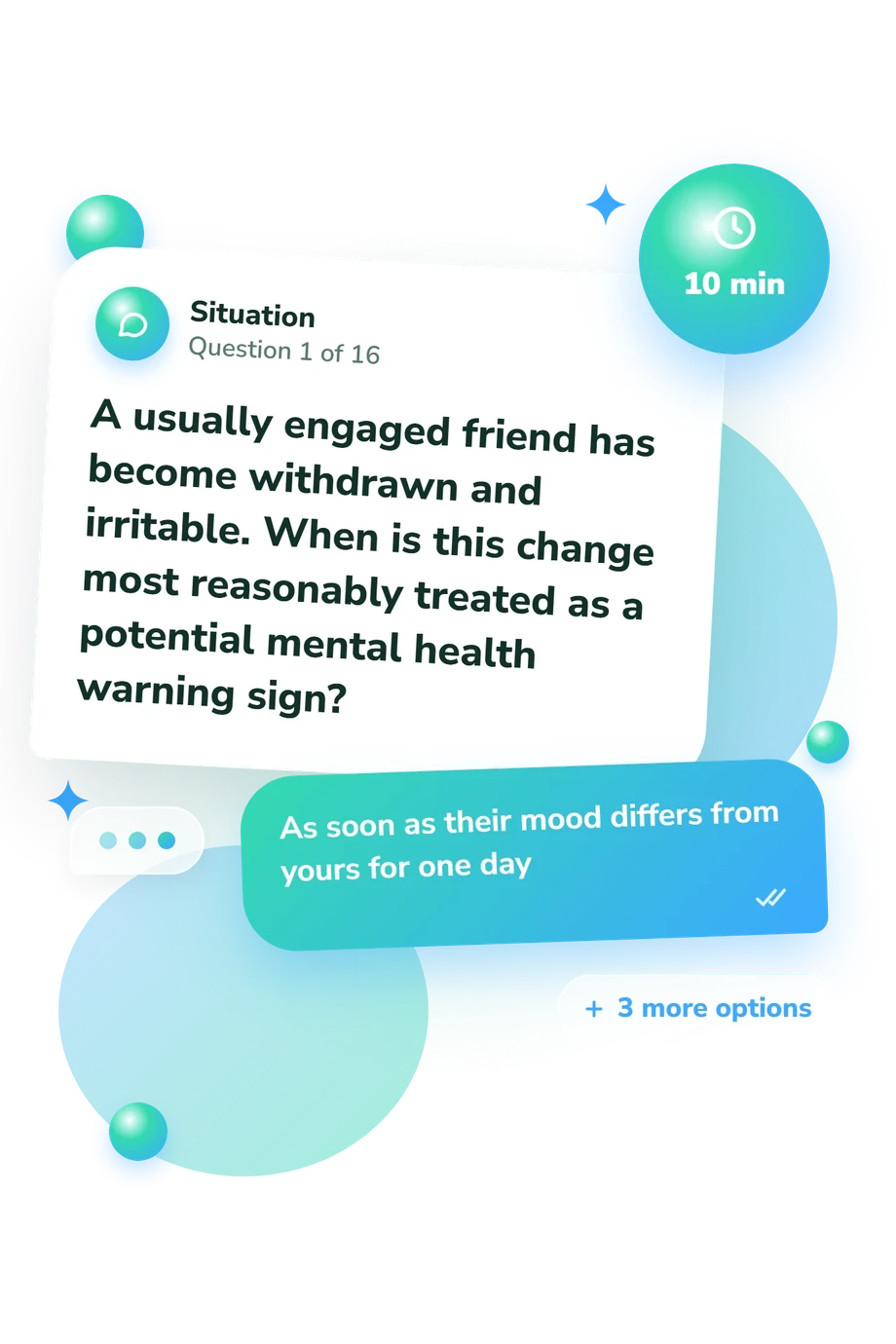
- As soon as their mood differs from yours for one day
- Only when they can name a specific mental health condition
- When the change persists, causes distress, or disrupts daily functioning
- Only after the same change appears in several other people
- A qualified professional conducting an appropriate assessment
- Anyone who completes a short online symptom checklist
- A social media creator who discusses the condition often
- A friend who has experienced similar symptoms
- “A mentally ill person who cannot cope normally”
- “Someone defined by their psychiatric diagnosis”
- “A person living with a mental health condition”
- “A person suffering from permanent mental weakness”
Mental Health Awareness Quiz - Description and methodology of the test
People who want to strengthen practical knowledge about mental health can use this assessment to examine how they recognize warning signs and respond to common situations. The mental health awareness quiz with answers is suited to learners, supporters, and anyone who wants a clearer foundation for conversations about distress, care, stigma, and safety. Its accessible format brings some mental health quiz fun to learning while keeping serious scenarios respectful and clearly focused on safety.
What This Assessment Explores
Questions focus on mental-health literacy, not personal wellbeing. They ask respondents to distinguish disruptive change from an isolated experience, respond to unusual perceptions without confirming certainty, recognize physical symptoms needing urgent care, and identify when professional or crisis support is appropriate.
Beyond recognition, the mental health awareness test addresses respectful communication, treatment beliefs, stigma, and individual differences in coping. Its result is reported on the Mental Health Awareness Knowledge scale, 0-16, with Foundations to build (0-6), Developing awareness (7-12), and Strong awareness (13-16). These bands describe knowledge performance, not wellbeing or clinical severity.
The result covers four practical areas:
- Warning-sign recognition identifies meaningful changes in persistence or functioning.
- Supportive responses measure understanding of listening, choice, and calm help-seeking.
- Treatment knowledge reflects awareness of assessment, individualized care, and self-diagnosis limits.
- Stigma and safety awareness captures respectful language and urgent-risk priorities.
Methodology and Evidence Base
Each item presents an everyday situation with four response options. The respondent selects the answer that best reflects established mental-health knowledge, and the result reflects correct answers about mental health awareness. The mental health quiz questions therefore test applied understanding rather than asking respondents to rate their own symptoms.
One useful conceptual reference, the MHLS, focuses on recognizing concerns, understanding help, and responding to mental-health information. This questionnaire is conceptually consistent with that instrument, but it is not an administration or adaptation of the MHLS. Related mental-health-literacy work also emphasizes recognition, treatment beliefs, community action, knowledge, attitudes, and help-seeking.
This is an educational, unvalidated online quiz, and its bands have no diagnostic or clinical-cutoff meaning. Guessing, social desirability, current context, and prior exposure to mental-health information can affect performance. A higher result indicates stronger performance on these items; a lower result highlights topics to revisit, while urgent safety concerns require prompt real-world help regardless of the total.
- O'Connor, Matt, and Leanne Casey. "The Mental Health Literacy Scale (MHLS): A new scale-based measure of mental health literacy." Psychiatry Research 229, no. 1-2 (2015): 511-516. 10.1016/j.psychres.2015.05.064
- Jorm, Anthony F., Ailsa E. Korten, Patricia A. Jacomb, Helen Christensen, Bryan Rodgers, and Penelope Pollitt. "‘Mental health literacy’: A survey of the public’s ability to recognise mental disorders and their beliefs about the effectiveness of treatment." Medical Journal of Australia 166, no. 4 (1997): 182-186.
- Jorm, Anthony F. "Mental health literacy: Empowering the community to take action for better mental health." American Psychologist 67, no. 3 (2012): 231-243. 10.1037/a0025957
- Wei, Yifeng, Patrick J. McGrath, Jill Hayden, and Stan Kutcher. "Mental health literacy measures evaluating knowledge, attitudes and help-seeking: A scoping review." BMC Psychiatry 15 (2015): 291. 10.1186/s12888-015-0681-9
Updated: