
Memorial Day Quiz
How the Scales are Structured
Who Usually Takes This Test?
See How You Compare
Below is a preview of how scores are typically distributed across each scale.
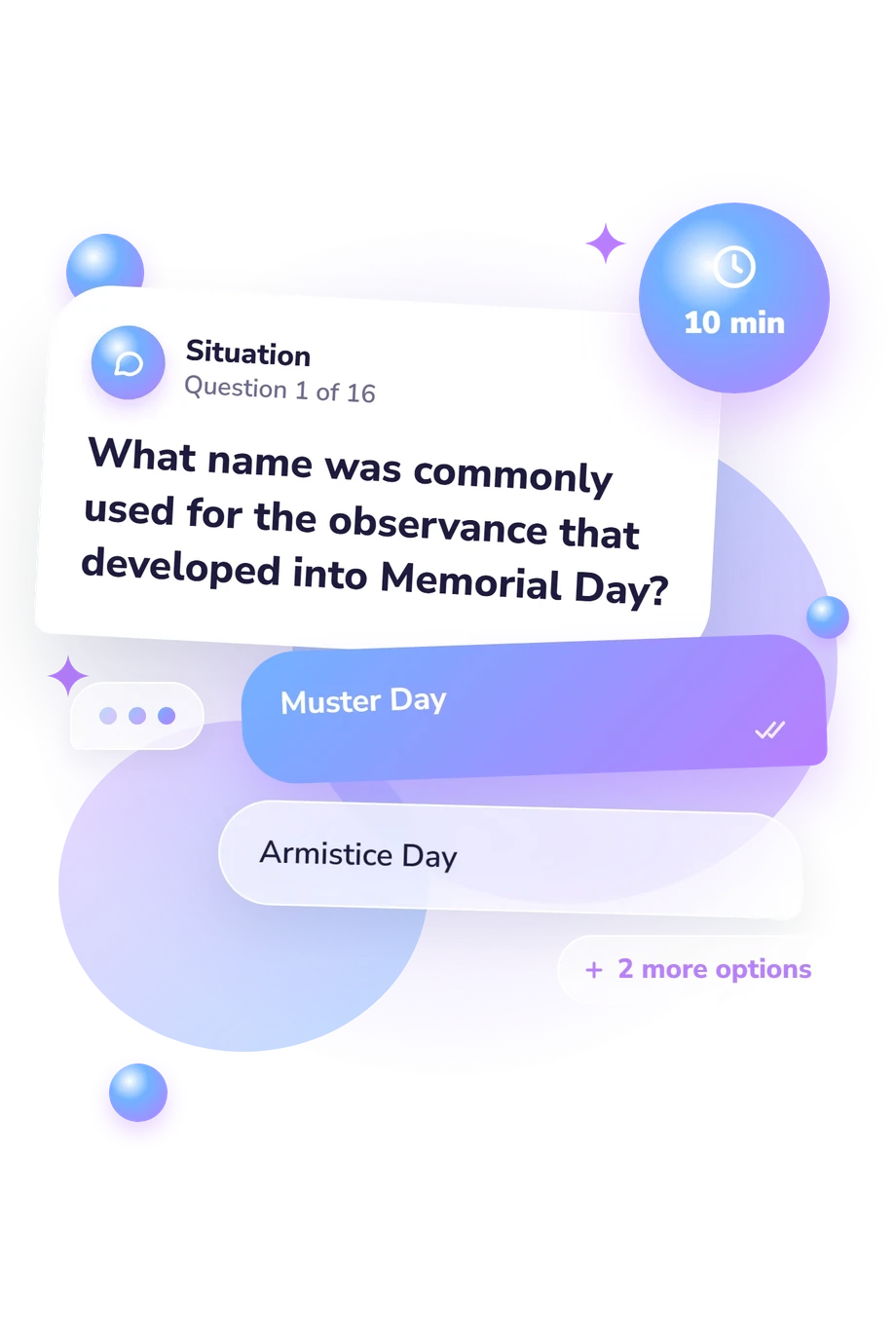
Example Questions From the Test
- Muster Day
- Armistice Day
- Remembrance Sunday
- Decoration Day
- People currently serving in the U.S. armed forces
- Military personnel who died while serving
- All people who previously completed military service
- Civilian workers employed by the Department of Defense
- The Tomb of the Unknown Soldier at Arlington National Cemetery
- The Liberty Bell at Independence National Historical Park
- The USS Arizona Memorial at Pearl Harbor
- The National Archives Rotunda in Washington, D.C.
Memorial Day Quiz - Description and methodology of the test
Readers deciding whether to take an assessment of civic and military history may benefit from a focused check on how confidently they distinguish Memorial Day from related observances. For learners, educators, families, and anyone preparing for a ceremony or discussion, this Memorial Day Quiz offers a focused way to test that knowledge. As a Memorial Day history quiz, this assessment returns a broad knowledge-level result that can guide further reflection.
What This Assessment Explores
The questions examine factual knowledge rather than attitudes. They distinguish Memorial Day from Veterans Day and Armed Forces Day, connect it with the Civil War and Decoration Day, and cover graves, flags, Arlington, the National Moment of Remembrance, and the red poppy.
The result describes overall Memorial Day knowledge through three broad levels. This Memorial Day trivia quiz helps distinguish military observances that often blur together, while its result gives an overall knowledge level.
The questionnaire reports one knowledge dimension:
- Memorial Day Knowledge (0-16) reflects correct answers about the holiday’s meaning, history, and customs. Foundations to Explore (0-6) indicates basics need review; Developing Knowledge (7-12) shows many essentials with some details to strengthen; Strong Knowledge (13-16) indicates a well-rounded grasp.
It is a focused snapshot for learning, preparation, or remembrance, not a measure of service, patriotism, or emotional connection.
Methodology and Evidence Base
Each item presents four answer choices, and the respondent selects the option that best fits the question. The format tests recognition and recall of dates, places, people, symbols, and distinctions among military observances.
Scoring is answer-based rather than a personality profile. The score reflects correct answers and is reported through the displayed result bands; the questionnaire does not estimate feelings, patriotism, military experience, or character. This online Memorial Day knowledge quiz supports independent review by giving respondents a way to check knowledge.
The historical content is consistent with Bellware and Gardiner’s account of Decoration Day and Memorial Day’s development. Blight adds context about Civil War memory and remembrance. Current observances, including timing, flag practice, and the National Moment of Remembrance, align with Congressional Research Service material. Moina Michael’s account is consistent with the red poppy tradition.
The questionnaire is not an adaptation of any of these sources, and no standardized norms or validated interpretation are provided for it. Results reflect performance on this factual set at completion; prior exposure, reading attention, and familiarity with U.S. history can influence the score.
- Bellware, Daniel, and Richard Gardiner. The Genesis of the Memorial Day Holiday in America. Columbus State University, 2014.
- Blight, David W. Race and Reunion: The Civil War in American Memory. Belknap Press of Harvard University Press, 2001. 10.4159/9780674022096
- Congressional Research Service. Memorial Day Speech Resources: Fact Sheet. R43973, updated May 12, 2023.
- Michael, Moina Belle. The Miracle Flower: The Story of the Flanders Fields Memorial Poppy. Dorrance, 1941.
Updated: