
Life of Pi Quiz
How the Scales are Structured
Who Usually Takes This Test?
See How You Compare
Below is a preview of how scores are typically distributed across each scale.
Example Questions From the Test
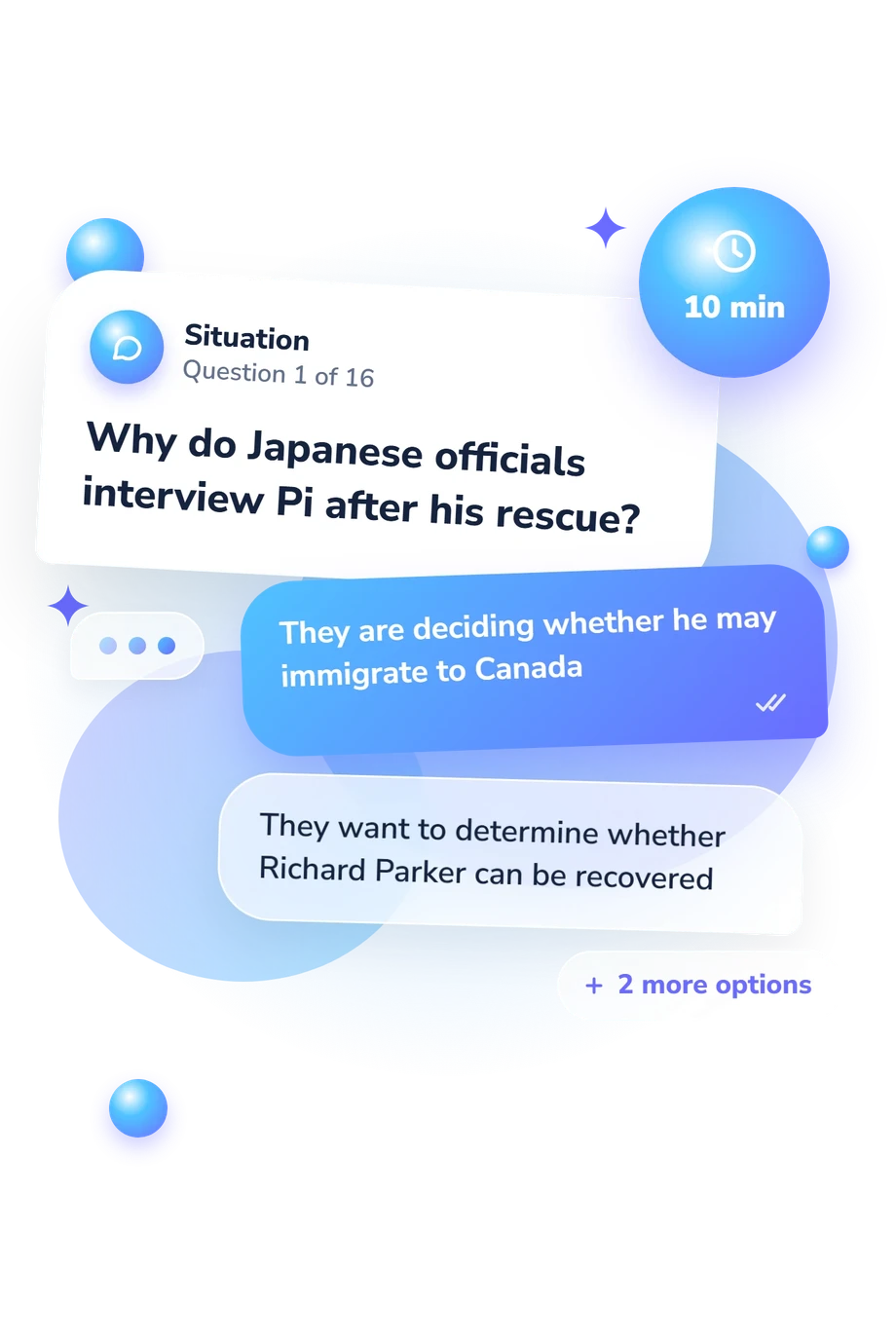
- They are deciding whether he may immigrate to Canada
- They want to determine whether Richard Parker can be recovered
- They are investigating the sinking of the Japanese-owned Tsimtsum
- They are collecting evidence about the algae island’s location
- The coast of Mexico
- A beach in southern India
- The Hawaiian Islands
- The western coast of Canada
- A horse, a hyena, an orangutan, and a leopard
- A zebra, a jackal, a chimpanzee, and a Bengal tiger
- A zebra, a hyena, an orangutan, and a Bengal tiger
- A zebra, a wild dog, a baboon, and a Bengal tiger
Life of Pi Quiz - Description and methodology of the test
Readers who want to check how closely they remember Yann Martel’s novel can use this life of pi quiz as a focused comprehension exercise. Questions about Life of Pi in this quiz cover events, characters, settings, religious ideas, and competing explanations within Pi Patel’s voyage. The result identifies strengths in recall and areas worth revisiting, making the assessment useful for students, book-club members, and anyone returning to the novel.
What This Assessment Explores
This assessment checks plot recall and interpretation, not personality or reading speed. It covers the shipwreck, characters, survival, religious identity, the algae island, and the link between Pi’s animal and human accounts.
As a Life of Pi trivia test, it reports Life of Pi Knowledge (0-16): First Passage (0-6) recognizes central elements; Steady Reader (7-12) shows command of the main narrative; Deep Reader (13-16) shows strong command of plot, symbolism, survival, and Pi’s two stories.
The questions group into four areas:
- Plot and chronology cover the sinking, voyage, rescue, and sequence of events.
- Characters and relationships identify Pi, his family, Richard Parker, animals, and officials.
- Survival and setting recall supplies, lifeboat routines, the algae island, and places.
- Symbolism and competing accounts connect details with faith, storytelling, and Pi’s explanations.
A higher result indicates broader recall; a lower band suggests targets for rereading.
Methodology and Evidence Base
Each item presents a short prompt with four answer choices and asks for the best-supported detail from the novel. The set combines factual recall with interpretation, covering locations, names, objects, survival methods, religious commitments, violent sequences, and the relationship between Pi’s two accounts. One point is awarded for each correct answer, so the score is the number of correct responses.
As a Life of Pi novel test, this is a focused knowledge check rather than a standardized psychological scale. Its content is anchored in Life of Pi (Martel, 2001). Its attention to storytelling, faith, and competing explanations is conceptually consistent with discussions by Bogár and Szigethy (2020) and Stephens (2010), but the quiz is not an adaptation of either study.
The displayed categories are descriptive guides for this questionnaire, not externally normed clinical or educational cutoffs. Interpret the outcome as remembered content at testing: familiarity with the novel, rereading, attention, guessing, and memory slips can affect performance. The score is a snapshot of recall, not a measure of intelligence, literary value, or psychological functioning.
- Martel, Yann. Life of Pi: A Novel. Toronto: Alfred A. Knopf Canada, 2001.
- Bogár, Ádám Tamás, and Rebeka Sára Szigethy. “... Faith in the Act of Storytelling: The Critical Reception of Life of Pi.” In Critical Insights: Life of Pi, pp. 15-29. Salem Press/Grey House Publishing, 2020.
- Stephens, Gregory. “Feeding Tiger, Finding God: Science, Religion, and ‘the Better Story’ in Life of Pi.” Intertexts, vol. 14, no. 1, 2010, pp. 41-59. 10.1353/itx.2010.0004
Updated: