
Lice or Dandruff Quiz
How the Scales are Structured
Who Usually Takes This Test?
See How You Compare
Below is a preview of how scores are typically distributed across each scale.
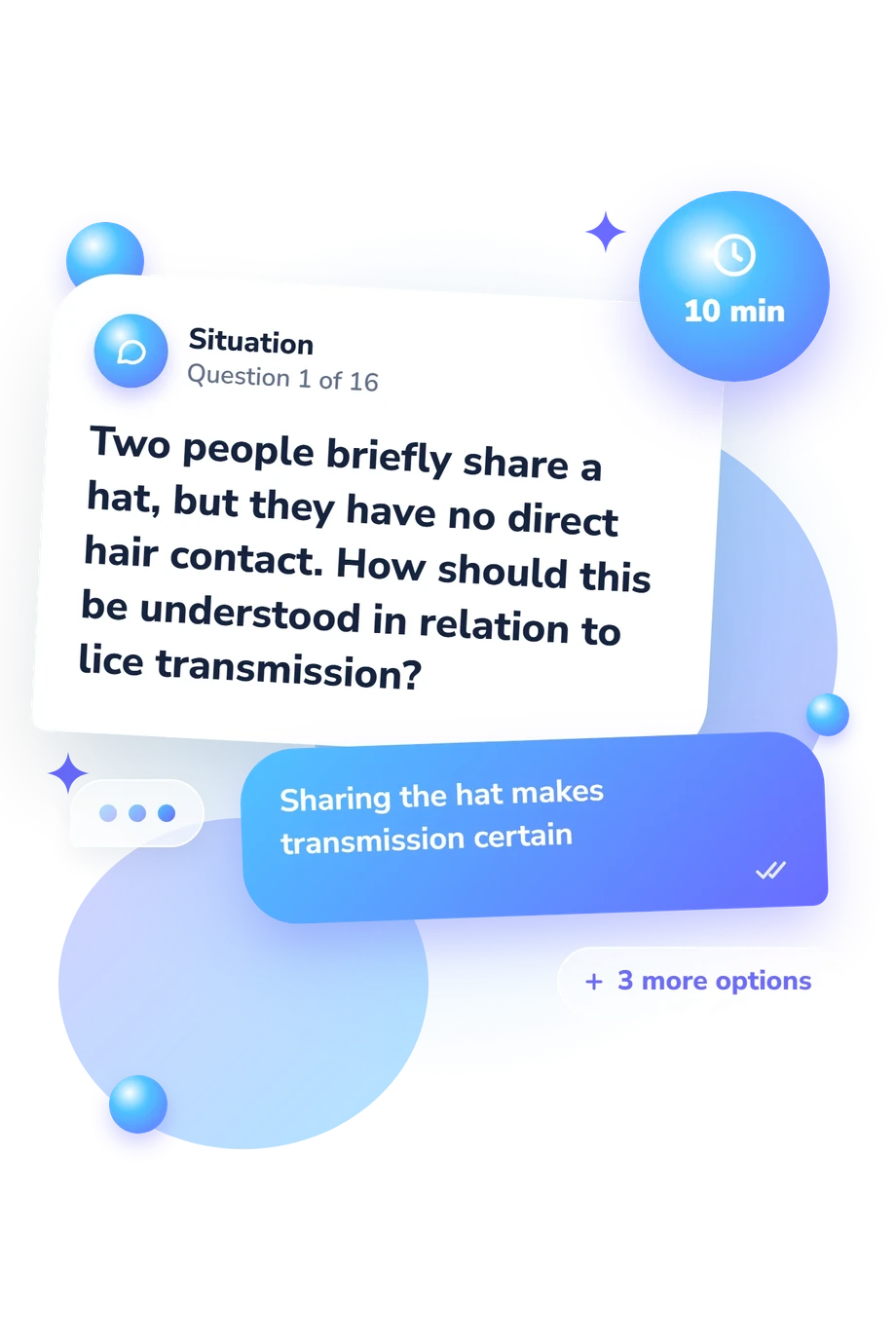
Example Questions From the Test
- It confirms dandruff if the itching is mild
- It cannot distinguish lice from dandruff or several other causes
- It rules out lice when no flakes are visible
- It confirms lice if the itching is worse at night
- It commonly spreads through brief head-to-head contact
- It spreads when flakes land on another person's clothing
- It is contagious only when the scalp is oily
- Dandruff itself is not contagious
- Through dandruff flakes left on furniture
- Through the air when an affected person coughs
- By jumping between people across a room
- Through direct head-to-head or hair-to-hair contact
Lice or Dandruff Quiz - Description and methodology of the test
People who want to tell ordinary scalp flaking from possible head lice need clear distinctions rather than an answer based on itching alone. This quiz is designed for readers reviewing everyday observations, household transmission, inspection clues, and sensible next steps. A do i have lice or dandruff quiz can also help organize what to check before deciding whether advice is needed.
What This Assessment Explores
This section tests knowledge of what head lice are, how they spread, and how their signs differ from dandruff or other flaking conditions. It separates useful evidence from weak clues: itching alone, a popping sound, or flakes on clothing cannot establish the cause. A head lice vs dandruff comparison depends on inspection, not one symptom.
The result is organized as Lice or Dandruff Knowledge (0-16), with three displayed bands:
- A score of 0-6 places the reader in Foundation to build, showing that basic distinctions among flakes, nits, and live lice need review.
- A score of 7-12 places the reader in Developing distinction, showing useful recognition with possible gaps in limitations or next steps.
- A score of 13-16 places the reader in Strong practical knowledge, showing understanding of main distinctions and common misconceptions.
These bands show what to review; they cannot identify the cause of an actual scalp symptom.
Methodology and Scientific Basis
Each item presents four answer choices, asking the respondent to select the statement that best fits the situation. The scenarios cover transmission, treatment directions, visual inspection, attached nits, live lice, pets, dandruff, and warning signs such as pain, crusting, or sores. The format tests applied recognition rather than one-symptom guessing.
Its method gives readers a knowledge-oriented self-reflection format for comparing lice and dandruff symptoms. Its content is conceptually consistent with the Nezhadali et al. (2020) knowledge scale, but it is not that published instrument, its adaptation, or its validation. Jahnke et al. (2009) supports careful inspection and wet combing; Nolt et al. (2022) supports management guidance; Borda and Wikramanayake (2015) supports the distinction between dandruff-related shedding and contagious infestation.
The displayed result reports a single knowledge score and uses the questionnaire’s stated bands rather than a clinical cutoff. Because the knowledge score is unvalidated, it reflects understanding of the tested distinctions, not whether lice are present. Answers can vary with prior experience, attention, current scalp concerns, and confidence in self-observation; uncertain or painful symptoms call for professional advice.
- Ali Nezhadali, Towhid Babazadeh, Haidar Nadrian, Hamid Allahverdipour. Cognitive Factors Associated to Pediculosis Preventive Behaviors Among Mothers of School-Age Children in Chaldoran County, Iran. Journal of Multidisciplinary Healthcare. 2020;13:19-26. 10.2147/JMDH.S237101
- Claudia Jahnke, Eline Bauer, Ulrich R. Hengge, Hermann Feldmeier. Accuracy of Diagnosis of Pediculosis Capitis: Visual Inspection vs Wet Combing. Archives of Dermatology. 2009;145(3):309-313. 10.1001/archdermatol.2008.587
- Dawn Nolt, Scot Moore, Albert C. Yan, Laura Melnick; Committee on Infectious Diseases, Committee on Practice and Ambulatory Medicine, Section on Dermatology. Head Lice. Pediatrics. 2022;150(4):e2022059282. 10.1542/peds.2022-059282
- Luis J. Borda, Tongyu C. Wikramanayake. Seborrheic Dermatitis and Dandruff: A Comprehensive Review. Journal of Clinical and Investigative Dermatology. 2015;3(2):10.13188/2373-1044.1000019. 10.13188/2373-1044.1000019
Updated: