
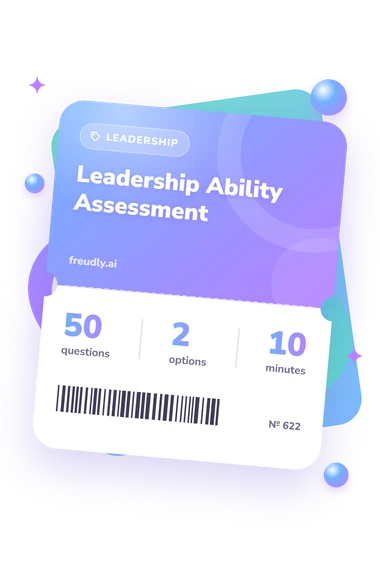
Leadership Ability Assessment Test
How the Scales are Structured
Who Usually Takes This Test?
See How You Compare
Below is a preview of how scores are typically distributed across each scale.
Example Questions From the Test
- a) yes
- b) no
- Yes
- No
- a) yes
- b) no
Leadership Ability Assessment Test - Description and methodology of the test
People who want to understand how they act in groups, handle responsibility, or influence collective decisions may find the Leadership Ability Assessment Test useful. It focuses on self-reported preferences and perceptions rather than a single leadership ideal. As a leadership assessment, it samples situations involving initiative, confidence, independence, resilience, and control to indicate an overarching tendency toward leadership qualities and group-related behavior.
What This Assessment Explores
The questions examine how a person responds when initiative, authority, disagreement, or responsibility enters a group situation. They also address confidence, independence, persistence, emotional steadiness, susceptibility to influence, and preferences for collegial or authoritarian organization. This makes the leadership ability test useful for reflecting on workplace behavior, group participation, and personal decisions.
The main themes represented by the questions include:
- Initiative and influence show willingness to organize, express a position, and persuade others.
- Responsibility and resilience describe responses to setbacks, important tasks, and difficult demands.
- Independence and composure reflect preferences for supervision, self-direction, disagreement, and control.
Leadership Ability is the displayed 0-50 scale for leadership qualities and group tendencies. Its bands are Low 0-25, Average 26-40, and High / Dictatorial tendency 41-50. Displayed bands place 26-40 under “Average”; the catalogue calls 26-35 average, 36-40 strong, below 25 weak, and above 40 a tendency toward authoritarian control.
Methodology and Scientific Basis
The format combines yes/no items with forced-choice questions. Some ask about past preferences or familiar behavior, while others present a practical choice between contrasting responses. Together, they sample initiative, responsibility, persuasion, discipline, resilience, and reactions to authority without requiring a long written explanation.
Responses are combined into the questionnaire’s single displayed result, while its answer-by-answer weighting is not documented. The score should therefore be read as an organized indication of tendencies, not as precise units of leadership or a complete account of performance in every group.
The closest named source is Diagnostics of Leadership Abilities (Zharikov & Krushelnitsky). This questionnaire is conceptually consistent with that work, but its relationship to the published instrument is not established as a standardized adaptation. Bass and Stogdill’s handbook and Stogdill’s review serve as contextual sources for viewing leadership through personal and group-related factors.
Results are most useful for structured self-reflection. Self-report can be affected by mood, memory, social desirability, and limited self-awareness, so this leadership skills assessment is strongest when considered alongside observed behavior and feedback from real group situations.
- Zharikov, E. S., & Krushelnitsky, E. L. (1991). For You and About You: A Book for Students. Moscow: Prosveshchenie.
- Zharikov, E. S., & Krushelnitsky, E. L. (2002). Diagnostics of Leadership Abilities. In N. P. Fetiskin, V. V. Kozlov, & G. M. Manuilov, Socio-Psychological Diagnostics of Personality Development and Small Groups (pp. 316-320). Moscow: Institute of Psychotherapy.
- Bass, B. M., & Stogdill, R. M. (1990). Bass & Stogdill’s Handbook of Leadership: Theory, Research, and Managerial Applications (3rd ed.). New York: Free Press. ISBN 0029015006.
- Stogdill, R. M. (1948). Personal Factors Associated with Leadership: A Survey of the Literature. The Journal of Psychology, 25(1), 35-71. 10.1080/00223980.1948.9917362