
Freudly+971 508685814hello@freudly.ai
Freudly
business

Communication and Leadership Skills Assessment Test
Take the online Communication and Leadership Skills Assessment Test - AI psychologist FreudlyYou can take Communication and Leadership Skills Assessment Testhere. Online version of a simple and accurate psychological test with interpretation.en
Understand how someone communicates, persuades, and leads in just 10 minutes. Get clear strengths and growth areas for hiring, coaching, or personal development in 54 items.
Start Online Test
Questions: 5410 minutes
08:30
October 2, 2025
October 2, 2025
Material has been updated
October 2, 2025
Material has been published
29,368 views
3,105 completions
2,679 likes
Verified by Daniel Hall
Psychologist with 25 years of experience
Share
Scale Explorer

How the Scales are Structured

example score
6/9
Rational (R)
Measures the tendency to use logical analysis, objectivity, and restraint when communicating and making decisions.
Low rationality
Moderate rationality
High rationality
03: Low rationality | 46: Moderate rationality | 79: High rationality
A score of 6 suggests a generally fact-based, measured communication style with room to apply even more consistency in objective analysis under pressure.
example score
3/9
Empathic (E)
Measures the tendency to recognize, understand, and respond supportively to other people’s emotions during communication.
Low
Moderate
High
03: Low | 46: Moderate | 79: High
A score of 3 falls in the Low range, suggesting empathy and supportive responding may be less consistent and could strengthen with deliberate attention to others’ emotional cues.
example score
5/9
Indifferent (I)
Measures the degree of emotional engagement and motivation a person shows during communication and interaction.
Engaged
Somewhat indifferent
Detached
03: Engaged | 46: Somewhat indifferent | 79: Detached
A score of 5 suggests a moderate level of indifference, with occasional emotional distance or reduced initiative in communication.
example score
7/9
Persuasive (P)
Measures persuasive influence—the ability to shape others’ opinions and motivate action through communication.
Developing
Effective
Highly persuasive
04: Developing | 56: Effective | 79: Highly persuasive
A score of 7 indicates a highly persuasive style, suggesting strong capacity to influence and motivate others.
example score
2/9
Instructive (I)
Measures the tendency to give clear instructions and explanations that guide others through tasks.
Low
Moderate
High
03: Low | 46: Moderate | 79: High
A score of 2 indicates a low instructive style, suggesting directions and mentoring cues may be used less often or with less clarity in group tasks.
example score
4/9
Humorous (H)
Measures how effectively a person uses humor to ease tension, support a positive climate, and smooth interpersonal friction in a team.
Low
Moderate
High
03: Low | 46: Moderate | 79: High
A score of 4 suggests a moderate ability to use humor to lighten the atmosphere, with room to apply it more consistently in group situations.
example score
5/9
Serious (S)
Seriousness measures responsibility, focus, and discipline in how a person approaches work and communication.
Low
Moderate
High
04: Low | 56: Moderate | 79: High
A score of 5 suggests a moderate level of seriousness, indicating a generally responsible and focused style with flexibility depending on the situation.
example score
4/9
Democratic (D)
Measures a democratic leadership style marked by shared participation, equality, and collective decision-making in groups.
Low democratic focus
Moderate democratic focus
High democratic focus
03: Low democratic focus | 46: Moderate democratic focus | 79: High democratic focus
A score of 4 suggests a moderate tendency to involve others and seek shared decisions, with room to strengthen consistent teamwork facilitation.
example score
3/9
Authoritarian (A)
Measures the tendency to lead through control, strict direction, and demanding management of others.
Low
Moderate
High
03: Low | 46: Moderate | 79: High
A score of 3 falls in the Low range, suggesting a generally non-controlling, less directive leadership style with limited reliance on strict management.
example score
6/9
Emotional (E)
This scale measures the intensity and expressiveness of feelings in communication, including emotional responsiveness to others.
Low
Moderate
High
03: Low | 46: Moderate | 79: High
A score of 6 indicates a moderate level of emotionality, suggesting generally open and responsive emotional expression that typically remains balanced in interaction.
example score
5/9
Leadership (L)
Measures the tendency to take responsibility, organize others, and guide a group toward shared goals.
Developing
Moderate
Strong
04: Developing | 56: Moderate | 79: Strong
A score of 5 falls in the Moderate range, suggesting a generally steady ability to take initiative and coordinate others, with room to strengthen consistency in leading group efforts.
example score
4/9
Follower (F)
Measures the tendency to follow others’ lead, accept decisions made by others, and comply with authority in group settings.
Independent stance
Balanced followership
Strong compliance
03: Independent stance | 46: Balanced followership | 79: Strong compliance
A score of 4 indicates a balanced followership style, with a readiness to accept direction while still maintaining some independent judgment.
example score
6/9
Benevolent (B)
Measures the tendency to maintain positive, respectful, and cooperative interactions with others.
Low
Moderate
High
03: Low | 46: Moderate | 79: High
A score of 6 suggests a generally cooperative and considerate communication style that supports a comfortable group atmosphere.
example score
3/9
Dialogic (D)
Measures the ability to hold an equal, two-way exchange by listening, considering the other person’s viewpoint, and cooperating in conversation.
Developing
Moderate
Strong
03: Developing | 46: Moderate | 79: Strong
A score of 3 indicates dialogical skills are still developing, with more consistency needed in listening and integrating others’ perspectives during exchanges.
example score
5/9
Monologic (M)
Measures the tendency to steer conversations in a one-sided, controlling way with limited invitation for feedback.
Balanced exchange
Somewhat one-sided
Strongly one-sided
04: Balanced exchange | 56: Somewhat one-sided | 79: Strongly one-sided
A score of 5 indicates a moderate tendency to take the lead in conversations, which may sometimes limit back-and-forth input from others.
example score
5/9
Heuristic (H)
Measures flexibility and originality in finding new communication approaches and solutions when interacting with others.
Low
Moderate
High
03: Low | 46: Moderate | 79: High
A score of 5 indicates a moderate heuristic ability, suggesting a balanced tendency to try new interaction strategies while still relying on familiar approaches.
example score
6/9
Conservative (C)
This scale measures preference for traditional, stability-oriented communication and leadership approaches over experimentation and change.
Flexible/innovative
Balanced
Strongly conservative
03: Flexible/innovative | 46: Balanced | 79: Strongly conservative
A score of 6 suggests a balanced style that generally values proven methods and consistency while still allowing some openness to new approaches when needed.
example score
6/9
Aggressive (A)
Measures the tendency to communicate in a forceful, confrontational, and dominance-oriented way when asserting one’s position.
Low
Moderate
High
03: Low | 46: Moderate | 79: High
A score of 6 indicates a moderate level of aggressiveness, suggesting generally assertive and direct communication that may become confrontational in tense situations.
Start Online Test
just completed the test
DATA-BASED USER COHORTS

Who Usually Takes This Test?

New and aspiring managers
41%OF USERS
They take it to understand how well they influence, delegate, and communicate while leading a team.
HR and team leads
34%OF USERS
They use it to support hiring, promotion, and team selection by spotting leadership and communication strengths and gaps.
Students and early professionals
25%OF USERS
They take it for self-development to build persuasive communication, confidence in groups, and leadership potential.
BASED ON AGGREGATED, ANONYMIZED DATA FROM TENS OF THOUSANDS OF FREUDLY USERS.
Benchmarking

See How You Compare

Once you complete the test, your results are compared with real-world data from people in your country.
Below is a preview of how scores are typically distributed across each scale.
Rational (R)
Rational (R)
Average
5.3
Normal range
3.76.9
min.
0
max.
9
This curve shows how scores are typically distributed.
Once you complete the test, your result will appear on the scale so you can see how you compare.
Empathic (E)
Empathic (E)
Average
4
Normal range
2.45.6
min.
0
max.
9
This curve shows how scores are typically distributed.
Once you complete the test, your result will appear on the scale so you can see how you compare.
Indifferent (I)
Indifferent (I)
Average
4.4
Normal range
2.86.1
min.
0
max.
9
This curve shows how scores are typically distributed.
Once you complete the test, your result will appear on the scale so you can see how you compare.
Impressive (I)
Impressive (I)
Average
5.5
Normal range
4.46.7
min.
0
max.
9
This curve shows how scores are typically distributed.
Once you complete the test, your result will appear on the scale so you can see how you compare.
Instructive (I)
Instructive (I)
Average
6.5
Normal range
5.17.9
min.
0
max.
9
This curve shows how scores are typically distributed.
Once you complete the test, your result will appear on the scale so you can see how you compare.
Humorous (H)
Humorous (H)
Average
4.4
Normal range
35.9
min.
0
max.
9
This curve shows how scores are typically distributed.
Once you complete the test, your result will appear on the scale so you can see how you compare.
Serious (S)
Serious (S)
Average
6.4
Normal range
4.98
min.
0
max.
9
This curve shows how scores are typically distributed.
Once you complete the test, your result will appear on the scale so you can see how you compare.
Democratic (D)
Democratic (D)
Average
2.3
Normal range
13.5
min.
0
max.
9
This curve shows how scores are typically distributed.
Once you complete the test, your result will appear on the scale so you can see how you compare.
Authoritarian (A)
Authoritarian (A)
Average
4.6
Normal range
3.55.8
min.
0
max.
9
This curve shows how scores are typically distributed.
Once you complete the test, your result will appear on the scale so you can see how you compare.
Emotional (E)
Emotional (E)
Average
3.2
Normal range
1.54.9
min.
0
max.
9
This curve shows how scores are typically distributed.
Once you complete the test, your result will appear on the scale so you can see how you compare.
Leadership (L)
Leadership (L)
Average
4.7
Normal range
3.46
min.
0
max.
9
This curve shows how scores are typically distributed.
Once you complete the test, your result will appear on the scale so you can see how you compare.
Led (L)
Led (L)
Average
4.5
Normal range
3.25.9
min.
0
max.
9
This curve shows how scores are typically distributed.
Once you complete the test, your result will appear on the scale so you can see how you compare.
Benevolent (B)
Benevolent (B)
Average
3.5
Normal range
1.95.1
min.
0
max.
9
This curve shows how scores are typically distributed.
Once you complete the test, your result will appear on the scale so you can see how you compare.
Dialogical (D)
Dialogical (D)
Average
2.7
Normal range
1.34
min.
0
max.
9
This curve shows how scores are typically distributed.
Once you complete the test, your result will appear on the scale so you can see how you compare.
Monologic (M)
Monologic (M)
Average
4.3
Normal range
2.75.8
min.
0
max.
9
This curve shows how scores are typically distributed.
Once you complete the test, your result will appear on the scale so you can see how you compare.
Heuristic (H)
Heuristic (H)
Average
2.7
Normal range
1.14.4
min.
0
max.
9
This curve shows how scores are typically distributed.
Once you complete the test, your result will appear on the scale so you can see how you compare.
Conservative (C)
Conservative (C)
Average
6
Normal range
4.97.2
min.
0
max.
9
This curve shows how scores are typically distributed.
Once you complete the test, your result will appear on the scale so you can see how you compare.
Aggressive (A)
Aggressive (A)
Average
6.5
Normal range
4.88.2
min.
0
max.
9
This curve shows how scores are typically distributed.
Once you complete the test, your result will appear on the scale so you can see how you compare.
Featured On
SAMPLE QUESTIONS

Example Questions From the Test

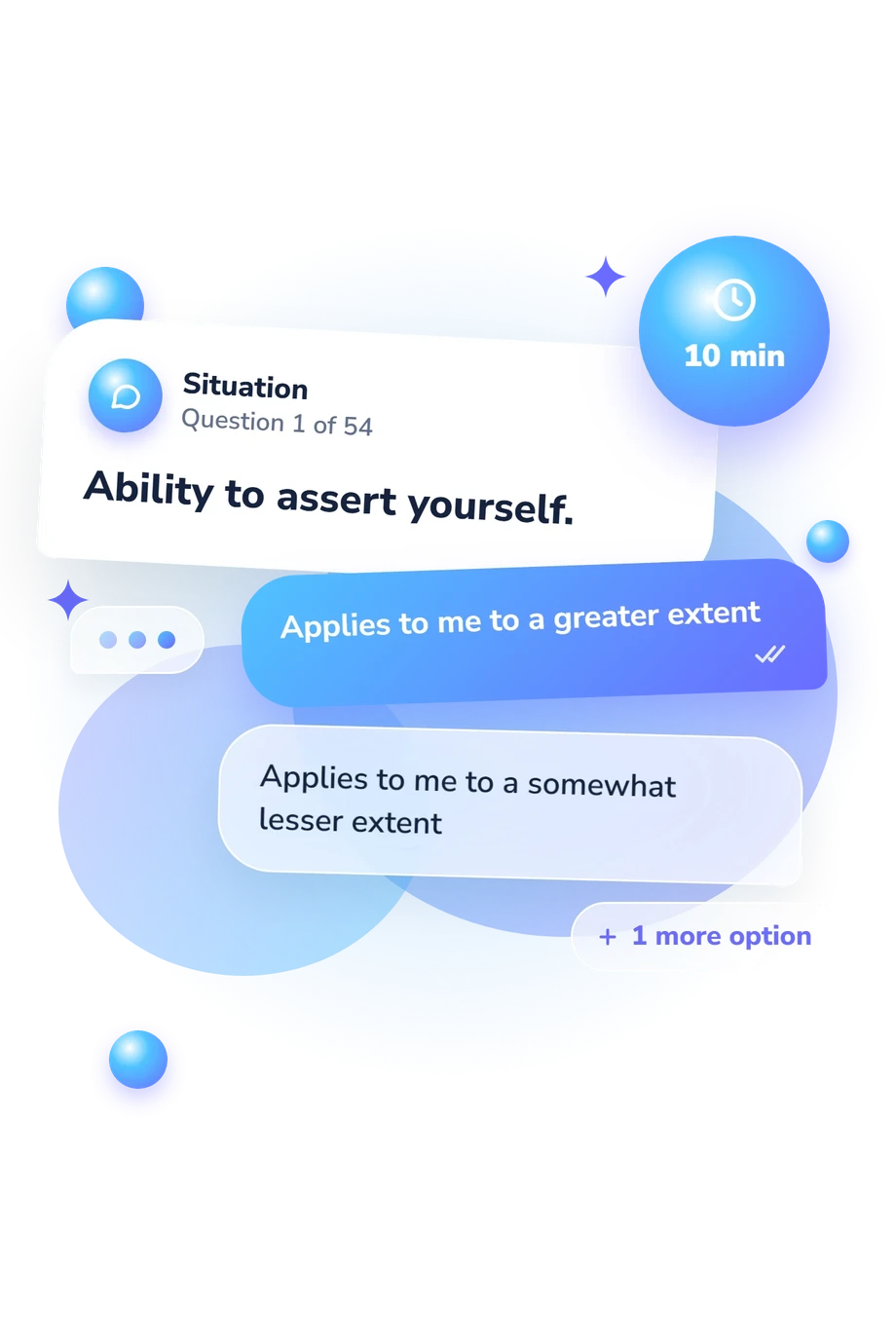
When answering the questions, aim to be as candid as possible. To obtain sufficiently objective information about yourself, respond quickly, recording the thoughts that arise upon your first reading of each item. Listed below are personality characteristics that apply to you—some to a greater extent, others to a lesser extent. Rate each characteristic according to how well it describes you using a three-point scale.
    • Applies to me to a greater extent
    • Applies to me to a somewhat lesser extent
    • Applies to me less
    • Applies to me to a greater extent
    • Applies to me to a somewhat lesser extent
    • Even less so
    • Characteristic to a greater extent
    • Characteristic to a somewhat lesser extent
    • Even less so
WHAT THE TEST MEASURES
About This Assessment
Assessment of Communicative and Leadership Skills Test

Communication and Leadership Skills Assessment Test - Symptoms and Signs

business
leadership

This instrument is used to evaluate interpersonal communication behaviors and leadership-related skills in a structured self-report format. The Communication and Leadership Skills Assessment is intended to support an initial appraisal of perceived strengths and areas for development in typical social and group settings.

The measure includes 54 items and typically requires about 10 minutes to complete. Item content generally focuses on communication style, social influence, and behaviors relevant to coordinating with others.

Results from the Communication and Leadership Skills Assessment may be used as an adjunct to broader assessment efforts (e.g., coaching, training needs assessment, or organizational development) and should be interpreted in context with other clinical or performance information. The version referenced here is attributed to Ronald E. Riggio.

Author: Ronald E. Riggio
Literature: Riggio, R. E. Assessment of basic social skills. Journal of Personality and Social Psychology. 1986.
Popular tests
Comments
Leave a Comment