
Handedness Assessment (Right-Handed vs. Left-Handed) Test
How the Scales are Structured
Who Usually Takes This Test?
See How You Compare
Below is a preview of how scores are typically distributed across each scale.
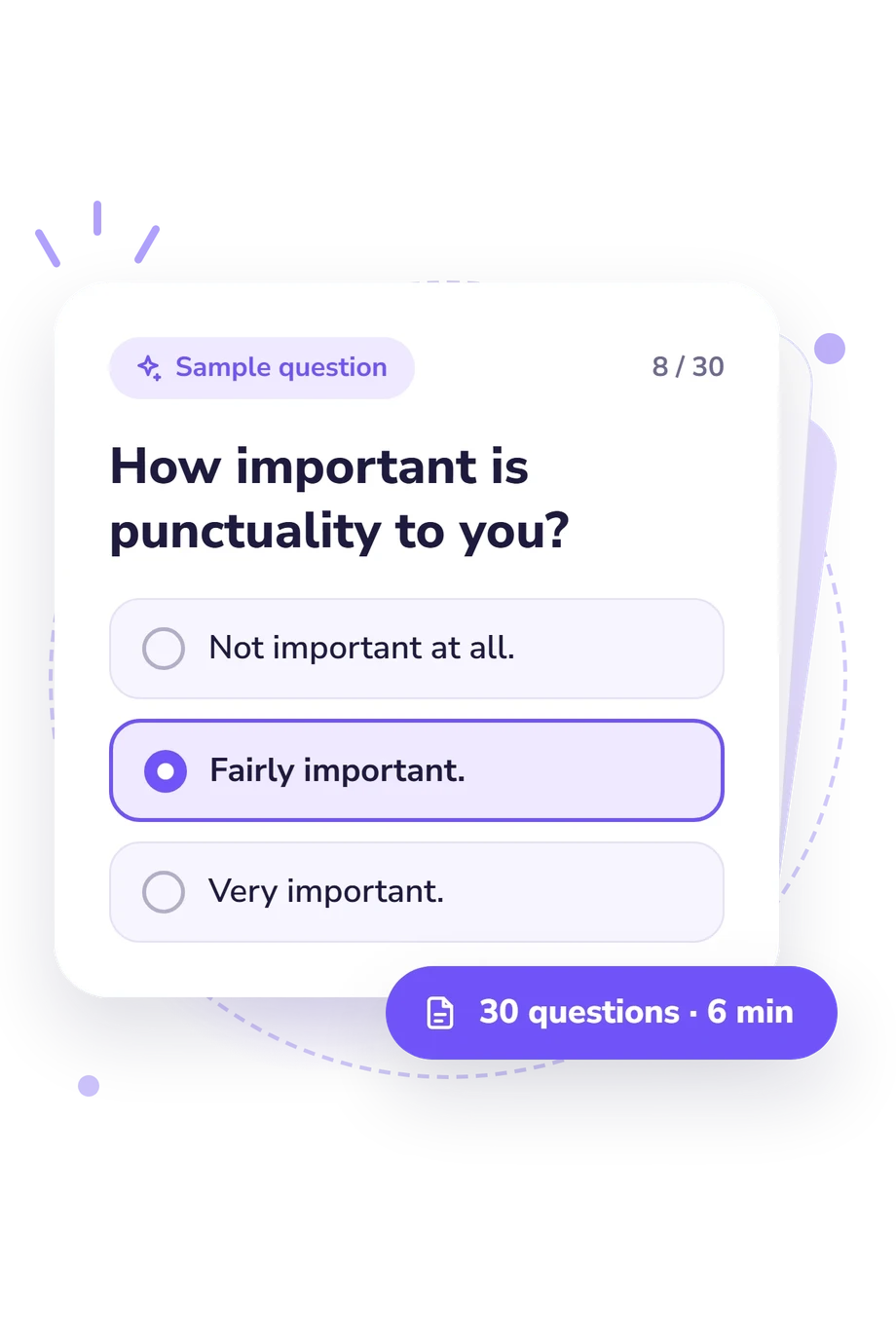
Example Questions From the Test
- Having the opportunity to do what you want.
- Having an ideal family.
- Achieving outstanding success in your chosen career.
- Very much.
- Not very much, although I sometimes follow my gut feeling.
- Hardly at all; I prefer to rely on reason and logic.
- Curious.
- Well organized.
- Serious and systematic, diligent study.
Handedness Assessment (Right-Handed vs. Left-Handed) Test - Description and methodology of the test
People who want to reflect on their everyday preferences, problem-solving style, and relationship with intuition may find the Handedness Assessment (Right-Handed vs. Left-Handed) Test useful. It offers a broad handedness profile, showing whether responses lean toward a left-hemisphere, mixed, or right-hemisphere pattern. The result is best read as a structured self-description of tendencies, not as a direct measure of ability or brain anatomy.
What This Assessment Explores
The questions examine laterality through choices about intuition, imagination, organization, punctuality, persistence, decision-making, academic preferences, and practical behavior. They also touch on creativity, rules, mistakes, pressure, and career commitment. Together, these themes describe a cognitive style profile; the score interprets those preferences through laterality and hemispheric dominance rather than measuring hand use alone.
The interpretation associates lower scores with an analytical, sequential style linked to stronger language and academic abilities, and higher scores with a more creative, intuitive approach; the middle range suggests a mixed pattern. The displayed Total Score ranges from 0 to 60 and is reported as follows:
- Left-hemisphere dominant (0-30) indicates the lower-scoring analytical and sequential tendency.
- Balanced/mixed (31-48) indicates an intermediate pattern between the two directional profiles.
- Right-hemisphere dominant (49-60) indicates the higher-scoring creative and intuitive tendency.
Methodology and Scientific Basis
Each item offers three answer choices, and the respondent selects the alternative that best matches a habitual preference or reaction. The questions combine concrete behavior with symbolic self-description, so no single item should be treated as a verdict. Scoring produces the displayed total, but item-level point assignments are not stated; the range therefore cannot be reverse-engineered into a custom rule.
Its closest conceptual source is Human Information Processing Survey (Torrance et al., 1984), a preference-based measure of broad information-processing styles. The questionnaire is conceptually consistent with Bryden's work, but it is not a direct adaptation or validated version of those publications. Nielsen et al. (2013) found no simple whole-brain division that classifies people globally as left-brained or right-brained, so this profile should be read as a broad tendency rather than a map of brain function.
For organized self-reflection, the tool offers a hemispheric dominance profile, yet the result depends on honest self-report, current mood, and self-awareness. The bands are descriptive categories, not evidence of clinical status, and the questionnaire does not establish cognitive ability, personality, or neurological status.
- Torrance, E. Paul, Barbara Taggart, and William Taggart. Human Information Processing Survey. Bensenville, Illinois: Scholastic Testing Service, 1984.
- Bryden, M. P. Measuring handedness with questionnaires. Neuropsychologia, 15(4-5), 617-624, 1977. 10.1016/0028-3932(77)90067-7.
- Bryden, Philip. Choosing Sides: The Left and Right of the Normal Brain. Canadian Psychology/Psychologie canadienne, 31(4), 297-309, 1990. 10.1037/h0078949.
- Nielsen, Jared A., Brandon A. Zielinski, Michael A. Ferguson, Janet E. Lainhart, and Jeffrey S. Anderson. An Evaluation of the Left-Brain vs. Right-Brain Hypothesis with Resting State Functional Connectivity Magnetic Resonance Imaging. PLoS ONE, 8(8), e71275, 2013. 10.1371/journal.pone.0071275.
Updated: