
Landmarks Quiz
How the Scales are Structured
Who Usually Takes This Test?
See How You Compare
Below is a preview of how scores are typically distributed across each scale.
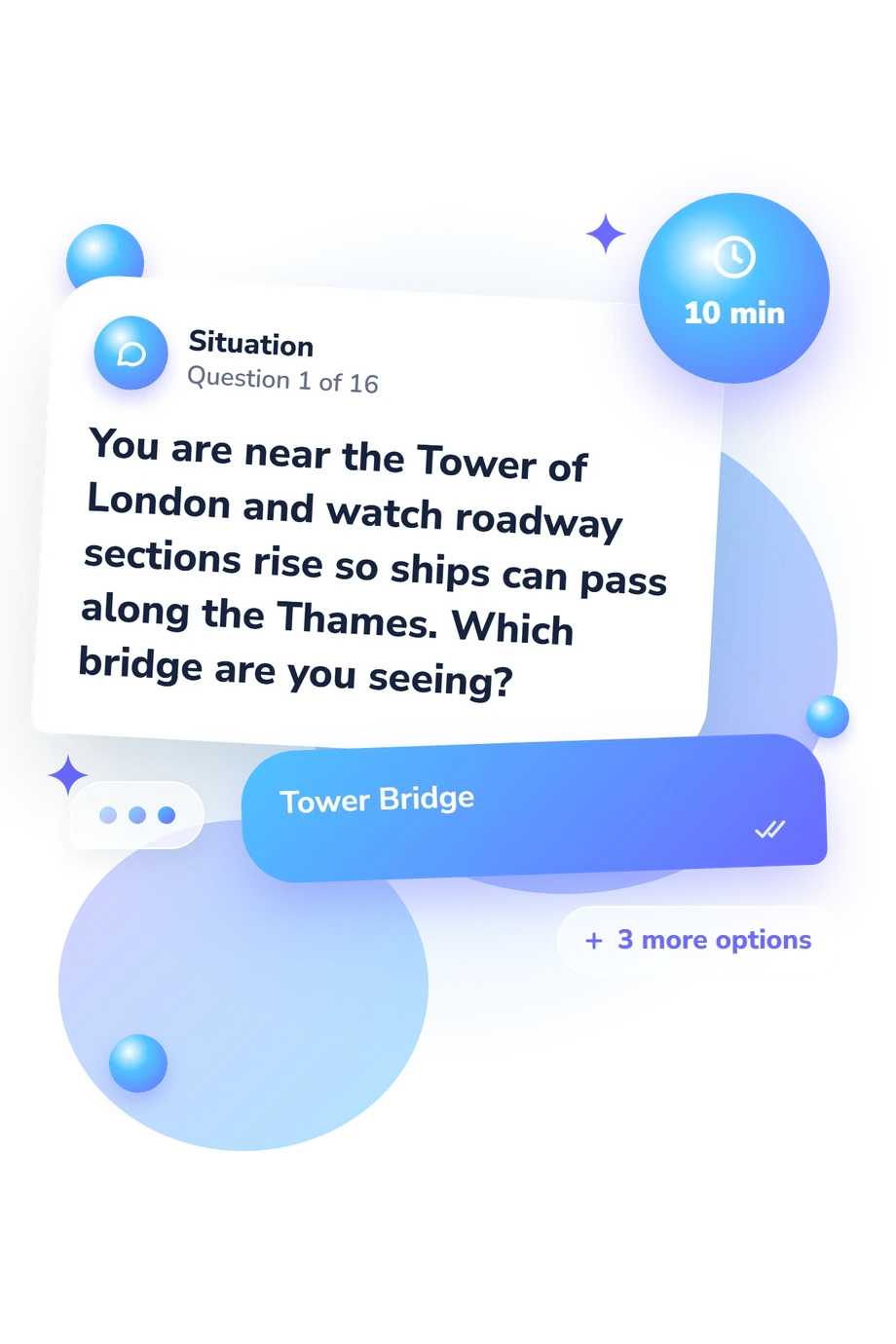
Example Questions From the Test
- Tower Bridge
- Westminster Bridge
- Millennium Bridge
- London Bridge
- Senate debates and elections
- Permanent markets and workshops
- Public spectacles, including gladiatorial contests
- Religious pilgrimages and monastic retreats
- The clock face
- The tower
- The Great Bell
- The clock mechanism
Landmarks Quiz - Description and methodology of the test
Visitors interested in geography, travel, history, or architecture can use this landmarks quiz to gauge how accurately they handle landmark questions before deciding whether to explore the subject more deeply. It suits curious learners and travelers who want a concise way to decide whether further study would be worthwhile. As a famous places quiz, this assessment gives one overall result to support that decision.
What This Assessment Measures
The assessment examines landmark recognition as cultural and geographic knowledge. Items ask readers to identify buildings, monuments, archaeological sites, bridges, statues, and civic settings from descriptions, locations, historical functions, or distinctive design features. As a quiz about world landmarks, it asks respondents to connect names with places, people, periods, and purposes, so the result reflects more than memorizing isolated titles.
The result is one Landmarks Knowledge score from 0-16, which offers a practical snapshot of secure and less secure landmark connections. The displayed bands are:
- Foundation (0-6) indicates recognition of some major sites while location, history, and signature-feature knowledge may need development.
- Developing (7-12) reflects broad landmark knowledge with room to strengthen regional and historical connections.
- Landmark Expert (13-16) indicates consistent links between famous sites and accurate geographic, cultural, and architectural details.
Methodology and Scientific Basis
Each item presents a scenario or factual prompt with four answer choices. Options ask the reader to select a landmark, location, historical use, culture, or architectural detail. As a quiz about famous landmarks, its four-choice format asks readers to distinguish among related names, places, historical uses, cultures, and architectural details.
The closest named comparison is Tranel and colleagues' 2005 landmark recognition-and-naming test, which treats landmark identification as a recognition-and-naming task. This questionnaire is conceptually consistent with that work, not a reproduction or validated adaptation. That comparison supports interpreting the task's focus, but does not establish equivalent measurement for this questionnaire.
The questionnaire reports one overall performance result for these landmark items rather than separate abilities in geography, history, architecture, or culture. Familiarity, education, travel exposure, attention, and choice accuracy can affect performance. Read the result as a learning-oriented profile, not evidence of general memory or ability.
- Tranel, Daniel, Nonso Enekwechi, and Ken Manzel. (2005). A test for measuring recognition and naming of landmarks. Journal of Clinical and Experimental Neuropsychology, 27(1), 102-126. 10.1080/138033990513663
- Lei, Pei Lan, Gloria Yi Ming Kao, San-Ju Lin, and Chuen-Tsai Sun. (2009). Impacts of geographical knowledge, spatial ability and environmental cognition on image searches supported by GIS software. Computers in Human Behavior, 25(6), 1270-1279. 10.1016/j.chb.2009.05.003
- Siegel, Alexander W., and Sheldon H. White. (1975). The development of spatial representations of large-scale environments. In Advances in Child Development and Behavior, Vol. 10, 9-55. Academic Press. 10.1016/S0065-2407(08)60007-5
- Edelsbrunner, Peter A., Bianca A. Simonsmeier, and Michael Schneider. (2025). The Cronbach’s Alpha of Domain-Specific Knowledge Tests Before and After Learning: A Meta-Analysis of Published Studies. Educational Psychology Review, 37, Article 4. 10.1007/s10648-024-09982-y
Updated: