
Know and Love Personality Quiz
How the Scales are Structured
Who Usually Takes This Test?
See How You Compare
Below is a preview of how scores are typically distributed across each scale.
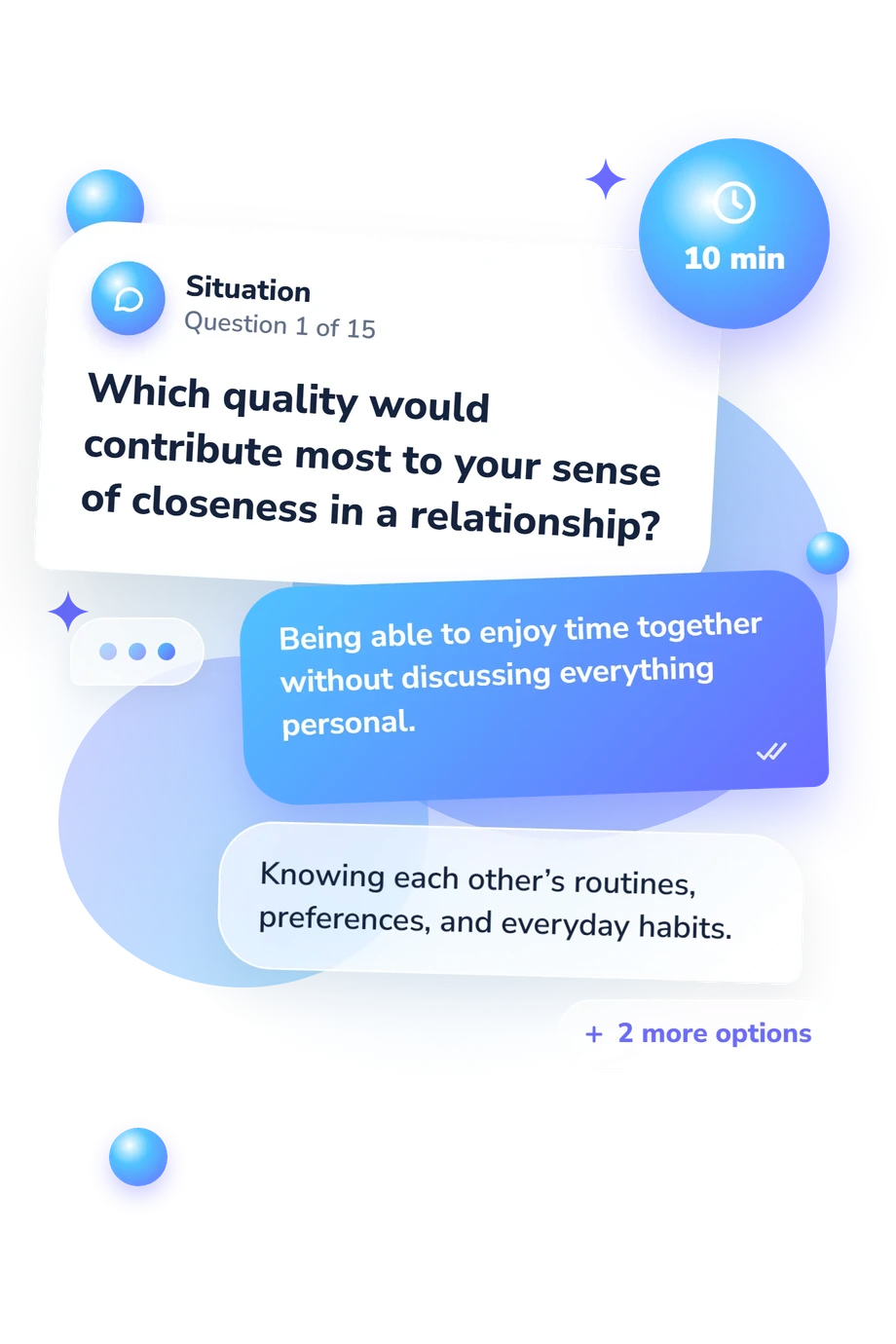
Example Questions From the Test
- Being able to enjoy time together without discussing everything personal.
- Knowing each other’s routines, preferences, and everyday habits.
- Understanding each other’s values and recurring emotional patterns.
- Recognizing each other’s contradictions, private hopes, and unspoken concerns.
- Not much; they do not need to understand every decision I make.
- A little; I would clarify if the subject came up naturally.
- Quite a bit; I would make time to explain my reasoning.
- A great deal; feeling accurately understood would matter as much as explaining the decision itself.
- Somewhat constraining, even when I know they mean well.
- Pleasant, provided our responsibilities remain mostly separate.
- Reassuring once I have had time to trust the pattern.
- Deeply supportive; dependable care strengthens my sense of connection.
Know and Love Personality Quiz - Description and methodology of the test
People who want to understand how they create and receive closeness can use this questionnaire as a structured self-reflection exercise. The Know and Love Personality Quiz offers a profile of separate tendencies: desire to feel personally understood, receptivity to affection and support, and attentiveness when tailoring care. As a relationship self-reflection quiz, it can help anyone name interpersonal preferences and prepare for conversation.
What This Assessment Explores
Three themes organize the profile. This relationship personality quiz examines separate tendencies involving the wish to be understood, comfort receiving care, and attention to another person’s individuality. Anyone reflecting on a meaningful relationship can use these dimensions to compare the profile with everyday experience.
The displayed dimensions are:
- Desire to Be Known (0-15) measures how strongly emotional and personal understanding supports connection: Selectively Visible (0-5), Gradually Revealed (6-10), or Deeply Seen (11-15).
- Receptivity to Love (0-15) measures comfort with accepting affection and dependable support: Self-Contained (0-5), Open with Boundaries (6-10), or Readily Receptive (11-15).
- Relational Attunement (0-15) measures how closely you notice personal cues and tailor care: Easygoing Connection (0-5), Thoughtful Attention (6-10), or Highly Attuned (11-15).
Together, the profile distinguishes being known, receiving love, and adapting care; a higher band means a stronger tendency, not a universally better style.
Methodology and Evidence Base
Each question offers four ordered response choices. Depending on the situation, options move from privacy toward disclosure, from independence toward accepting support, or from general goodwill toward care tailored to personal details. The profile therefore describes patterns across related situations rather than assigning one fixed personality type. The questionnaire works best when answers reflect usual tendencies rather than an idealized self-image, making its relationship closeness profile more informative.
The closest named source is the Minding Scale, which examines attention to a close partner’s needs, preferences, and inner experience. This questionnaire is conceptually consistent with that work, not an adaptation of the published scale. Its focus on feeling accurately understood also connects with Schroeder and Fishbach’s research on feeling known, while its attention to interpreting cues resembles the multidimensional mentalizing approach represented by the MMQ.
Scores are presented as three descriptive profiles, with a named result band shown for each. Because answers are self-reported, current relationship context, self-awareness, and a wish to appear caring can influence the pattern; use the result as a prompt for reflection and conversation, not a diagnosis.
- Omarzu, J., Whalen, J., & Harvey, J. H. (2001). How Well Do You Mind Your Relationship? A Preliminary Scale to Test the Minding Theory of Relating. In J. H. Harvey & A. Wenzel (Eds.), Close Romantic Relationships: Maintenance and Enhancement (pp. 345-356). Lawrence Erlbaum Associates. 10.4324/9781410600462-23
- Harvey, J. H., & Omarzu, J. (1997). Minding the Close Relationship. Personality and Social Psychology Review, 1(3), 224-240. 10.1207/S15327957PSPR0103_3
- Schroeder, J., & Fishbach, A. (2024). Feeling known predicts relationship satisfaction. Journal of Experimental Social Psychology, 111, 104559. 10.1016/j.jesp.2023.104559
- Gori, A., Arcioni, A., Topino, E., Craparo, G., & Lauro Grotto, R. (2021). Development of a New Measure for Assessing Mentalizing: The Multidimensional Mentalizing Questionnaire (MMQ). Journal of Personalized Medicine, 11(4), 305. 10.3390/jpm11040305
Updated: