
Kibbe Type Quiz
How the Scales are Structured
Who Usually Takes This Test?
See How You Compare
Below is a preview of how scores are typically distributed across each scale.
Example Questions From the Test
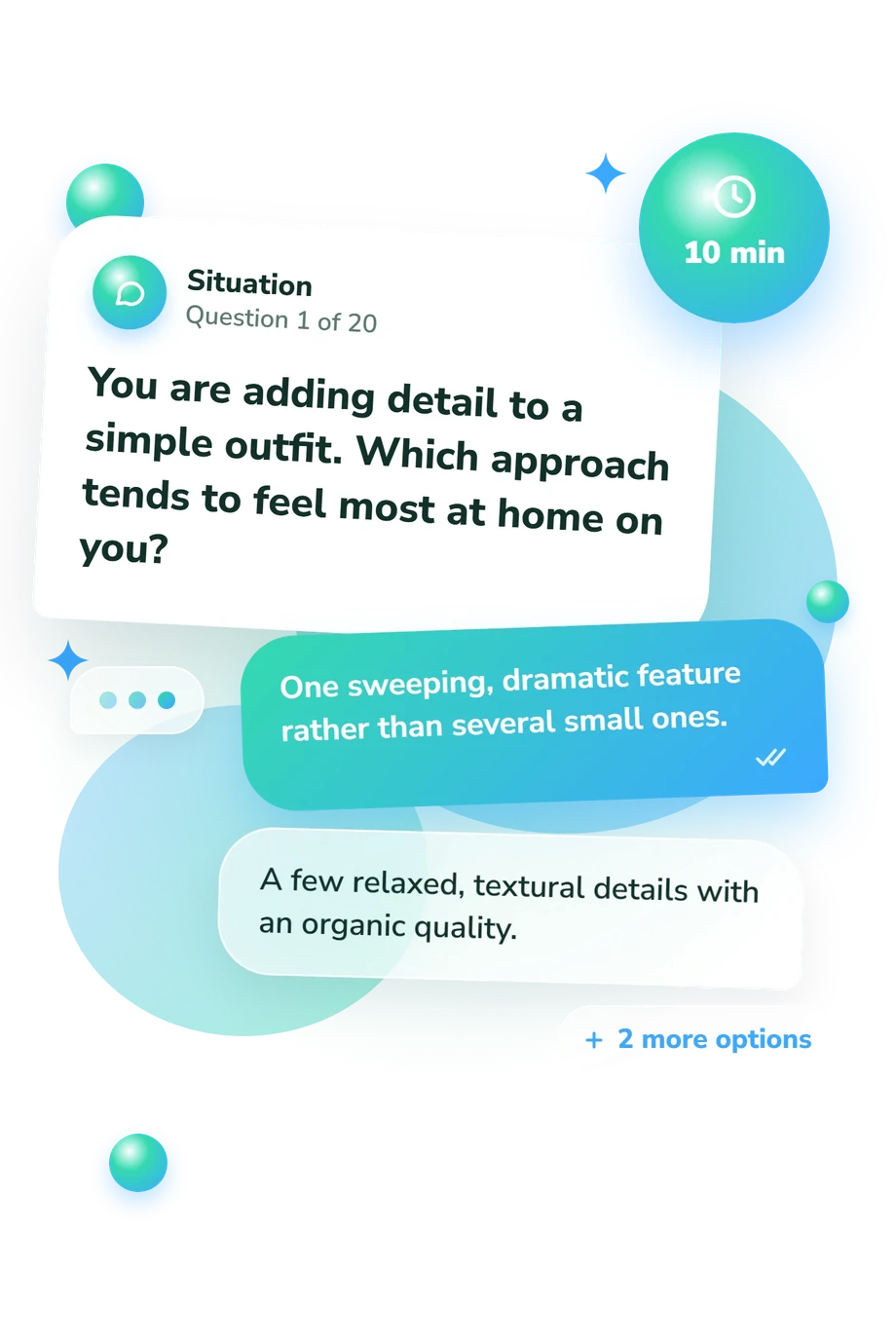
- One sweeping, dramatic feature rather than several small ones.
- A few relaxed, textural details with an organic quality.
- Two or three neat accents kept within a balanced color story.
- Several crisp, compact accents that create playful visual rhythm.
- A long, narrow, sharply defined neckline.
- An open, relaxed neckline with minimal construction.
- A moderate rounded neckline with restrained finishing.
- A softly curved or gathered neckline with delicate definition.
- A rounded, gently shaped jacket with decorative detail.
- An easy jacket with open space and a slightly relaxed fit.
- A tailored jacket with moderate structure and minimal excess.
- A sharply cut jacket with an elongated lapel and strong outline.
Kibbe Type Quiz - Description and methodology of the test
People who want a more deliberate way to compare styling affinities can use this Kibbe style quiz rather than chase a fixed label. The Kibbe Type Quiz connects reactions to line, scale, symmetry, softness, and texture with clothing choices. It helps curious self-observers see which visual principles recur across their responses.
What This Assessment Explores
Items explore how lines and garment details interact with appearance, not body dimensions. Across these situations, the questionnaire compares styling affinities, offering a Kibbe style analysis of line, proportion, structure, texture, and softness. This is about recurring harmony, not an identity. The five displayed scales are:
- Classic Family (0-12) reflects symmetry and moderation; Limited affinity 0-4; Situational affinity 5-8; Strong affinity 9-12.
- Dramatic Family (0-12) reflects length, sharp structure, and bold geometry; Limited affinity 0-4; Situational affinity 5-8; Strong affinity 9-12.
- Gamine Family (0-12) reflects cropped lines, contrast, and lively detail; Limited affinity 0-4; Situational affinity 5-8; Strong affinity 9-12.
- Natural Family (0-12) reflects openness, texture, and relaxed construction; Limited affinity 0-4; Situational affinity 5-8; Strong affinity 9-12.
- Romantic Family (0-12) reflects curves, softness, and ornate detail; Limited affinity 0-4; Situational affinity 5-8; Strong affinity 9-12.
Methodology and Evidence Base
Each item presents a styling situation with four response choices. The options vary line, scale, texture, construction, contrast, and fit experience, making the questionnaire comparative self-report rather than body measurement. Responses are grouped into five family totals. Compare all totals: the highest is strongest, while scores within one point form a blended result. Interpret the result through the displayed affinity bands and its relative ranking.
Conceptually, the questionnaire is consistent with David Kibbe's Image Identity System, which considers clothing through line, proportion, and yin-yang-inspired visual qualities. Kibbe's later writing develops that style philosophy for a contemporary audience; these conceptual parallels do not make the online questionnaire an adaptation of the published system.
Interpretation stays practical: the result is a comparative Kibbe styling profile, not a physical measurement. Its relationship to the Image Identity System is conceptual, not an adaptation claim. It is an unofficial style reflection, rather than a definitive Kibbe classification. Preferences, styling familiarity, current context, and self-perception can shift answers, so test the profile across outfits, fabrics, photographs, and daily settings.
- Kibbe, David. David Kibbe's Metamorphosis: Discover Your Image Identity and Dazzle as Only YOU Can. New York: Atheneum, 1987. ISBN 9780689118470.
- Kibbe, David. David Kibbe's Power of Style: A New Vision of Beauty: A Guided Journey to Help You Discover Your Authentic Style. New York: Rodale Books, 2025. ISBN 9780593581148.
- Song, Hwa Kyung, and Susan P. Ashdown. "Categorization of Lower Body Shapes for Adult Females Based on Multiple View Analysis." Textile Research Journal 81, no. 9 (2011): 914-931. 10.1177/0040517510392448.
Updated: