
It's vs Its Quiz
How the Scales are Structured
Who Usually Takes This Test?
See How You Compare
Below is a preview of how scores are typically distributed across each scale.
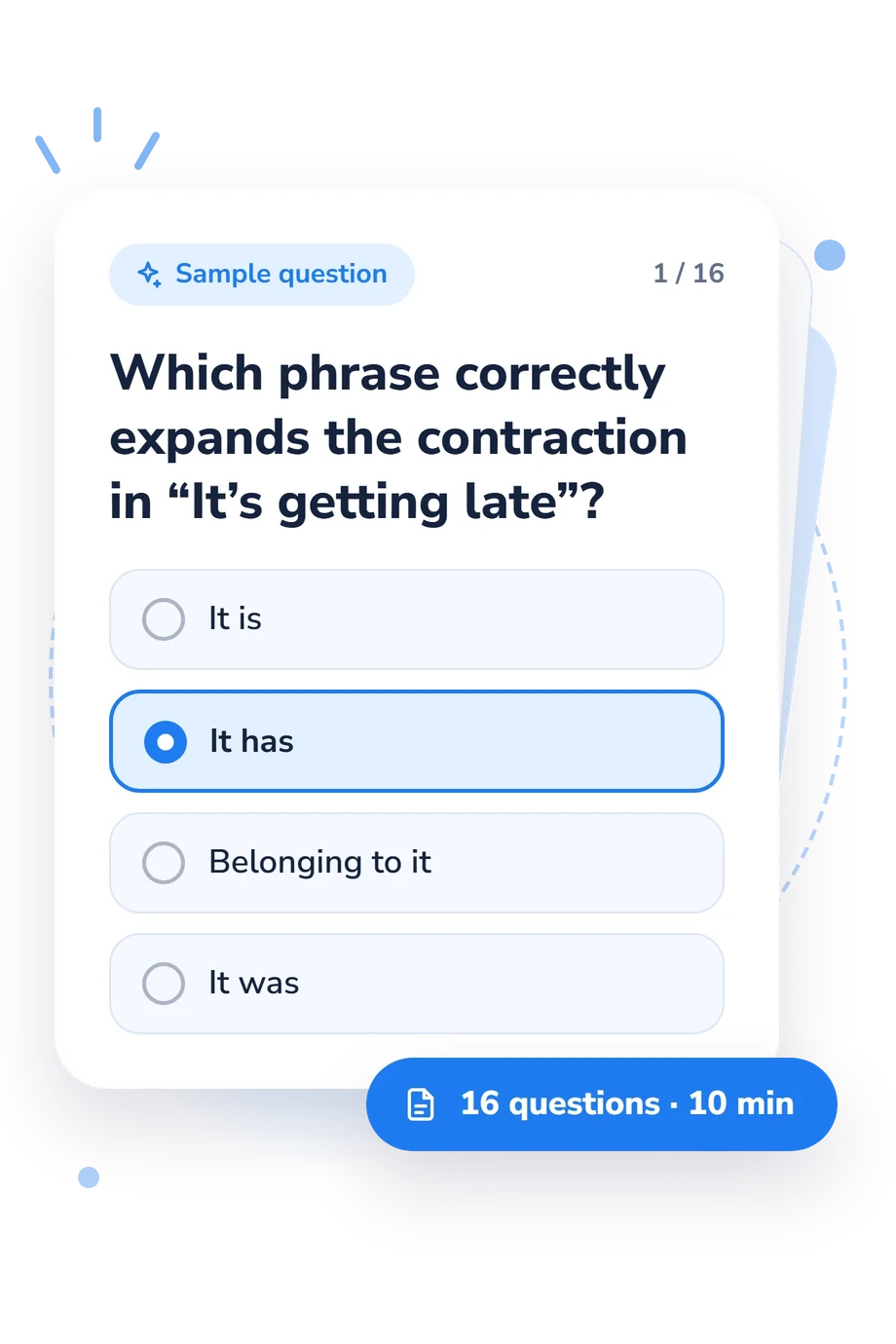
Example Questions From the Test
- It is
- It has
- Belonging to it
- It was
- “it’s,” because the anniversary is connected to the club
- “its,” showing that the anniversary belongs to the club
- “its’,” using an apostrophe after the possessive pronoun
- “it is,” creating the phrase “celebrated it is tenth anniversary”
- “it’s,” because an apostrophe always marks ownership
- “its’,” as though “its” were a plural noun
- “its,” because the opening hours belong to the museum
- “it is,” producing the phrase “changed it is opening hours”
It's vs Its Quiz - Description and methodology of the test
People who want to write clearer everyday English can use this quiz on “its” and “it’s” to check a small but persistent grammar distinction. The It's vs Its Quiz helps learners identify where their sentence-level decisions are reliable and where editing habits need reinforcement. Its result offers a quick indication of which rule applications feel secure and which need more attention.
What This Test Measures
The test focuses on choosing a contraction or possessive form in context, making it's vs its practice central to the exercise. It asks whether “it’s” expands to “it is” or “it has,” while “its” expresses belonging before a noun. The questions provide practice with “it’s” versus “its” in everyday sentences rather than testing the distinction as an isolated definition.
The displayed scale, It's vs Its Knowledge (0-16), awards one point for each correct answer and uses Foundation to Build (0-6), Developing Control (7-12), and Strong Command (13-16) as its result bands. The question themes are:
- Contraction recognition shows whether you can expand “it’s” accurately.
- Possessive selection shows whether “its” correctly precedes a noun.
- Sentence completion tests how context guides the choice.
- Proofreading tasks show whether you can repair apostrophe errors.
Methodology and Evidence Base
Each item has four options for expanding contractions, completing sentences, identifying correct writing, or editing errors. Together, these tasks form an its vs it's grammar test measuring recognition and application; the score counts correct choices, with no stated weighting or penalty.
The rule framework is consistent with Cambridge Dictionary, which distinguishes “it’s” as a contraction of “it is” or “it has” from possessive “its.” Aarts, Chalker, and Weiner, Huddleston and Pullum, and the Australian Government Style Manual provide compatible descriptions of contractions, pronouns, and apostrophe use.
As an online educational exercise, the questionnaire applies the same grammar distinctions described in these references. The exercise measures performance on these selected usage decisions rather than overall writing ability; it is a focused grammar test on the “its” versus “it’s” distinction. There are no stated population norms or reliability estimates, so the bands are local descriptions of performance on these items, not norm-referenced language-proficiency levels. Attention, guessing, and familiarity with sentence context can influence the result; use it as a focused snapshot that can guide further editing practice.
- Cambridge Dictionary. "It's or its?" English Grammar Today. Cambridge University Press, n.d.
- Aarts, Bas, Sylvia Chalker, and Edmund Weiner. The Oxford Dictionary of English Grammar. 2nd ed. Oxford University Press, 2014. ISBN 978-0-19-965823-7.
- Huddleston, Rodney, and Geoffrey K. Pullum. The Cambridge Grammar of the English Language. Cambridge University Press, 2002. 10.1017/9781316423530.
- Australian Government Style Manual. "It's and its." Australian Government, 2024.
Updated: