
Islamic Quiz on Prophets
How the Scales are Structured
Who Usually Takes This Test?
See How You Compare
Below is a preview of how scores are typically distributed across each scale.
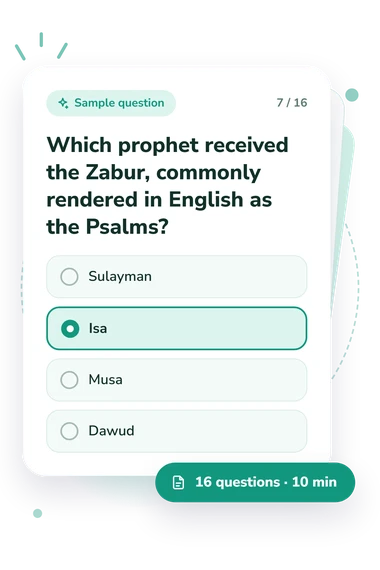
Example Questions From the Test
- Ayyub
- Zakariya
- Yunus
- Ilyas
- Idris
- Nuh
- Ibrahim
- Adam
- Sulayman
- Yusuf
- Dawud
- Ibrahim
Islamic Quiz on Prophets - Description and methodology of the test
People who want to review prophetic narratives in Islamic teaching can use the Islamic Quiz on Prophets with Answers to check recall across figures, missions, communities, and events. It is suitable for learners, readers revisiting Qur’anic stories, and anyone curious about how these accounts connect. The format offers Islamic quiz questions and answers about prophets in a compact setting, while the result identifies areas that may merit further study.
What This Assessment Explores
As an Islamic quiz on prophets, this assessment checks recognition of named prophets and associated Qur’anic episodes, rather than personality or devotional practice. It covers identities, missions, communities, signs, family links, and distinctive events.
The recurring knowledge areas are:
- Prophet identities show whether you match names with defining stories or titles.
- Communities and missions show whether you recognize whom each prophet addressed.
- Signs and events test recall of the ark, sea crossing, fire, great fish, and she-camel.
- Family links show knowledge of relationships and descendants.
The Islamic Prophets Knowledge scale (0-16) reports performance on this quiz only: Foundations to Build (0-6) marks basic recognition, Developing Knowledge (7-12) reflects broader but incomplete familiarity, and Strong Knowledge (13-16) indicates consistent grasp of the covered material.
Methodology and Evidence Base
Each item presents a short stem with four answer choices and asks the reader to identify the prophet linked to an event, relationship, mission, or title. The format tests recognition and recall rather than feelings or behavior. Its subject matter connects the outcome to the prophets and episodes covered by this quiz about Islamic prophets.
One displayed scale uses three interpretive bands to summarize performance on this quiz only, keeping the outcome tied to its prophets, missions, communities, and events rather than a population comparison. The score describes recognition within covered material, not standing against test-takers.
The content is conceptually consistent with Wheeler (2002), the closest scholarly frame for Qur’anic prophets and Muslim exegesis. Rubin (2017) adds context on prophethood; Nasr and colleagues’ commentary and Abdel Haleem’s translation support English renderings of names and episodes. These sources support subject matter and wording, not adaptation or validation of this questionnaire.
Interpretation remains limited by selected topics, prior learning, translation familiarity, and guessing. The score can guide review of unfamiliar narratives, but it is not a complete measure of religious understanding.
- Wheeler, Brannon M. (2002). Prophets in the Quran: An Introduction to the Quran and Muslim Exegesis. London: Continuum.
- Rubin, Uri (2017). Prophets and Prophethood. In The Wiley Blackwell Companion to the Qur'an, edited by Andrew Rippin and Jawid Mojaddedi. Wiley Blackwell. 10.1002/9781118964873.ch15
- Nasr, Seyyed Hossein, Caner K. Dagli, Maria Massi Dakake, Joseph E. B. Lumbard, and Mohammed Rustom (2015). The Study Quran: A New Translation and Commentary. New York: HarperOne.
- Abdel Haleem, Muhammad A. S. (2004). The Quran: A New Translation. Oxford: Oxford University Press.
Updated: