
Is My Relationship Healthy Quiz
How the Scales are Structured
Who Usually Takes This Test?
See How You Compare
Below is a preview of how scores are typically distributed across each scale.
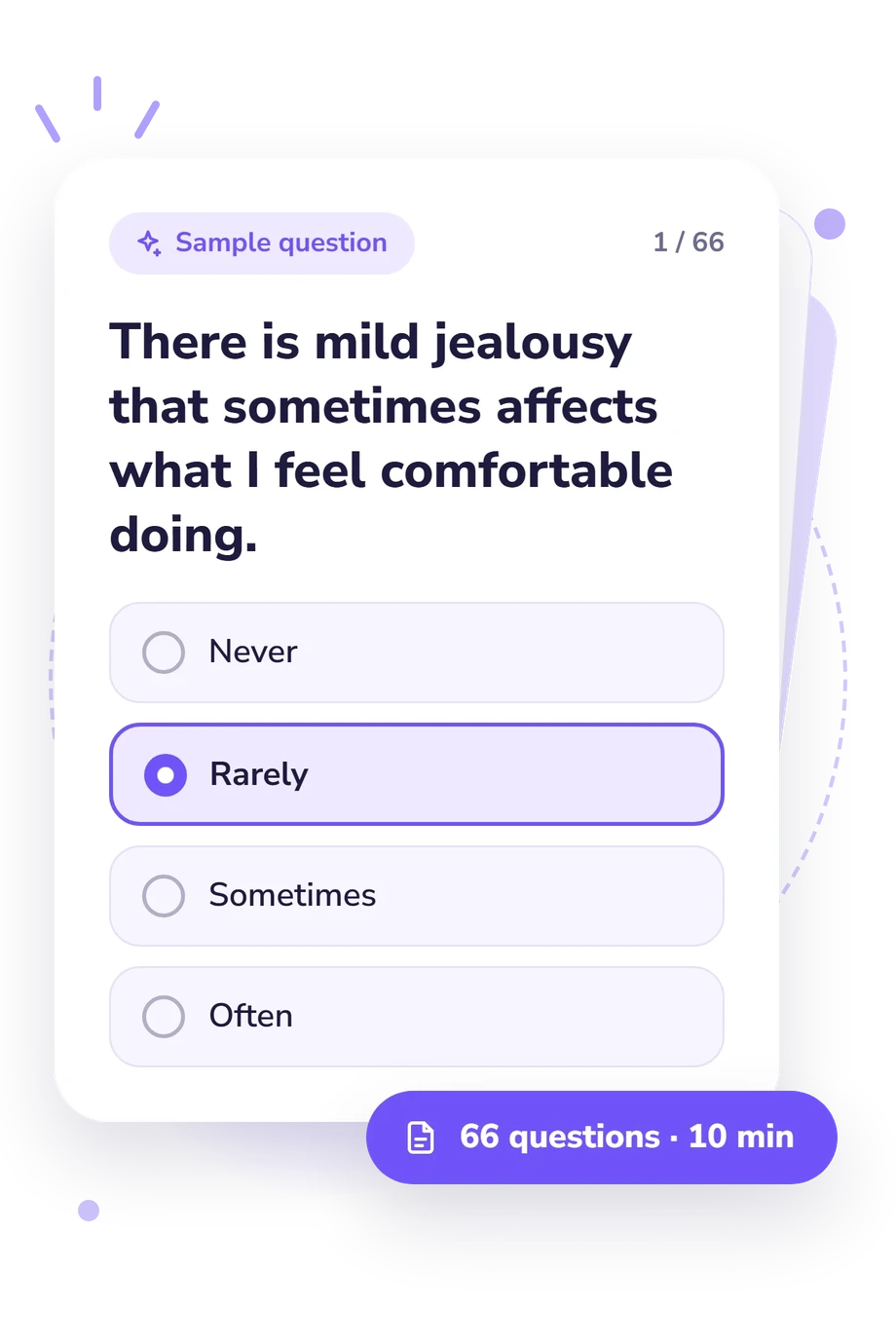
Example Questions From the Test
- Never
- Rarely
- Sometimes
- Often
- Strongly disagree
- Disagree
- Not sure
- Agree
- Never
- Rarely
- Sometimes
- Often
Is My Relationship Healthy Quiz - Description and methodology of the test
People who feel uncertain about safety, fairness, or emotional security in a partnership can use the Is My Relationship Healthy Quiz to organize reflection around repeated interaction patterns. In practice, the healthy relationship quiz format helps a reader look beyond one argument and consider how support, boundaries, trust, and repair operate over time. The result offers a structured starting point for noticing strengths and deciding which concerns deserve closer attention.
What This Test Measures
The items examine wellbeing alongside patterns that may signal caution or harm. They cover jealousy, control, intimidation, fear, disrespect, autonomy, communication, trust, fairness, and conflict repair. This suits someone asking the question behind an am i happy in my relationship quiz when happiness depends on feeling safe, heard, and free.
Results distinguish broad wellbeing from cautionary and high-risk indicators; the three displayed scales are:
- Red Flags (0-20) measures harmful or unsafe dynamics: Low concern 0-6; Moderate concern 7-13; High concern 14-20.
- Relationship Health (0-40) measures wellbeing across support, balance, safety, communication, trust, respect, boundaries, and repair: Needs attention 0-19; Generally healthy 20-31; Very healthy 32-40.
- Yellow Flags (0-20) counts caution patterns such as inconsistent communication, boundary issues, and recurring conflict: Few Yellow Flags 0-6; Some Yellow Flags 7-13; Many Yellow Flags 14-20.
Methodology and Scientific Basis
Each statement uses one of two four-point formats: Never/Rarely/Sometimes/Often for frequency, or Strongly disagree/Disagree/Not sure/Agree for experience. The questionnaire presents combined totals and bands without an item-by-item weighting rule; the contribution of each response should not be inferred from the score ranges.
Conceptually, the questionnaire is consistent with Measure of Psychologically Abusive Behaviors (Follingstad, 2011), especially its focus on coercion, intimidation, degradation, control, and fear. Follingstad et al. (2015) examined that measure's validity and psychometric properties. Those studies clarify relevant constructs, but this questionnaire is not presented as an adaptation or validation of that instrument.
The Relationship Assessment Scale (Hendrick, Dicke, and Hendrick, 1998) provides a framework for overall relationship satisfaction, while this questionnaire also addresses safety, autonomy, and interactional harm. Viewed as a relationship health assessment, it is most informative when answers describe repeated experiences rather than a temporary mood.
This version has no established population norms or validated clinical thresholds, so its bands are descriptive rather than diagnostic. Self-report can be shaped by current conflict, fear, memory, or limited self-awareness; concrete circumstances belong alongside the numerical profile.
- Follingstad, Diane R. (2011). A measure of severe psychological abuse normed on a nationally representative sample of adults. Journal of Interpersonal Violence, 26(6), 1194-1214. 10.1177/0886260510368157
- Follingstad, Diane R., Coker, Ann L., Lee, Eunkyung, Williams, Corrine M., Bush, Heather M., & Mendiondo, Marta M. (2015). Validity and psychometric properties of the measure of psychologically abusive behaviors among young women and women in distressed relationships. Violence Against Women, 21(7), 875-896. 10.1177/1077801215584070
- Hendrick, Susan S., Dicke, Amy, & Hendrick, Clyde (1998). The Relationship Assessment Scale. Journal of Social and Personal Relationships, 15(1), 137-142. 10.1177/0265407598151009
Updated: