
Is My Period Normal Quiz
How the Scales are Structured
Who Usually Takes This Test?
See How You Compare
Below is a preview of how scores are typically distributed across each scale.
Example Questions From the Test
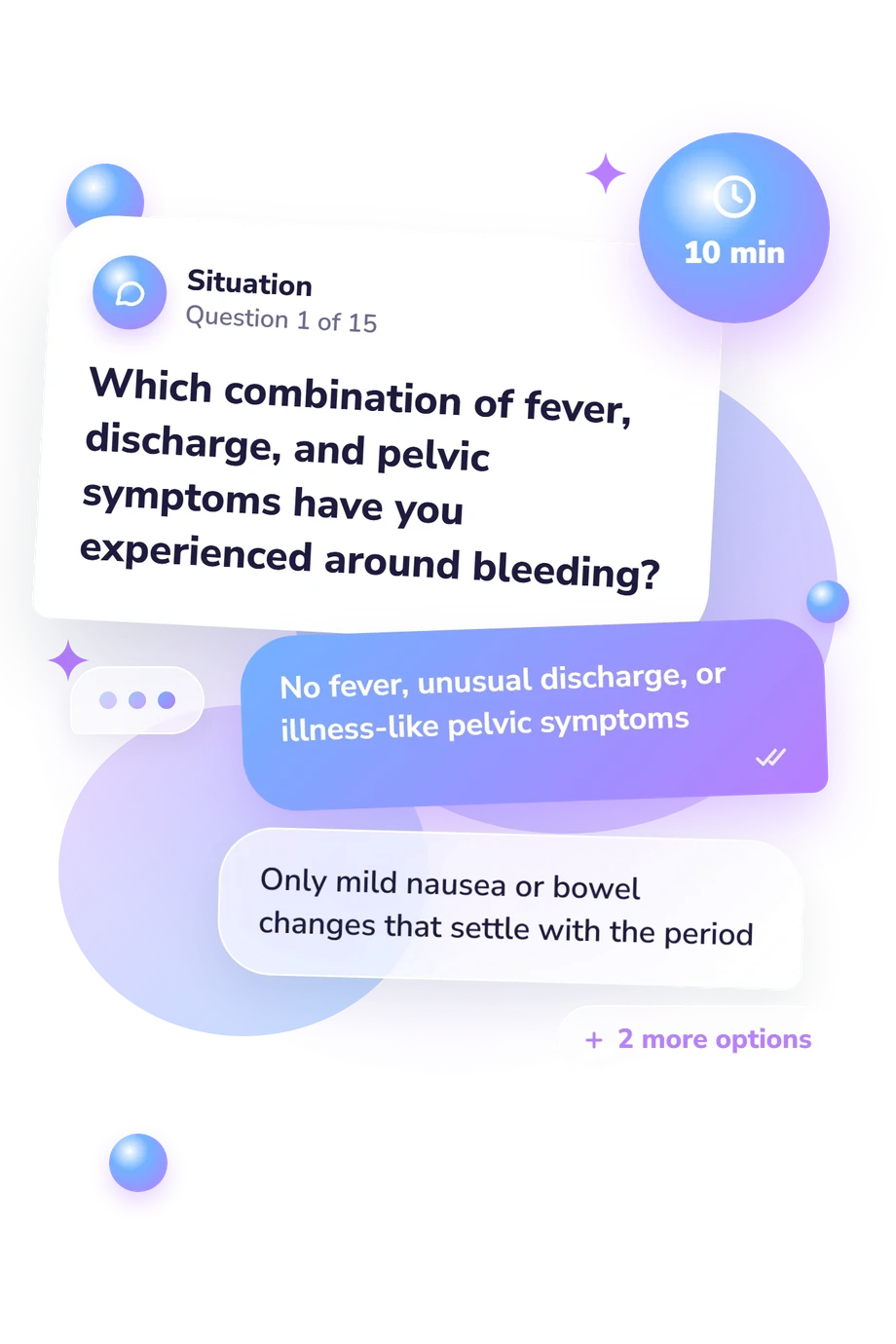
- No fever, unusual discharge, or illness-like pelvic symptoms
- Only mild nausea or bowel changes that settle with the period
- A measured fever or distinctly unusual or foul-smelling discharge with pelvic discomfort
- Fever with severe pelvic pain, fainting, confusion, or feeling acutely unwell
- No
- I sometimes notice a brief, mild ache around the middle of my cycle
- I have recurring or persistent pelvic pain outside my period
- I have sudden severe or one-sided pelvic pain, particularly with faintness or a possibility of pregnancy
- The bleeding has stopped by then
- I occasionally have a small amount of spotting on day eight
- Clear bleeding often continues for roughly eight to ten days
- Bleeding regularly continues beyond ten days or seems not to stop
Is My Period Normal Quiz - Description and methodology of the test
People reviewing bleeding, cycle timing, cramps, or related symptoms can use the Is My Period Normal Quiz to organize observations. It is intended for personal reflection and deciding what to track before speaking with a healthcare professional. Rather than reducing the experience to a severity label, this quiz asks: how bad is my period? Its result organizes flagged bleeding, cycle or reproductive-context, and pain or body-symptom indicators, showing when monitoring or prompt review may be appropriate.
What This Assessment Explores
The questionnaire looks beyond a normal-or-abnormal label. It covers bleeding amount and duration, cycle timing, bleeding between periods, pregnancy or menopause context, pelvic pain, and symptoms such as dizziness, weakness, breathlessness, or palpitations. Someone asking, are my periods normal, can use this quiz to organize experiences against an established pattern; the result does not establish that a cycle is normal.
The dimensions are:
- Bleeding and Flow Indicators (0-15) cover heavy or prolonged flow, flooding, and clots; bands are No flagged indicators (0), Worth monitoring (1-2), and Prompt review (3-15).
- Cycle Change and Reproductive-Context Indicators (0-15) cover timing, unexpected bleeding, and pregnancy or menopause context; bands are No flagged indicators (0), Worth monitoring (1-2), and Prompt review (3-15).
- Pain and Body-Symptom Indicators (0-15) cover pain, dizziness, fainting, breathlessness, and chest symptoms; bands are No flagged responses (0), Worth monitoring (1-2), and Prompt review (3-15).
Methodology and Evidence Base
Four response levels structure this self-report: no relevant change, an occasional or manageable experience, a repeated or disruptive pattern, and a red-flag situation. They capture presence, recurrence, severity, and impact without treating responses as clinically equivalent.
Scoring groups answers into three sections and assigns each a displayed band. The bands are unvalidated, non-diagnostic, and not probability estimates or medical cutoffs; 0 cannot rule out a health problem, and any red-flag response matters independently. When you wonder, is my period irregular, this quiz uses timing items to organize changes by recurrence and context.
Conceptually, the questionnaire is consistent with the FIGO System 1 framework, which organizes abnormal uterine bleeding by pattern. ACOG guidance on acute bleeding, dysmenorrhea, and postmenopausal bleeding adds context; this questionnaire is not an adaptation of them.
Attention stays on patterns. Treat it as an irregular period quiz: interpretation depends on honest recall and circumstances, including stress, illness, medication, contraception, or possible pregnancy. Hourly soaking, fainting, severe weakness, sudden severe pain, chest pain, severe breathing difficulty, or possible pregnancy with pain or bleeding should be acted on independently of the total.
- Munro MG, Critchley HOD, Fraser IS, FIGO Menstrual Disorders Committee. The two FIGO systems for normal and abnormal uterine bleeding symptoms and classification of causes of abnormal uterine bleeding in the reproductive years: 2018 revisions. International Journal of Gynecology & Obstetrics. 2018;143(3):393-408. 10.1002/ijgo.12666
- American College of Obstetricians and Gynecologists, Committee on Gynecologic Practice. Management of acute abnormal uterine bleeding in nonpregnant reproductive-aged women. Committee Opinion No. 557. Obstetrics & Gynecology. 2013;121(4):891-896. 10.1097/01.AOG.0000428646.67925.9a
- American College of Obstetricians and Gynecologists, Committee on Adolescent Health Care. ACOG Committee Opinion No. 760: Dysmenorrhea and Endometriosis in the Adolescent. Obstetrics & Gynecology. 2018;132(6):e249-e258. 10.1097/AOG.0000000000002978
- American College of Obstetricians and Gynecologists. ACOG Committee Opinion No. 734: The Role of Transvaginal Ultrasonography in Evaluating the Endometrium of Women With Postmenopausal Bleeding. Obstetrics & Gynecology. 2018;131(5):e124-e129. 10.1097/AOG.0000000000002631
Updated: