
Is My Boyfriend Sexually Attracted to Me Quiz
How the Scales are Structured
Who Usually Takes This Test?
See How You Compare
Below is a preview of how scores are typically distributed across each scale.
Example Questions From the Test
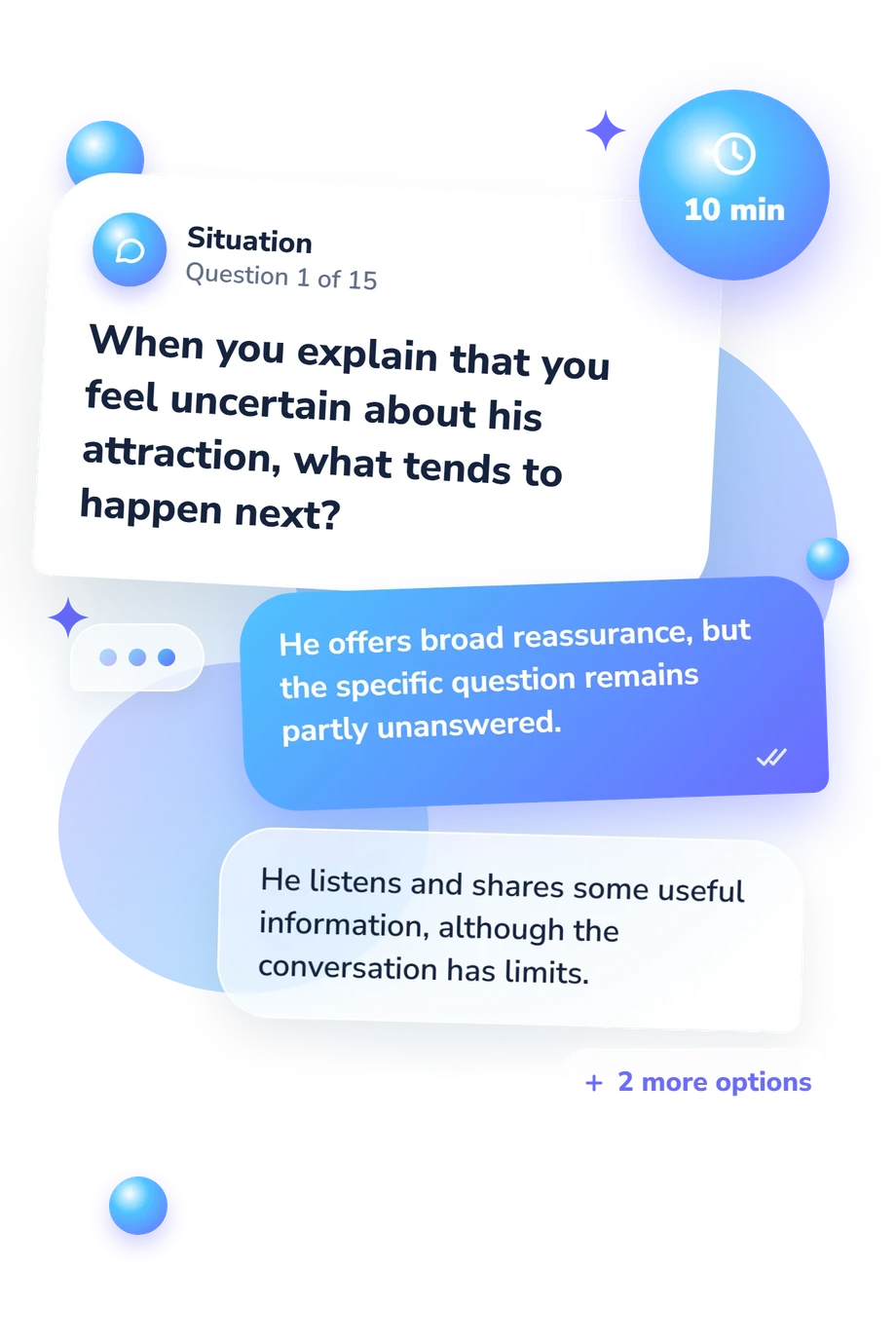
- He offers broad reassurance, but the specific question remains partly unanswered.
- He listens and shares some useful information, although the conversation has limits.
- He seems uneasy or shifts away from the subject before much becomes clear.
- He responds candidly with specific information about attraction, desire, and relevant context.
- They generally match, with understandable variations across situations.
- They often seem disconnected, leaving me unsure what to believe.
- They match consistently enough to give me a clear understanding of his attraction.
- They match in some situations but conflict in others.
- There is recurring playful or sexual tension that feels mutual.
- His tone is mainly friendly, practical, or informational.
- He occasionally uses affectionate hints or mild teasing.
- He often flirts playfully and makes his attraction noticeable.
Is My Boyfriend Sexually Attracted to Me Quiz - Description and methodology of the test
People wondering whether he is attracted to me can use this quiz to organize observable relationship patterns before a difficult conversation. The Is My Boyfriend Sexually Attracted to Me Quiz focuses on separating direct information from assumptions about his private state and noticing where words, behavior, and timing do not align. It helps identify what remains unclear and which questions need a direct answer before you interpret a pattern.
What This Assessment Explores
Someone trying to understand a boyfriend’s attraction can use this questionnaire when words, behavior, or timing are difficult to interpret. It organizes reported clues around clarity, mutually wanted engagement, and visible desire rather than private thoughts.
The result contains three dimensions:
- Attraction and Context Clarity (0-15) measures clarity from conversation and consistent behavior; bands are Considerable uncertainty (0-5), Partial clarity (6-10), and Clear shared understanding (11-15).
- Consensual Initiation and Response (0-15) summarizes mutually wanted engagement, not obligation; bands are Limited engagement (0-5), Situational engagement (6-10), and Consistent engagement (11-15).
- Observable Desire Signals (0-15) reflects visible or verbal attraction through attention or flirting; bands are Few visible signals (0-5), Mixed signals (6-10), and Strong visible signals (11-15).
The quiz addresses whether he is sexually attracted to me while keeping consent and personal boundaries separate from any score.
Methodology and Evidence Base
Each item offers four choices about conversation, context, initiation, reciprocity, or visible desire. The respondent selects the option closest to the recent relationship pattern. Answers feed displayed scales, but no point-by-point weighting rule is stated; bands summarize patterns rather than prove an answer’s meaning.
As a relationship attraction quiz, it is conceptually consistent with Sexual need responsiveness (Vowels et al., 2022), emphasizing attentive, reciprocal sexual engagement. This connection is conceptual, not evidence the questionnaire adapts the measure. Its communication also aligns with the Sexual Communication Scale (Moazami et al., 2023). Mallory et al. (2019) link sexual communication with sexual function, while Birnbaum and Reis (2012) link perceived responsiveness with sexual interest; neither validates these scores.
Use the profile for respectful conversation, not to establish his private feelings. The bands are interpretive categories; answers may reflect current stress, hurt, memory, expectations, or felt safety. A refusal, lower libido, or boundary does not by itself disprove attraction; fear, pressure, threats, or retaliation for setting boundaries warrant support regardless of result.
- Vowels, L. M., Roos, C. A., Mehulić, J., O’Dean, S. M., & Sánchez-Hernández, M. D. (2022). What Does It Mean to Be Responsive to a Partner’s Sexual Needs? Toward a Definition of Sexual Need Responsiveness. Archives of Sexual Behavior, 51(8), 3735-3747. 10.1007/s10508-022-02432-2
- Moazami, S., Ashley, M., Czechowski, K., Courtice, E. L., & Shaughnessy, K. (2023). The Sexual Communication Scale (SeCS). Journal of Sex Research, 60(1), 71-90. 10.1080/00224499.2022.2129558
- Mallory, A. B., Stanton, A. M., & Handy, A. B. (2019). Couples’ Sexual Communication and Dimensions of Sexual Function: A Meta-Analysis. Journal of Sex Research, 56(7), 882-898. 10.1080/00224499.2019.1568375
- Birnbaum, G. E., & Reis, H. T. (2012). When Does Responsiveness Pique Sexual Interest? Attachment and Sexual Desire in Initial Acquaintanceships. Personality and Social Psychology Bulletin, 38(7), 946-958. 10.1177/0146167212441028
Updated: