
Is He Right for Me Quiz
How the Scales are Structured
Who Usually Takes This Test?
See How You Compare
Below is a preview of how scores are typically distributed across each scale.
Example Questions From the Test
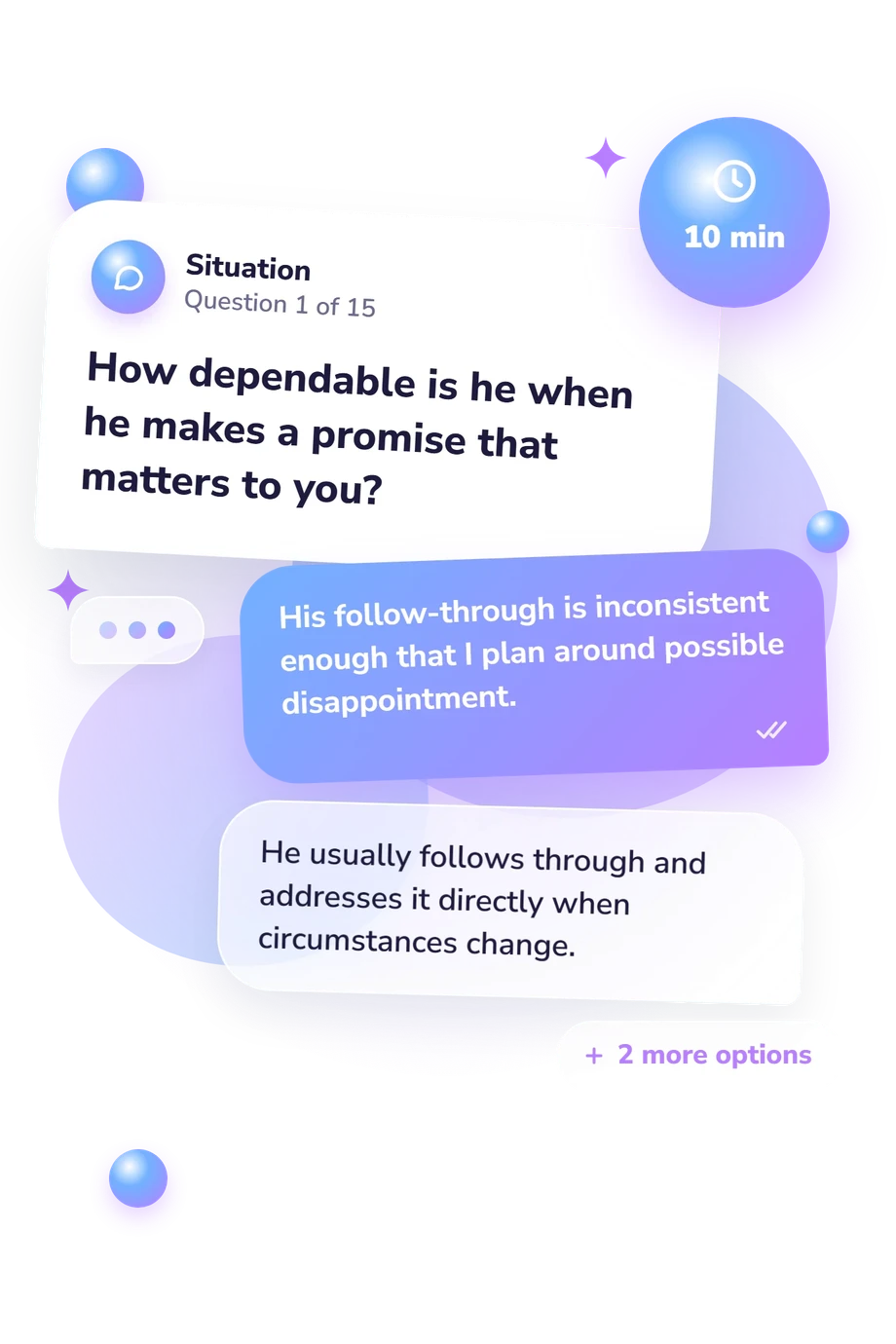
- His follow-through is inconsistent enough that I plan around possible disappointment.
- He usually follows through and addresses it directly when circumstances change.
- He keeps many promises, but I sometimes need to remind or check with him.
- It depends on the situation, so I am not fully sure what to expect.
- I usually adapt to the decision after it has effectively been made.
- We both have meaningful input, even when the final choice is not my first preference.
- We consult each other, but the process sometimes feels uneven.
- We try to decide together, yet discussions often stall or leave lingering frustration.
- Repair took time, but we both made efforts that helped.
- We reached understanding, took responsibility where needed, and rebuilt connection.
- The conflict ended without enough resolution for my trust to recover.
- Some repair occurred, but I still feel uncertain about what will happen next time.
Is He Right for Me Quiz - Description and methodology of the test
People weighing whether a relationship meets their needs can use the Is He Right for Me Quiz to organize impressions that are easy to blur. It helps clarify how relationship compatibility, commitment, and next steps fit your expectations. Rather than forcing a yes-or-no verdict, the profile highlights dependable strengths, unresolved differences, and subjects that merit direct conversation.
What This Assessment Explores
Concrete relationship situations explore emotional connection and trust through openness, reliability, authenticity, and conflict repair. Other items cover decisions, future plans, routines, values, money, and pressure. The test suits relationship reflection.
These dimensions organize the result:
- Emotional Connection and Trust (0-15) reflects openness, reliability, authenticity, and repair: Connection uncertain (0-5), Uneven connection (6-10), or Strong connection (11-15).
- Future Partnership Alignment (0-15) reflects commitment, partnership, money, location, and major choices: Unclear or mismatched (0-5), Partial alignment (6-10), or Strong alignment (11-15).
- Values and Everyday Fit (0-15) reflects routines, needs, values, and decision styles: Limited fit evidence (0-5), Mixed fit (6-10), or Strong fit evidence (11-15).
The profile turns concerns about relationship fit into concrete discussion topics about trust, plans, and daily life. A high connection score does not excuse frightening, coercive, or harmful behavior.
Methodology and Scientific Basis
Each item describes a relationship situation and offers four response descriptions. Selecting the closest option captures your experience, expectations, or likely approach, depending on the situation described; responses are grouped into three displayed dimensions. Ranges and bands describe the profile, but no universal point value per answer is stated.
Methodologically, it is conceptually consistent with the Couple Relationship Scale, which examines recurring relationship functioning. It also relates to Fletcher, Simpson, and Thomas’s perceived relationship-quality components and Spanier’s dyadic-adjustment framework. This online questionnaire uses its own displayed profile scoring and does not claim to reproduce or validate those published instruments.
Before major commitments, the result can clarify relationship expectations by surfacing direction, roles, and practical choices. Its bands organize current answers, so interpretation should remain tied to the evidence available now rather than treated as a fixed forecast.
Treat the profile as a current snapshot, not a prediction about the relationship’s future. Mood, memory, self-awareness, and honest reporting can shape self-report, while future plans, daily routines, and conflict responses may change with circumstances.
- Anderson, Shayne R., Lee N. Johnson, Richard B. Miller, and Connor C. Barham. “The Couple Relationship Scale: A brief measure to facilitate routine outcome monitoring in couple therapy.” Journal of Marital and Family Therapy 48, no. 2 (2022): 464-483. 10.1111/jmft.12541
- Fletcher, Garth J. O., Jeffry A. Simpson, and Geoff Thomas. “The measurement of perceived relationship quality components: A confirmatory factor analytic approach.” Personality and Social Psychology Bulletin 26, no. 3 (2000): 340-354. 10.1177/0146167200265007
- Spanier, Graham B. “Measuring dyadic adjustment: New scales for assessing the quality of marriage and similar dyads.” Journal of Marriage and the Family 38, no. 1 (1976): 15-28. 10.2307/350547
Updated: