
International Current Affairs Quiz
How the Scales are Structured
Who Usually Takes This Test?
See How You Compare
Below is a preview of how scores are typically distributed across each scale.
Example Questions From the Test
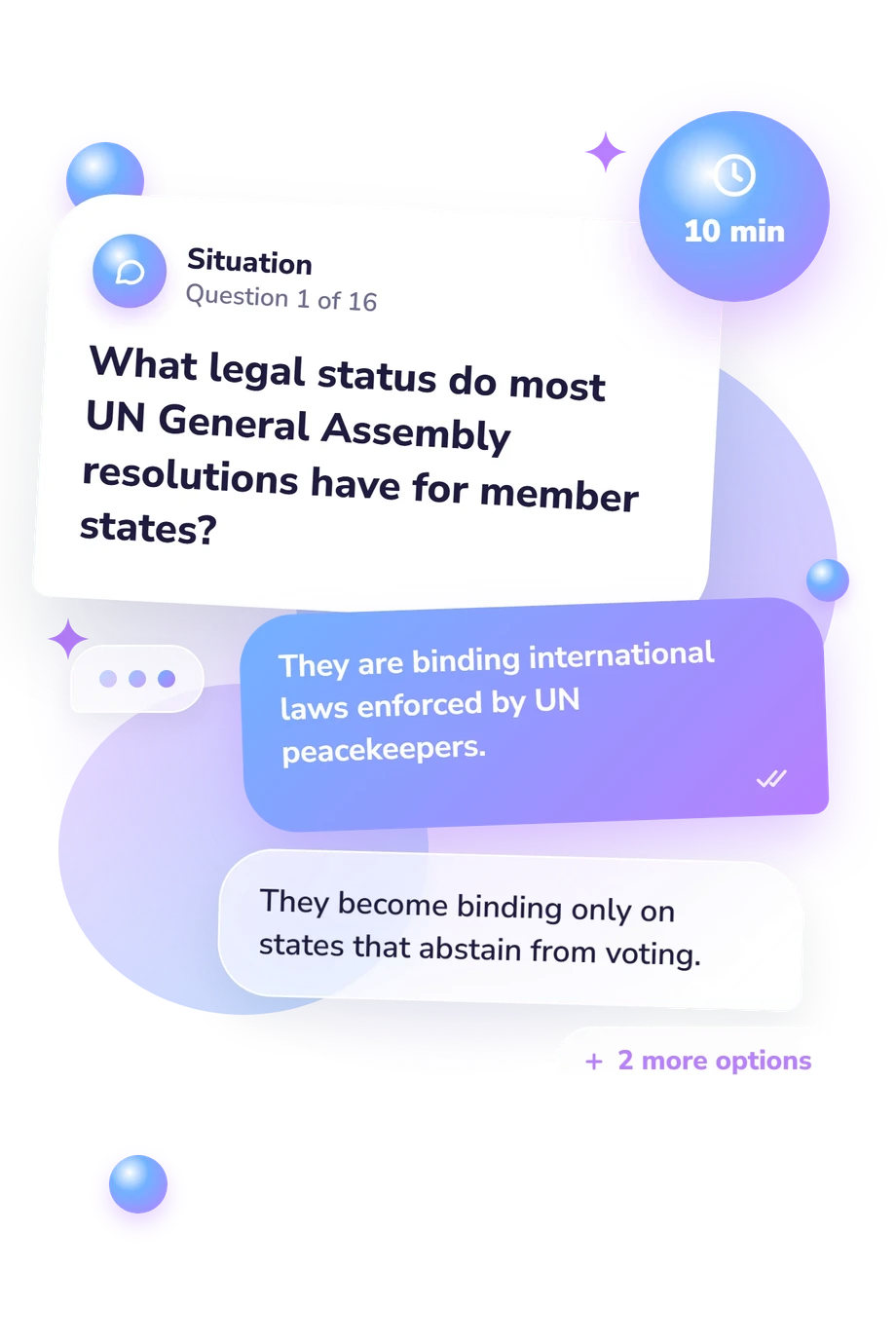
- They are binding international laws enforced by UN peacekeepers.
- They become binding only on states that abstain from voting.
- They are generally recommendations, although decisions on certain internal UN matters can have binding effects.
- They function as judgments of the International Court of Justice.
- A limit on the number of panels that may enter the country
- A payment made to domestic producers for every panel they manufacture
- A tax imposed on imported goods
- A technical rule specifying how imported panels must be built
- It requires retailers to reduce prices by law.
- It increases government spending without additional borrowing.
- It guarantees that wages rise faster than consumer prices.
- It makes borrowing more expensive, which can reduce demand and ease price pressure over time.
International Current Affairs Quiz - Description and methodology of the test
For readers deciding whether a structured check of global knowledge would be useful, this international current affairs quiz offers a focused way to examine familiarity with institutions and events. Its broad coverage makes a world current affairs quiz useful for learners, news readers, and internationally minded citizens weighing whether to pursue deeper study. The result gives an overall knowledge band rather than a detailed profile of separate abilities.
What This Assessment Explores
Questions about concepts give the world affairs quiz value for interpreting news. It suits curious readers, students, and anyone checking their grasp of institutions, law, economics, conflict, migration, climate policy, security, and source verification.
The question themes show the kinds of understanding contributing to the result:
- Institutions and law show whether you can distinguish the authority of major international bodies.
- Economics tests interpretation of tariffs, interest rates, exchange rates, and GDP.
- Conflict and protection cover humanitarian access, sanctions, refugees, collective defence, and pauses in fighting.
- Evidence and policy assess source checking and recognition of climate commitments such as NDCs.
International Current Affairs Knowledge runs from 0-16 and summarizes concepts behind reporting. The bands are Foundation to build (0-6), Developing perspective (7-12), and Strong framework (13-16); this is a summary, not a credential or survey of regions and events.
Methodology and Scientific Basis
Each item presents a scenario or definition with four answer choices. The respondent selects the option that best fits the question, so the format tests recognition and application of concepts rather than asking for explanations. The result is a summary score; no subscale weighting is described.
Questions about institutions, economics, law, and events give this international current affairs test subject matter conceptually consistent with the Pew international-affairs knowledge study, which treats international-affairs knowledge as a set of durable concepts. It is not presented as an adaptation or reproduction of that work. Robison’s research is relevant because question format can affect measured political knowledge, while Hahn and colleagues’ analysis supports interpreting public-affairs knowledge as a broad but incomplete domain.
The result is a single summary score without a norm-referenced interpretation, reported reliability coefficients, or clinical cutoffs. Scores can reflect exposure to international news, guessing, wording, and the respondent’s current information environment. For that reason, the result works best as a broad learning prompt: it can identify topics for review, but it cannot establish expertise across countries, regions, events, or policy fields.
- Silver, Laura, Christine Huang, Laura Clancy, Aidan Connaughton, and Sneha Gubbala. "What Do Americans Know About International Affairs?" Pew Research Center, May 25, 2022.
- Robison, Joshua. "Who Knows? Question Format and Political Knowledge." International Journal of Public Opinion Research, 27(1), 2015, 1-21. 10.1093/ijpor/edu019
- Hahn, Kyu S., Shanto Iyengar, Peter van Aelst, and James Curran. "Does Knowledge of Hard News Go with Knowledge of Soft News? A Cross-National Analysis of the Structure of Public Affairs Knowledge." In How Media Inform Democracy: A Comparative Approach, edited by Toril Aalberg and James Curran, Routledge, 2013, 119-137.
Updated: