
Insurance Quiz
How the Scales are Structured
Who Usually Takes This Test?
See How You Compare
Below is a preview of how scores are typically distributed across each scale.
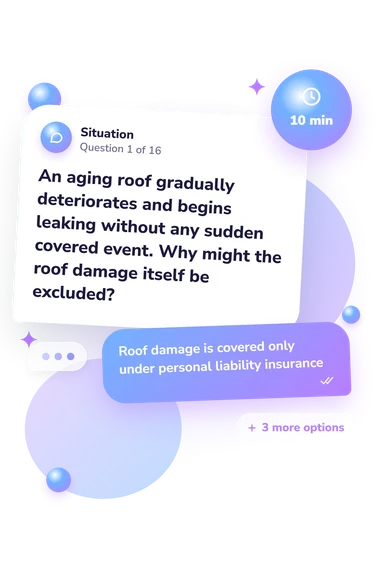
Example Questions From the Test
- Dwelling coverage
- Loss of use coverage
- Other structures coverage
- Personal liability coverage
- The cost of the newest equivalent model, with no deductions
- Its replacement cost minus depreciation for age and condition
- The price originally paid for it
- A preset percentage of the dwelling limit
- Dwelling coverage
- Personal property coverage
- Personal liability coverage
- Medical payments to others coverage
Insurance Quiz - Description and methodology of the test
People reviewing a homeowners policy before buying, renewing, or filing a claim can use this assessment to check practical knowledge. The insurance quiz focuses on distinctions that often affect decisions, including covered property, exclusions, deductibles, limits, and claims steps. The result identifies topics worth revisiting during a homeowners policy review or discussing with an insurer before a purchase, renewal, or claim.
What This Assessment Explores
Coverage knowledge matters when everyday wording blurs distinctions between protection and responsibility. This home insurance knowledge test examines understanding of dwelling, other structures, personal property, liability, medical payments, and loss-of-use coverage, alongside exclusions, deductibles, valuation, endorsements, flood, sewer backup, and claim documentation. The intended reader is anyone seeking a practical grasp of standard homeowners policy mechanics.
The displayed scale is Homeowners Insurance Knowledge (0-16), interpreted through these bands:
- Foundation (0-6) indicates recognition of some basics and points toward reviewing coverage sections, exclusions, and claim terms.
- Developing (7-12) reflects understanding of many standard concepts while leaving room to strengthen their application in real situations.
- Strong knowledge (13-16) reflects a solid working grasp of typical homeowners coverage, while policy forms, endorsements, limits, and laws may still vary.
Methodology and Evidence Base
Each item presents a brief household or claims scenario with four response options. The questions ask the respondent to distinguish covered from excluded loss, identify relevant coverage, apply deductible or valuation concepts, and recognize sensible claims steps. These homeowners policy questions test applied understanding rather than isolated definitions.
The questionnaire reports a result on the displayed knowledge scale. No item-weighting or point-mapping rule is stated, so the result summarizes performance on this questionnaire rather than establishing a broader measure.
Conceptually, the content is consistent with Tennyson’s 2011 survey-based insurance-literacy study and with Allodi, Bocchino, and Stella’s seven-item insurance-knowledge measure. It is not an adaptation of either instrument, and those studies do not validate this questionnaire. The National Association of Insurance Commissioners’ consumer guide supports the policy concepts addressed, including exclusions, endorsements, and claim review.
Interpretation also depends on attention, current circumstances, and honest self-report. Because policy forms, limits, deductibles, endorsements, and jurisdiction vary, the result helps select topics for review rather than determine actual protection.
- Tennyson, Sharon. (2011). “Consumers’ Insurance Literacy: Evidence from Survey Data.” Financial Services Review, 20(3), 165-179. 10.61190/fsr.v20i3.4701
- Allodi, Evita, Enrico Maria Bocchino, and Gian Paolo Stella. (2021). “Understanding Insurance Knowledge: A Brief 7-Item Measure.” International Journal of Business and Management, 16(2), 65-74. 10.5539/ijbm.v16n2p65
- National Association of Insurance Commissioners. (2022). A Consumer’s Guide to Home Insurance. National Association of Insurance Commissioners.