
Inference Quiz
How the Scales are Structured
Who Usually Takes This Test?
See How You Compare
Below is a preview of how scores are typically distributed across each scale.
Example Questions From the Test
- The library is being permanently renovated.
- Lena arrived before the staff that morning.
- Tuesday is not considered a weekday there.
- The library had closed for the day.
- The concert will probably end before sunset.
- Marcus will need formal clothing for the second act.
- The temperature is likely to become cooler during the concert.
- The performers plan to move the concert indoors.
- Ravi has already completed a separate final draft.
- Ravi believes only the opening paragraph will be graded.
- Ravi has decided not to submit the essay.
- Ravi is having difficulty moving beyond the beginning of the essay.
Inference Quiz - Description and methodology of the test
Readers who want to examine how they draw conclusions from limited information can use this inference quiz to focus on evidence, implications, and the limits of a conclusion. The format suits learners, teachers, and adults who want a brief quiz for practising inference that emphasizes justified answers rather than intuition alone. Results show where reasoning is consistently supported and where closer attention to context may help.
What This Assessment Explores
Across the scenarios, respondents connect observable clues with the conclusion they best support. The items cover everyday decisions, physical traces, changes over time, implied feelings, and likely causes.
As an inference skills test, it examines these dimensions:
- Evidence and conclusions show whether you choose an idea that stays within the information given.
- Implied meaning and motives show whether you recognize what actions or wording suggest without treating a guess as certain.
- Causes and consequences show whether you connect events cautiously when several explanations are possible.
- Inference Knowledge (0-16) reflects performance across the items. Emerging foundation (0-6) means separating evidence from assumptions needs practice; Developing inference skills (7-12) means implications are often recognized but subtle limits may be missed; Strong inference skills (13-16) means conclusions stay closely supported without extending beyond the passage.
It suits anyone practicing evidence-based reasoning.
Methodology and Evidence Base
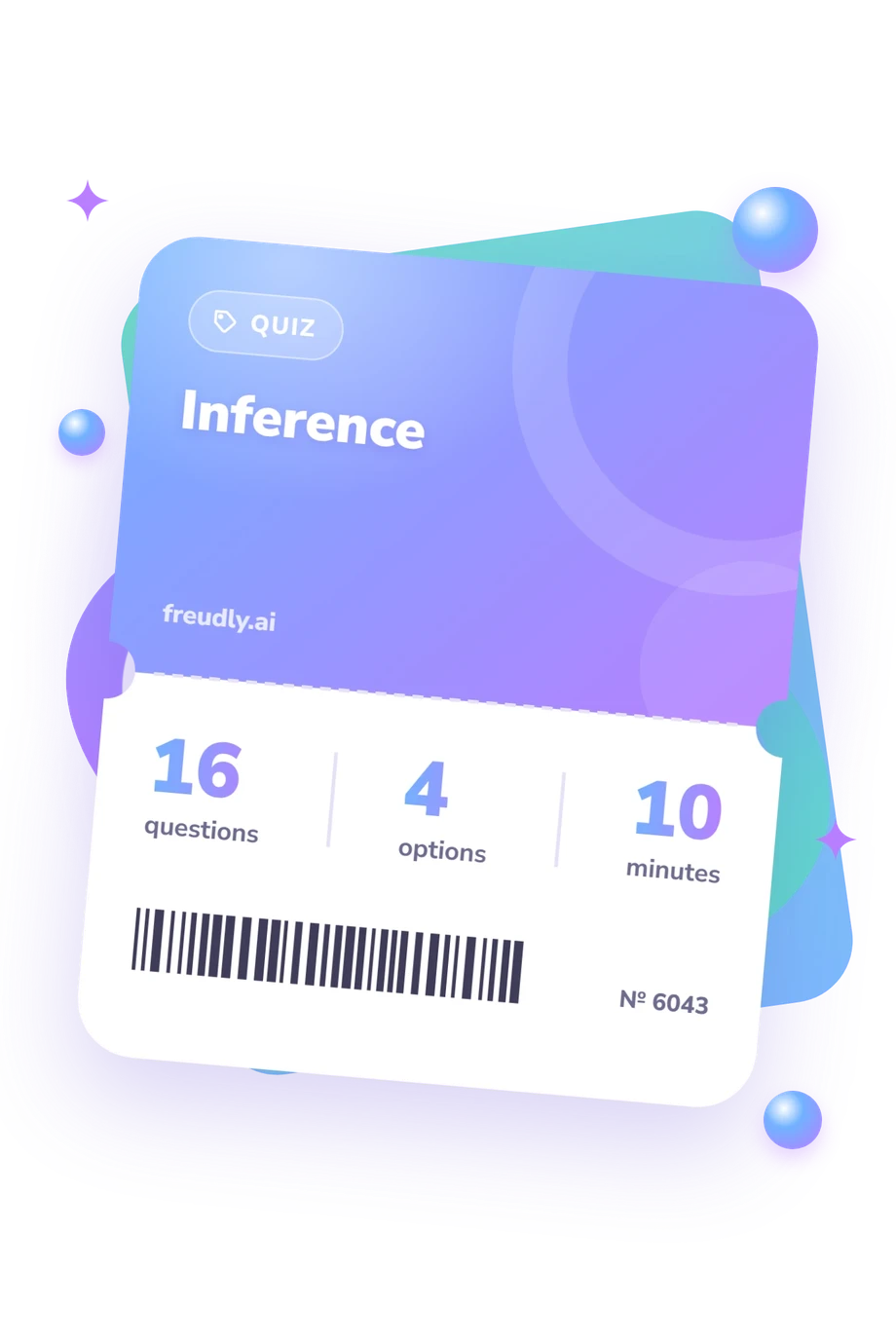
Each item presents four inference answer choices. Respondents choose the best-supported inference, so the correct option must fit the clues without adding claims the evidence cannot establish. The four options let respondents compare their choice with the evidence and identify the conclusion best supported by the passage.
Scoring is direct: every correct response contributes one point. Higher performance reflects more consistent use of presented information, not uniformly accurate judgment in daily life.
Cromley et al.’s 2021 biology inference-making tool is the closest conceptual match. This questionnaire is conceptually consistent with that work, not a reproduction or validated adaptation of its items. Its approach also aligns with Graesser, Singer, and Trabasso's account of explanatory and causal inferences during comprehension, and with Kintsch's construction-integration view of meaning built from text and context.
Because the displayed bands describe performance on these items rather than a population-referenced score, the result is a structured snapshot of how well respondents distinguish supported conclusions in this questionnaire. Attention, familiarity, current concentration, and willingness to choose cautiously can affect answers; broader conclusions require evidence across tasks and settings.
- Cromley, Jennifer G., Ting Dai, Tia S. Fechter, Frank E. Nelson, Martin Van Boekel, and Yang Du. (2021). Development of a Tool to Assess Inference-Making and Reasoning in Biology. Journal of Microbiology & Biology Education, 22(2), e00159-21. 10.1128/jmbe.00159-21.
- Graesser, Arthur C., Murray Singer, and Tom Trabasso. (1994). Constructing Inferences During Narrative Text Comprehension. Psychological Review, 101(3), 371-395. 10.1037/0033-295X.101.3.371.
- Kintsch, Walter. (1998). Comprehension: A Paradigm for Cognition. Cambridge University Press.
Updated: