
Indian History Quiz
How the Scales are Structured
Who Usually Takes This Test?
See How You Compare
Below is a preview of how scores are typically distributed across each scale.
Example Questions From the Test
- Tamilakam in southern India
- The middle Ganga plain
- The Kashmir Valley
- The lower Indus valley
- Sarnath
- Hampi
- Fatehpur Sikri
- Pataliputra
- Kalidasa
- Banabhatta
- Aryabhata
- Charaka
Indian History Quiz - Description and methodology of the test
Students, lifelong learners, and curious readers can use this assessment to examine how they connect events, people, institutions, and cultural developments across the subcontinent. The Indian History Quiz suits anyone preparing for revision or choosing a period for further study. Its focus is on reasoning from context as well as recognizing names, dates, and institutions. As a quiz on the history of India, it highlights secure knowledge and worthwhile directions for reading.
What This Assessment Measures
Items test connected historical understanding through monuments, inscriptions, institutions, political events, and movements rather than isolated recall. They ask readers to connect causes, structures, and consequences across major periods. For a quiz about the history of India, context matters as much as recognition.
The main thematic groups are:
- Ancient and early medieval foundations show what archaeology, literature, science, and imperial ideas reveal.
- Regional kingdoms and institutions show how administration, revenue, defense, and urban planning worked.
- Colonial rule and resistance connect Company expansion with policy effects and organized opposition.
- National movement and state formation link mass campaigns, constitutional change, and independent India.
The result appears on the Indian History Knowledge scale, 0-16: Foundation Building (0-6), Developing Knowledge (7-12), and Strong Knowledge (13-16). These bands summarize broad, accurate knowledge across major eras, not complete historical expertise.
Methodology and Historical Basis
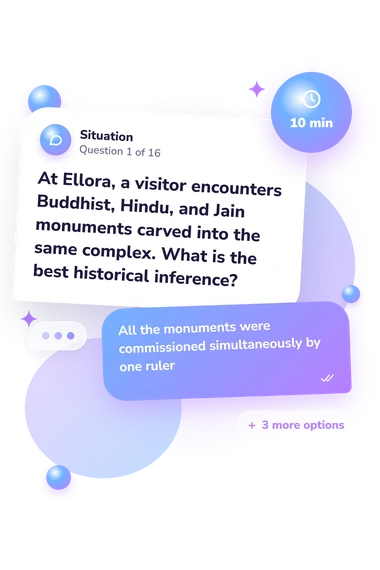
Each prompt presents a historical situation, source, term, event, or person with four answer choices. Some items ask for an inference from evidence; others test recognition of a development or institution. These Indian-history quiz questions reward the option that fits the context, not merely a familiar name.
Scoring aggregates performance across the items into the reported total. No separate psychometric weighting system, population norm, or reliability estimate is stated, so the result functions as an educational self-check rather than a standardized examination.
Its evidence base is conceptually consistent with Kulke and Rothermund (2016), Upinder Singh (2008), and Sekhar Bandyopadhyay (2004). Together, these histories provide chronological and thematic context for ancient, early medieval, colonial, and modern India. The questionnaire is not presented as an adaptation of those books or as a validated form of any one published instrument.
For a general-knowledge quiz on Indian history, missed topics can guide further reading and revision. Performance may vary with schooling, reading exposure, terminology, guessing, and current recall, so the score is best read as a snapshot of knowledge rather than a definitive measure of historical expertise.
- Hermann Kulke and Dietmar Rothermund. A History of India. 6th ed. Routledge, 2016. ISBN 978-1-138-96115-9. DOI 10.4324/9781315628806.
- Upinder Singh. A History of Ancient and Early Medieval India: From the Stone Age to the 12th Century. Pearson Education India, 2008. ISBN 978-81-317-1120-0.
- Sekhar Bandyopadhyay. From Plassey to Partition: A History of Modern India. Orient Longman, 2004. ISBN 978-81-250-2596-2.
Updated: