
Incontinence Quiz
How the Scales are Structured
Who Usually Takes This Test?
See How You Compare
Below is a preview of how scores are typically distributed across each scale.
Example Questions From the Test
- Urinating more than eight times on every day
- Any involuntary leakage of urine
- Waking during the night to urinate
- Having difficulty beginning the urine stream
- Caffeine can increase urgency or frequency in some people
- Coffee proves that the person has a urinary infection
- Coffee causes permanent loss of bladder control
- Caffeine affects stress leakage but never urinary urgency
- An occasional small leak during a forceful sneeze
- Visible blood in the urine
- Temporary frequency after several caffeinated drinks
- Wanting to urinate before a long journey
Incontinence Quiz - Description and methodology of the test
Adults considering whether to understand urinary concerns more clearly can use the incontinence quiz as a focused learning exercise before deciding what questions to raise with a healthcare professional. As a urinary incontinence knowledge test, it suits adults reflecting on symptoms, supporting someone else, or preparing for care. The result indicates how well the respondent recognizes common patterns, practical responses, and warning signs.
What This Assessment Explores
This assessment focuses on practical knowledge rather than estimating leakage severity. Its items cover definitions, stress and urgency patterns, overflow and functional difficulties, overactive bladder, bowel effects, medicines, bladder diaries, pelvic floor and bladder training, and warning signs. The questions cover bladder health knowledge and help readers identify what is familiar and what deserves review.
The questions bring together one scored result and three recurring themes:
- Incontinence Knowledge (0-16) shows the educational result: Building foundations (0-6), Developing knowledge (7-12), or Strong knowledge (13-16).
- Symptom recognition is a question theme about distinguishing common leakage patterns and urgency-related experiences.
- Management knowledge is a question theme covering medicine review, bladder diaries, voiding habits, and appropriate use of absorbent products.
- Safety awareness is a question theme testing recognition of visible blood in urine and sudden bladder-control loss with neurological symptoms.
Methodology and Scientific Basis
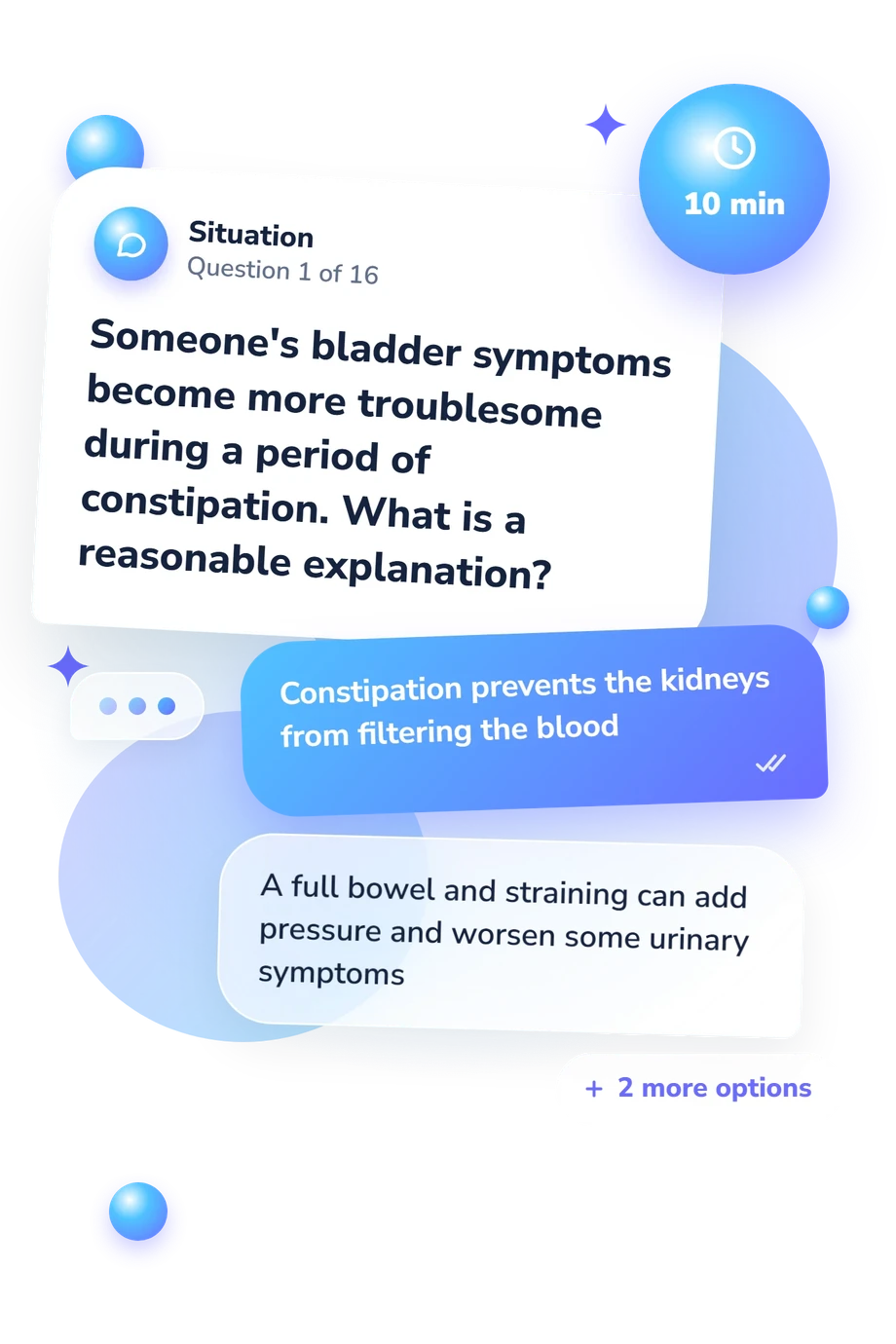
The questionnaire uses sixteen multiple-choice items built around short scenarios, definitions, and management decisions. Respondents select the most accurate option, testing recognition and practical reasoning rather than a narrative symptom history. Questions about urinary leakage patterns and safe responses sample knowledge about interpretation and action.
Its closest published comparison is the urinary-incontinence knowledge study by Branch and colleagues; this content is conceptually consistent with that work, not an adaptation. Shah and colleagues provide another knowledge-assessment reference, while Cameron and colleagues supply a current framework for overactive-bladder terminology and assessment priorities.
The displayed result is an unvalidated educational score summarizing performance across the knowledge items; it does not diagnose a condition or identify its cause. Its bands organize learning needs: lower results point to foundational topics for review, while higher results reflect broader understanding of the concepts tested. Answers may reflect guessing, prior education, wording interpretation, and current concerns. Use the result to guide reflection and care questions; persistent symptoms or urgent warning signs require appropriate medical attention.
- Branch, Laurence G., Laura A. Walker, Terrie T. Wetle, Catherine E. DuBeau, and Neil M. Resnick. “Urinary Incontinence Knowledge Among Community-Dwelling People 65 Years of Age and Older.” Journal of the American Geriatrics Society 42, no. 12 (1994): 1257-1261. 10.1111/j.1532-5415.1994.tb06507.x
- Shah, Aparna D., Michael P. Massagli, Neeraj Kohli, Sujatha S. Rajan, Kari P. Braaten, and Lennox Hoyte. “A Reliable, Valid Instrument to Assess Patient Knowledge About Urinary Incontinence and Pelvic Organ Prolapse.” International Urogynecology Journal 19, no. 9 (2008): 1283-1289. 10.1007/s00192-008-0631-x
- Cameron, Anne P., Doreen E. Chung, Elodi J. Dielubanza, Ekene Enemchukwu, David A. Ginsberg, Brian T. Helfand, Brian J. Linder, W. Stuart Reynolds, Eric S. Rovner, Lesley Souter, Anne M. Suskind, Elizabeth Takacs, Blayne Welk, and Ariana L. Smith. “The AUA/SUFU Guideline on the Diagnosis and Treatment of Idiopathic Overactive Bladder.” The Journal of Urology 212, no. 1 (2024): 11-20. 10.1097/JU.0000000000003985
Updated: