
I Like Two Guys How Do I Choose Quiz
How the Scales are Structured
Who Usually Takes This Test?
See How You Compare
Below is a preview of how scores are typically distributed across each scale.
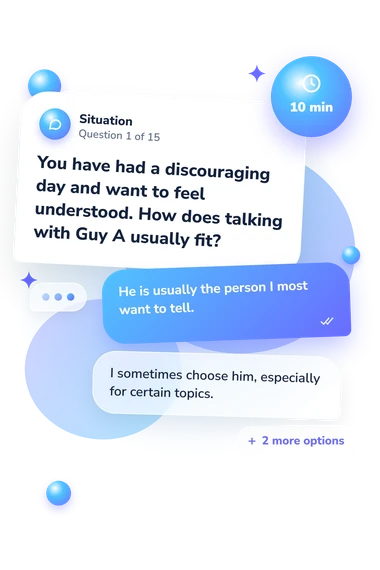
Example Questions From the Test
- He is usually the person I most want to tell.
- I sometimes choose him, especially for certain topics.
- I could talk to either guy and feel similarly supported.
- I am generally more drawn to Guy B for that kind of conversation.
- Guy A is usually my first thought.
- Guy B is the person I immediately want to contact.
- I would be equally happy telling either one.
- I usually tell Guy B once I have had time to take it in.
- I would still feel ready to choose the person I prefer.
- I would probably keep my current lean but use the extra time.
- I would want the week to understand my feelings better.
- I would feel relieved that I did not have to choose yet.
I Like Two Guys How Do I Choose Quiz - Description and methodology of the test
For someone weighing two romantic connections, this I Like Two Guys How Do I Choose Quiz offers a structured way to notice preference, uncertainty, and the wish for more space. It suits a reader seeking a how to choose between two guys quiz when several feelings compete. The result distinguishes each person's current affinity from a strong wish to postpone choosing, which may fit better for now.
What This Assessment Explores
The questionnaire compares each connection across ordinary, emotional, and future-oriented situations. Items ask whom you want to contact, how you handle disagreement, whose company feels natural, and whether postponing a decision brings tension, relief, or clarity. For a reader seeking an i like two guys quiz, this questionnaire captures present affinity rather than predicting relationship success.
Three dimensions shape results:
- Choose Guy A (0-15) records current affinity for A: Faint pull (0-5), Real possibility (6-10), or Strong pull (11-15).
- Choose Guy B (0-15) records current affinity for B: Faint pull (0-5), Real possibility (6-10), or Strong pull (11-15).
- Pause Before Choosing (0-15) indicates readiness: Ready to compare (0-5), More room needed (6-10), or Strong pull to pause (11-15). This is guidance, not an instruction.
Guy A and Guy B scores show current affinity; a pause score suggests postponing may fit better now.
Methodology and Evidence Base
Each item presents a situation with four response options about emotional contact, repair, everyday companionship, future fit, or having no deadline. You select the reaction that best matches your current experience in this how to pick between two guys quiz.
Responses form three parallel totals, but the questionnaire does not state how many points each option contributes. Guy A and Guy B totals indicate relative current affinity; scores within one point suggest a blended result. A high pause total suggests postponing a choice may currently fit better.
Themes are conceptually consistent with Pinquart, Stotzka, and Silbereisen (2009) on relationship ambivalence, Vennum and Fincham (2011) on romantic decision-making, and Joel, Stanton, Page-Gould, and MacDonald (2021) on changing commitment and intentions to end a relationship. This questionnaire is not an adaptation of those instruments. It helps someone use the i like two guys what should i do quiz to consider communication, boundaries, and whether to decide now or pause.
Self-report scores can shift with mood, recent interactions, expectations, and self-awareness. No standardized norms or clinical cutoffs are stated, so read the result as a structured snapshot alongside relationship pattern.
- Pinquart, Martin, Carolin Stotzka, and Rainer K. Silbereisen. "Development of Two Instruments for Assessment of Ambivalence Concerning the Beginning of an Intimate Relationship." Journal of Family Research, vol. 21, no. 2, 2009, pp. 194-207. 10.20377/jfr-226
- Vennum, Amber, and Frank D. Fincham. "Assessing Decision Making in Young Adult Romantic Relationships." Psychological Assessment, vol. 23, no. 3, 2011, pp. 739-751. 10.1037/a0023287
- Joel, Samantha, Sarah C. E. Stanton, Elizabeth Page-Gould, and Geoff MacDonald. "One Foot Out the Door: Stay/Leave Ambivalence Predicts Day-to-Day Fluctuations in Commitment and Intentions to End the Relationship." European Journal of Social Psychology, vol. 51, 2021, pp. 294-312. 10.1002/ejsp.2739