
How Smart Is My Dog Quiz
How the Scales are Structured
Who Usually Takes This Test?
See How You Compare
Below is a preview of how scores are typically distributed across each scale.
Example Questions From the Test
- Watch my hand without following the direction
- Follow the point directly to the indicated area
- Search generally but not in the pointed direction
- Look between me and the area, then investigate it
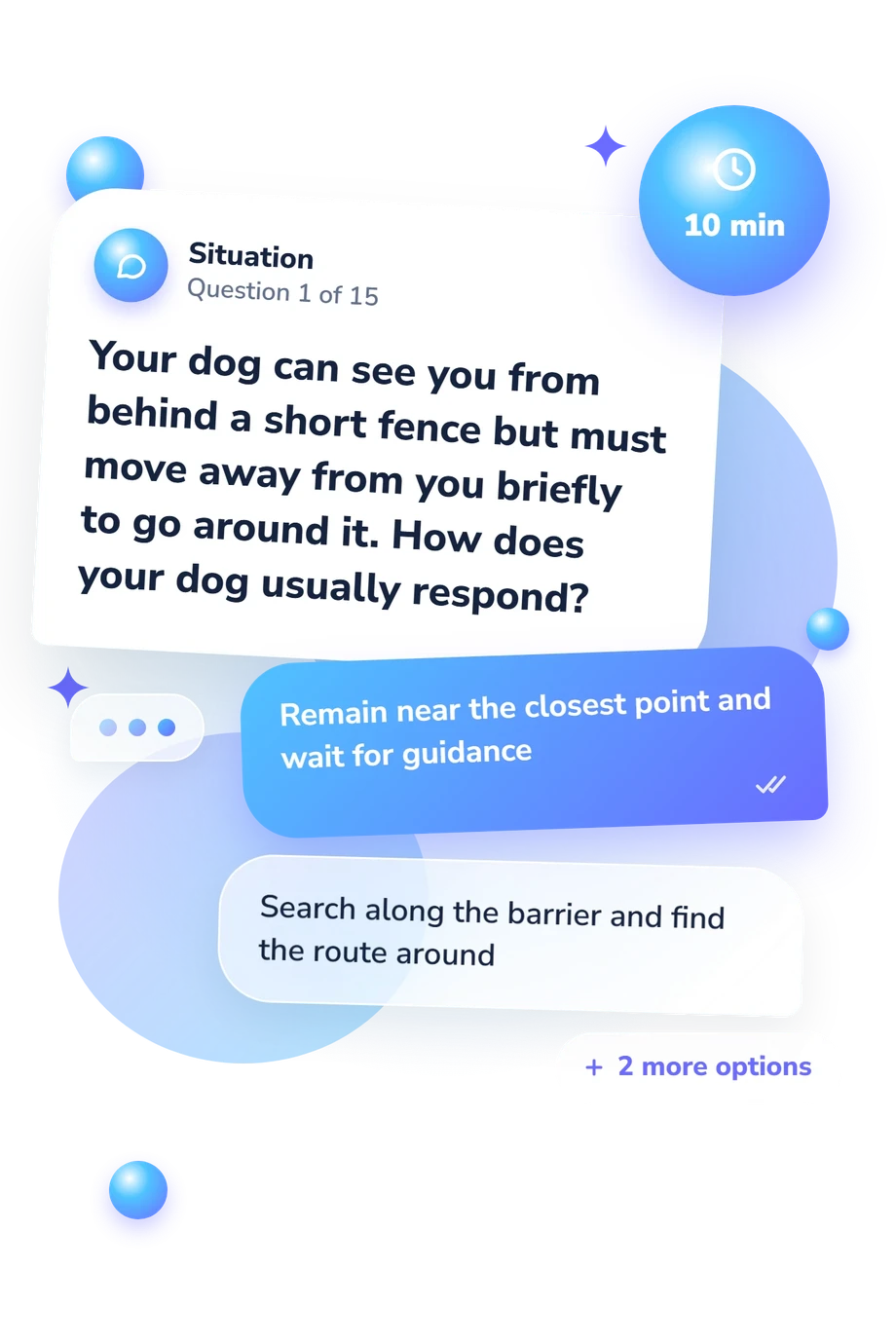
- Pause and wait at the usual route until someone intervenes
- Try the usual route repeatedly before accepting guidance
- Look for another route and find it after some exploration
- Quickly switch to a workable alternative route
- Choose the correct container directly or after one quick check
- Check containers without a clear preference for the hiding place
- Approach the correct area but inspect another container first
- Look to me for prompting before making a choice
How Smart Is My Dog Quiz - Description and methodology of the test
Dog owners who want to understand everyday strengths, rather than assign a single label, can use this assessment to organize observations about learning, flexibility, and communication. The How Smart Is My Dog Quiz turns those observations into a structured profile for the person completing it. Owners treating this as a how smart is your dog quiz can use the profile for practical training reflection rather than a simplistic verdict.
What This Assessment Explores
The questionnaire avoids ranking breeds or reducing intelligence to one label. Its situations cover new cues, routines, alternative routes, gesture-following, and attention-getting. The profile connects behavior with training choices.
The displayed scales cover these dimensions:
- Learning and Memory (0-15) reflects acquiring cues, retaining associations, and recalling information; Experience Dependent (0-5), Steady Learner (6-10), and Quick & Durable Learning (11-15) are the shown bands.
- Problem-Solving and Adaptability (0-15) reflects exploring alternatives when a familiar route fails; Familiar Routes (0-5), Flexible Explorer (6-10), and Inventive Solver (11-15) are the shown bands.
- Social Communication (0-15) reflects noticing human signals and directing attention toward wants or discoveries; Subtle/Independent (0-5), Responsive Partner (6-10), and Highly Attuned (11-15) are the shown bands.
These dimensions show where practice may help; the result reframes the question behind an is my dog dumb quiz as a profile, not a verdict.
Methodology and Scientific Basis
Each item presents a concrete situation with four descriptions of usual behavior. The respondent chooses the closest fit, so the result reflects their report of usual behavior across everyday situations rather than performance on one task. Online scoring converts responses into three displayed scores; the ranges and bands describe tendencies, but do not show how many points any answer contributes.
The smartDOG battery is a conceptually related published instrument involving human cues, response control, and spatial challenges. This questionnaire is conceptually consistent with that framework, but is not an adaptation of the battery. Research by Junttila and colleagues links cognitive traits with everyday behavior, while work by Pongrácz and colleagues supports owner-reported memory.
This focused dog intelligence test is an informal online profile of learning and memory, problem-solving and adaptability, and social communication, not a global cognitive score. Its bands are descriptive categories, not population-norm comparisons unless documented. Scores may reflect training history, reward value, hearing, age, mobility, attention, motivation, stress, expectations, and setting. A lower result may describe the respondent's circumstances rather than a fixed limit on the dog’s capacity.
- Junttila, Saara, Anna Valros, Katariina Mäki, Heli Väätäjä, Elisa Reunanen, and Katriina Tiira. "Breed differences in social cognition, inhibitory control, and spatial problem-solving ability in the domestic dog (Canis familiaris)." Scientific Reports 12(1), 22529 (2022). 10.1038/s41598-022-26991-5
- Junttila, Saara, Anna Valros, Katariina Mäki, and Katriina Tiira. "Do cognitive traits associate with everyday behaviour in the domestic dog, Canis familiaris?" Animal Behaviour 213 (2024): 71-84. 10.1016/j.anbehav.2024.04.012
- Pongrácz, Péter, Veronika Benedek, Sybille Enz, and Ádám Miklósi. "The owners' assessment of 'everyday dog memory': A questionnaire study." Interaction Studies 13(3) (2012): 386-407. 10.1075/is.13.3.04pon
Updated: