
Hopeless Romantic Quiz
How the Scales are Structured
Who Usually Takes This Test?
See How You Compare
Below is a preview of how scores are typically distributed across each scale.
Example Questions From the Test
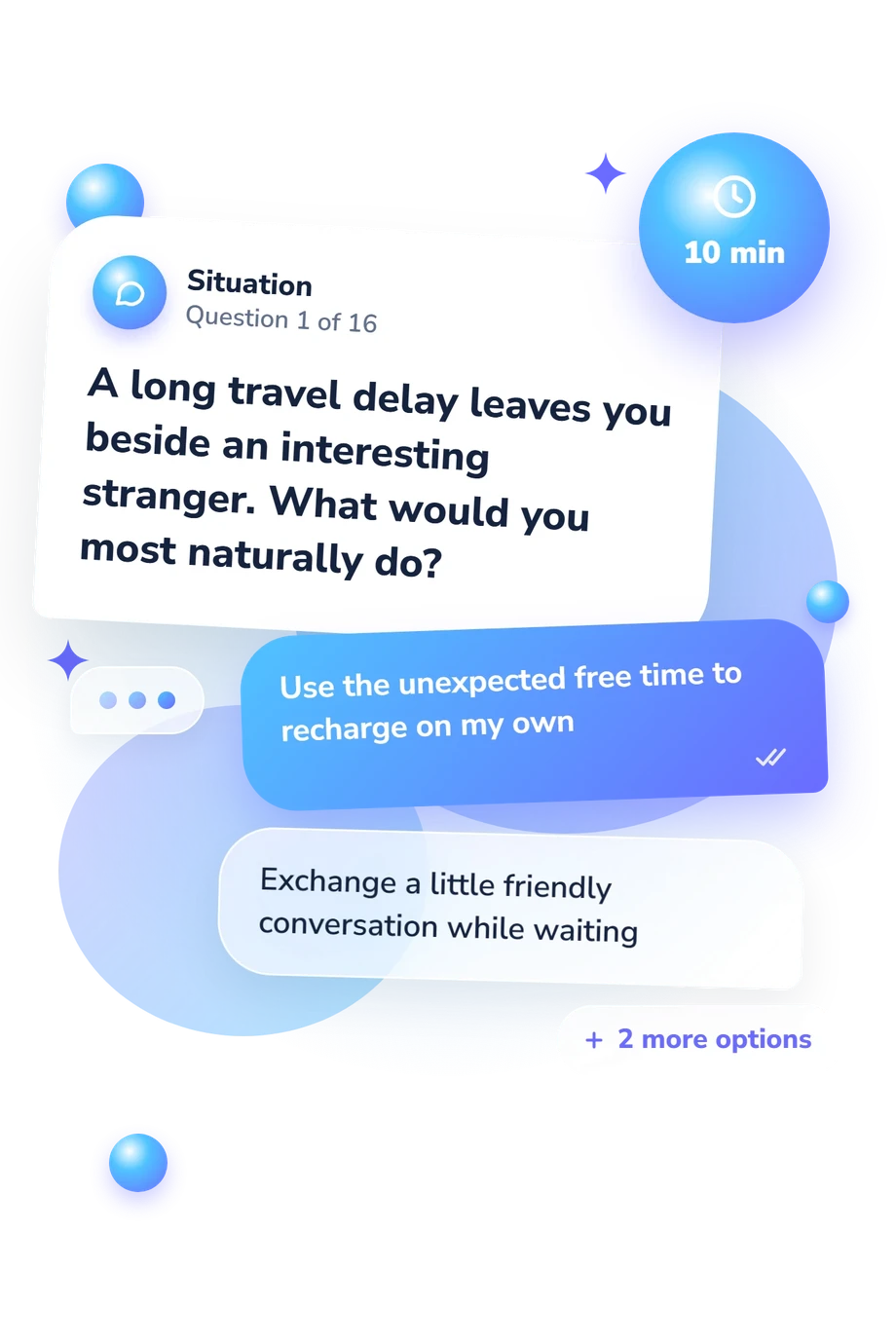
- Use the unexpected free time to recharge on my own
- Exchange a little friendly conversation while waiting
- Suggest a game or shared snack to make the delay more fun
- Turn the delay into a spontaneous mini-adventure together
- A calm conversation confirming that you understand each other
- A sincere message explaining what the relationship means
- An unexpected visit with something personally symbolic
- A sweeping declaration that turns the moment into a shared story
- Spending relaxed, uninterrupted time together
- Giving a keepsake connected to an inside joke
- Re-creating an important early date as a surprise
- Designing a sequence of clues that ends in a dramatic reveal
Hopeless Romantic Quiz - Description and methodology of the test
For readers curious about how they imagine love, the hopeless romantic quiz offers a structured way to examine the stories, gestures, and relationship rhythms that feel most appealing. It suits people reflecting on dependable everyday closeness and a warm shared life, alongside emotional spectacle, serendipity, or gradual intimacy; independence marks the low-score end of the first continuum. The result supports romantic self-reflection about preferred ways to experience and express romance.
What This Assessment Explores
Items use imagined dates, support, reunions, meeting stories, and future-home scenarios to reveal preferred romantic pacing and symbolism. The result shows which romantic ideals, relationship rhythms, and forms of connection appeal most strongly; close scores may combine into a blended profile of romantic preferences. The four dimensions are:
- Cozy Ever-After Romantic (0-12) measures shared life: Independent Romance (0-4) favors space; Warm Partnership (5-8) balances closeness; Cozy Ever-After (9-12) values care.
- Grand Gesture Dreamer (0-12) measures expressive love: Quiet Expression (0-4) prefers restraint; Selective Spectacle (5-8) welcomes sincerity; Cinematic Heart (9-12) seeks drama.
- Meet-Cute Adventurer (0-12) measures openness to surprise: Intentional Connection (0-4) favors clear beginnings; Open to Serendipity (5-8) welcomes chance; Chance-Encounter Hero (9-12) enjoys adventure.
- Slow-Burn Soulmate (0-12) measures gradual intimacy: Quick Spark (0-4) favors immediacy; Gradual Chemistry (5-8) values steady growth; Earned Intimacy (9-12) prizes patience and trust.
Methodology and Scientific Basis
Each item presents a romantic situation with four response options, ranging from private space to shared ritual, quiet feeling to dramatic expression, and immediate chemistry to slow development. Responses form four 0-12 scores rather than one total: the highest marks the strongest affinity, while scores within one point are read together as a blended result.
The framework is conceptually consistent with the Romantic Beliefs Scale of Sprecher and Metts (1989), which treats romantic expectations as beliefs; the scale supplies a conceptual comparison for romantic expectations. Pearson, Child, and Carmon (2011) is only a thematic parallel because it examines dating rituals and shared practices. Neither source validates this questionnaire’s four scales. The four scales and the blended-result rule are specific to this questionnaire.
This questionnaire makes romantic patterns easier to notice. Compare the four scores to see whether one affinity leads or nearby results suggest a blended pattern. Mood, recent experiences, cultural ideals, and self-awareness can shape responses, so scores may vary with context and should be read as a profile rather than a permanent identity.
- Sprecher, Susan, and Sandra Metts. (1989). Development of the 'Romantic Beliefs Scale' and Examination of the Effects of Gender and Gender-Role Orientation. Journal of Social and Personal Relationships, 6(4), 387-411. 10.1177/0265407589064001
- Sprecher, Susan, and Sandra Metts. (1999). Romantic Beliefs: Their Influence on Relationships and Patterns of Change Over Time. Journal of Social and Personal Relationships, 16(6), 834-851. 10.1177/0265407599166009
- Pearson, Judy C., Jeffrey T. Child, and Anna F. Carmon. (2011). Rituals in Dating Relationships: The Development and Validation of a Measure. Communication Quarterly, 59(3), 359-379. 10.1080/01463373.2011.583502
Updated: