
HHHHHMM Scale Quiz
How the Scales are Structured
Who Usually Takes This Test?
See How You Compare
Below is a preview of how scores are typically distributed across each scale.
Example Questions From the Test
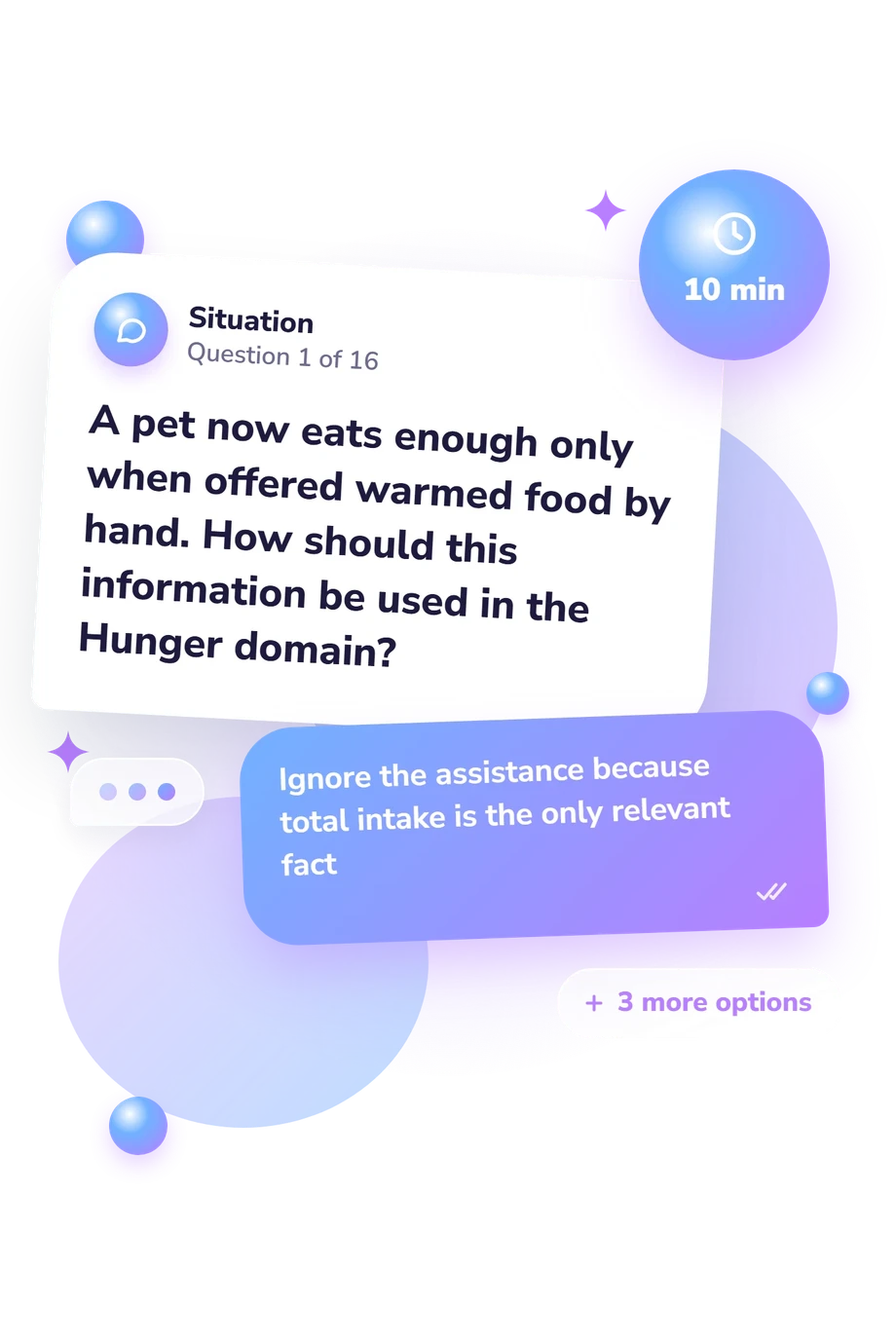
- Ignore the assistance because total intake is the only relevant fact
- Give the highest score because hand-feeding proves normal appetite
- Score only the type of food, not the pet’s willingness or ability to eat
- Consider actual intake, willingness to eat, and the amount of support required
- Ignore it because only the total can be meaningful
- Investigate the specific change and contact a veterinarian promptly if it is concerning or persists
- Raise another domain’s score to keep the total comparable
- Conclude that the animal’s overall quality of life is necessarily unacceptable
- 70
- 35
- 10
- 100
HHHHHMM Scale Quiz - Description and methodology of the test
People who want a clearer way to discuss a companion animal’s comfort and daily function can use the HHHHHMM Scale Quiz as a guided learning tool. For a caregiver assessing a cat, this cat quality of life quiz organizes observations about eating, mobility, hygiene, comfort, and engagement while showing why a total should be considered alongside the animal’s day-to-day experience.
What This Assessment Explores
The questionnaire focuses on seven domains that help caregivers describe comfort and function without jumping to a diagnosis. Used as a quality of life quiz, it helps users notice changes, compare observations across days, and prepare focused questions for a veterinarian. The result reflects understanding of the framework and its interpretation.
Seven domains are used to organize the observations behind the result:
- Hurt shows whether pain, discomfort, or breathing difficulty seems controlled.
- Hunger captures intake, willingness to eat, and feeding support required.
- Hydration considers fluid intake and possible signs of dehydration.
- Hygiene reflects cleanliness, skin protection, and freedom from prolonged soiling.
- Happiness reflects interest in familiar people, surroundings, and enjoyable activities.
- Mobility considers comfortable movement, including effective available assistance.
- More good days than bad summarizes comfort, function, engagement, and distress over time.
Methodology and Evidence Base
Each item presents a practical observation or interpretation problem with answer choices. The self-report format tests application of the seven-domain framework, including assistance, change over time, separate domain scores, and urgent symptoms.
The displayed result is HHHHHMM Scale Knowledge, scored 0-16. “Foundation to build” covers 0-6, “Developing knowledge” 7-12, and “Strong knowledge” 13-16. These bands describe understanding of the framework, not an animal’s condition.
The HHHHHMM Quality of Life Scale (Villalobos, 2004) provides the framework, while this HHHHHMM scale questionnaire presents it as a knowledge exercise. Villalobos and Kaplan (2007) discuss the seven-domain approach, and Testoni et al. (2023) report validation work on the HHHHHMM scale in an Italian context; that evidence does not validate this online knowledge score.
Because the quiz has no standardized clinical cutoff, answers remain sensitive to self-awareness, observer differences, and current context. Use the result to organize observations and questions; severe or sudden symptoms require prompt veterinary attention regardless of the knowledge band.
- Testoni, Ines; De Vincenzo, Ciro; Campigli, Michela; Caregnato Manzatti, Aljosha; Ronconi, Lucia; Uccheddu, Stefania. "Validation of the HHHHHMM Scale in the Italian Context: Assessing Pets' Quality of Life and Qualitatively Exploring Owners' Grief." Animals. 2023;13(6):1049. 10.3390/ani13061049.
- Villalobos, Alice E. "Quality of Life Scale Helps Make Final Call." Veterinary Practice News, September 2004.
- Villalobos, Alice, with Laurie Kaplan. Canine and Feline Geriatric Oncology: Honoring the Human-Animal Bond. 1st ed. Ames, Iowa: Blackwell Publishing, 2007. 10.1002/9780470344446.
Updated: