
Hero or Villain Quiz
How the Scales are Structured
Who Usually Takes This Test?
See How You Compare
Below is a preview of how scores are typically distributed across each scale.
Example Questions From the Test
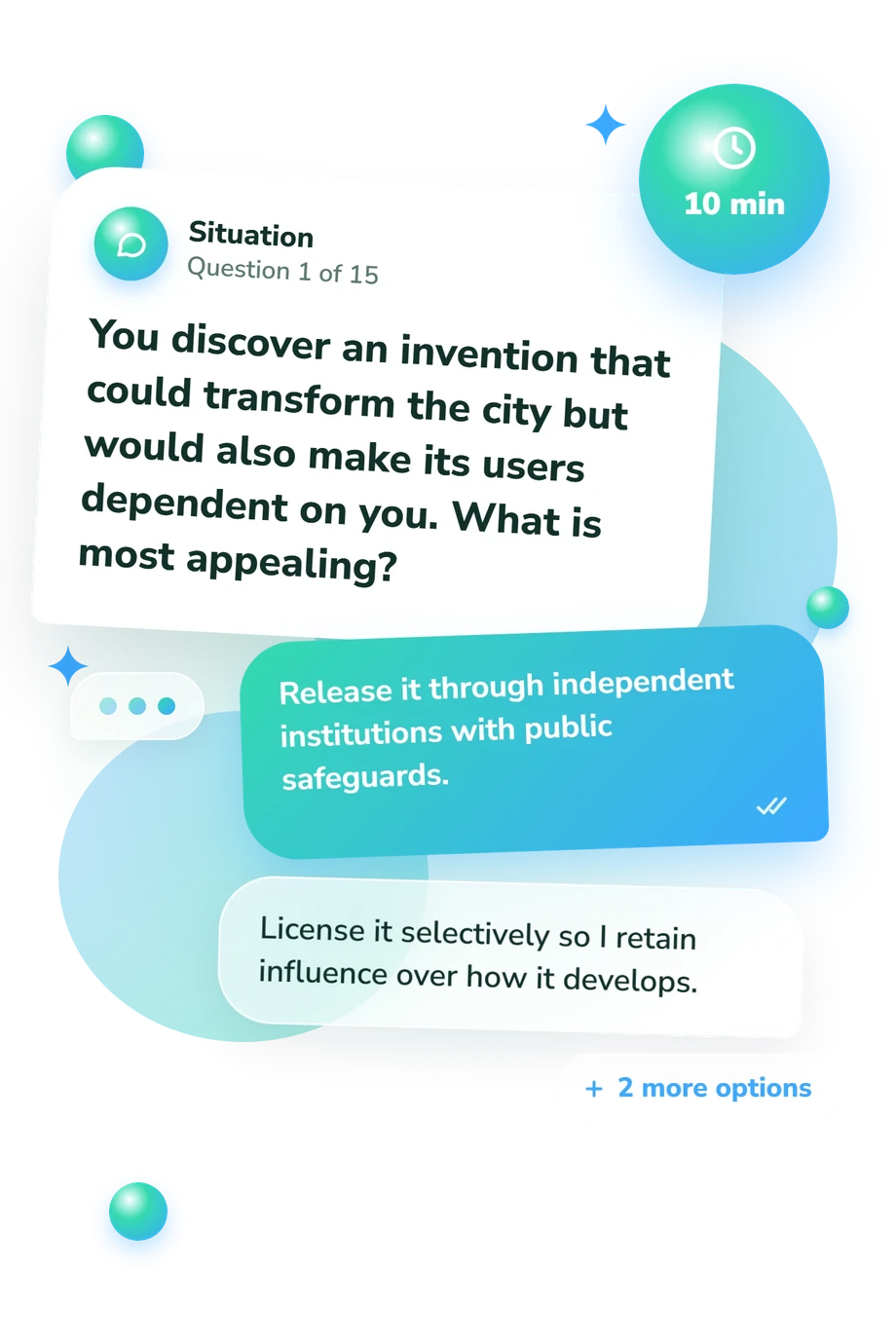
- Release it through independent institutions with public safeguards.
- License it selectively so I retain influence over how it develops.
- Keep it available only for emergencies until its effects are understood.
- Build the city's future around it, ensuring that every major decision leads back to me.
- A welcoming city base where allies and residents can ask for help.
- A mobile hideout that supports missions without tying me to one place.
- A discreet operations center hidden behind a respectable public identity.
- An unmistakable fortress designed to project the scale of my vision.
- Pause the conflict and determine whether the newcomer has exposed a genuine flaw.
- Adapt the plan and offer the newcomer a place in it if their talent is useful.
- Withdraw for now, preserving resources for a better opportunity.
- Turn their interference into the centerpiece of an even more ambitious scheme.
Hero or Villain Quiz - Description and methodology of the test
Readers who enjoy moral dilemmas, comic-book archetypes, and character-driven stories can use the hero or villain quiz to compare duty, independence, compromise, loyalty, and control in fictional situations. Readers wondering whether they are heroic or villainous can use this character archetype quiz to reflect on those competing motives. The result describes a fictional-role affinity rather than judging real-world character or predicting conduct.
What This Assessment Explores
Rather than sorting people into good and evil, this moral dilemma quiz explores fictional choices about duty, independence, compromise, influence, and control. It suits readers considering heroic, villainous, or mixed roles. The three result dimensions are:
- Antihero Affinity (0-15) shows antiheroic affinity: Clear-Code Approach (0-5) favors structured action; Pragmatic Rebel (6-10) bends expectations; Reluctant Renegade (11-15) uses personal codes and unconventional methods.
- Hero Affinity (0-15) shows heroic affinity: Independent Path (0-5) leans away from classic duty; Emerging Protector (6-10) shows a heroic streak; Champion Spirit (11-15) centers protecting others.
- Villain Affinity (0-15) shows villainous affinity: Counterweight Energy (0-5) limits villainous appeal; Strategic Challenger (6-10) allows selective ambition or control; Mastermind Presence (11-15) emphasizes vision, calculated influence, and theatricality.
Methodology and Evidence Base
Each item presents a fictional dilemma with four response options. The choices contrast public duty, personal freedom, strategic compromise, loyalty, reputation, and control, so an answer shows which course feels compelling in a story. Taken as a fictional role assessment, the questionnaire covers heroic, villainous, and antiheroic choices rather than asking for direct trait ratings.
The three displayed scores are compared: the highest indicates the strongest fictional affinity, while scores within one point produce a blended result.
Doyle et al. (2025) is the closest conceptual reference, linking admiration for heroes, antiheroes, and villains with socially aversive personality features. Eden et al. (2015) addresses how moral violations and personality traits shape impressions of these characters, while Bergstrand and Jasper (2018) explain their social meanings. The questionnaire is conceptually consistent with these studies, not an adaptation of any one of them.
The online scores have no presented norms or reliability evidence, and self-report may reflect current mood, genre familiarity, or self-presentation, so the profile can vary with the respondent’s context.
- Doyle, E. K., Kay, C. S., & Arrow, H. (2025). Rating Heroes, Antiheroes, and Villains: Machiavellianism, Grandiose Narcissism, Psychopathy, and Sadism Predict Admiration for and Perceived Similarity to Morally Questionable Characters. Psychology of Popular Media, 14(3), 495-501. 10.1037/ppm0000571
- Eden, A., Oliver, M. B., Tamborini, R., Limperos, A., & Woolley, J. (2015). Perceptions of Moral Violations and Personality Traits Among Heroes and Villains. Mass Communication and Society, 18(2), 186-208. 10.1080/15205436.2014.923462
- Bergstrand, K., & Jasper, J. M. (2018). Villains, Victims, and Heroes in Character Theory and Affect Control Theory. Social Psychology Quarterly, 81(3), 228-247. 10.1177/0190272518781050
Updated: