
Harry Potter Blood Status Quiz
How the Scales are Structured
Who Usually Takes This Test?
See How You Compare
Below is a preview of how scores are typically distributed across each scale.
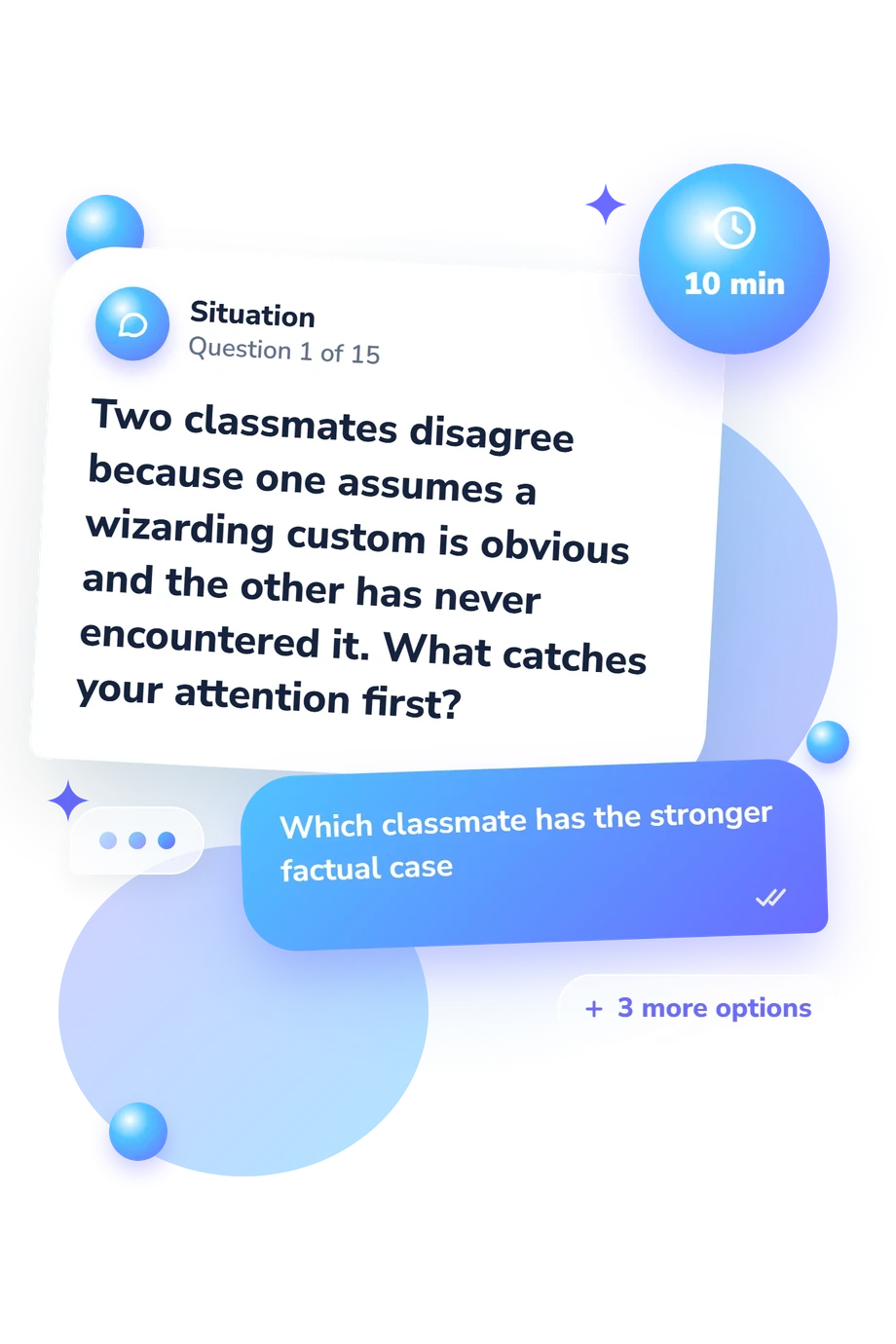
Example Questions From the Test
- Which classmate has the stronger factual case
- How the custom developed within wizarding history
- What each person is assuming from their own background
- How a clearer shared rule could prevent the same confusion
- Whether changing one step would reveal a more useful method
- The historical reason the method became standard
- How experienced potion-makers adapt the method in practice
- Mastering the accepted instructions before considering alternatives
- Observe quietly until the meanings become clear from context
- Ask direct questions and build my own glossary as I learn
- Find one experienced classmate whose explanations I can rely on
- Focus on practical lessons and leave cultural details for later
Harry Potter Blood Status Quiz - Description and methodology of the test
For readers who enjoy the wizarding world, the Harry Potter Blood Status Quiz offers a playful way to examine relationships with tradition, discovery, and cultural blending. The blood status quiz turns fictional categories into reflective profiles about learning, adapting, preserving customs, and connecting different frames of reference. Results can show a leading tendency or blended pattern without treating blood status as a measure of worth.
What the Results Explore
The scenarios give this Harry Potter blood status test its focus: inheritance, not superiority or prejudice, plus magical and Muggle frames, customs, family history, learning, technology, travel, and method choices.
The displayed profiles are:
- Half-blood (0-15) reflects affinity with navigating, translating, and combining magical and Muggle frames: Single-Context Lean (0-5) favors one; Flexible Connector (6-10) bridges both; Natural Bridge (11-15) interprets both and creates a blended identity.
- Muggle-born (0-15) reflects affinity with discovering magic as a newcomer, learning without inherited assumptions, and bringing a fresh perspective: Established-World Lean (0-5) favors continuity; Curious Arrival (6-10) learns while retaining familiarity; Fresh-Eyed Explorer (11-15) questions old assumptions.
- Pure-blood (0-15) reflects affinity with inherited traditions, family history, and established customs-not superiority or prejudice: Independent Path (0-5) limits legacy; Selective Traditionalist (6-10) chooses what fits; Heritage-Centered (11-15) centers family lore.
Close scores show a blended profile.
Methodology and Evidence Base
Each item presents a situation with four reactions. Choices contrast preserving customs, independent learning, combining old and new methods, or following an established guide. Respondents choose what feels natural, capturing preferred orientation rather than book knowledge or wizarding rules.
The result compares three profiles; scores within one point appear as a blended match. Because individual point values are unstated, displayed bands are catalogue-defined interpretations, not a reconstructable scoring formula.
Conceptually, the BII-2 is a related published instrument, not the source instrument for these fictional profiles; it examines how compatible, blended, or separate cultural frames feel. Benet-Martínez and Haritatos's 2005 identity-integration model provides related theory, while Ang and colleagues' 2007 work connects cross-cultural perspective taking with judgment and adaptation. This questionnaire is conceptually consistent with these works, not an adaptation or standardized administration of them.
As an online self-report questionnaire, it produces a fictional blood status profile without stated population norms or clinical cutoffs. Responses may shift with mood, self-awareness, or the appeal of a particular identity, so the profile is best used for reflective exploration.
- Huynh, Que-Lam, Verónica Benet-Martínez, and Angela-MinhTu D. Nguyen. (2018). Measuring variations in bicultural identity across U.S. ethnic and generational groups: Development and validation of the Bicultural Identity Integration Scale-Version 2 (BIIS-2). Psychological Assessment, 30(12), 1581-1596. 10.1037/pas0000606
- Benet-Martínez, Verónica, and Jana Haritatos. (2005). Bicultural identity integration (BII): Components and psychosocial antecedents. Journal of Personality, 73(4), 1015-1049. 10.1111/j.1467-6494.2005.00337.x
- Ang, Soon, Linn Van Dyne, Christine Koh, K. Yee Ng, Klaus J. Templer, Cheryl Tay, and N. Anand Chandrasekar. (2007). Cultural Intelligence: Its Measurement and Effects on Cultural Judgment and Decision Making, Cultural Adaptation and Task Performance. Management and Organization Review, 3(3), 335-371. 10.1111/j.1740-8784.2007.00082.x
Updated: