
Hair Loss Quiz
How the Scales are Structured
Who Usually Takes This Test?
See How You Compare
Below is a preview of how scores are typically distributed across each scale.
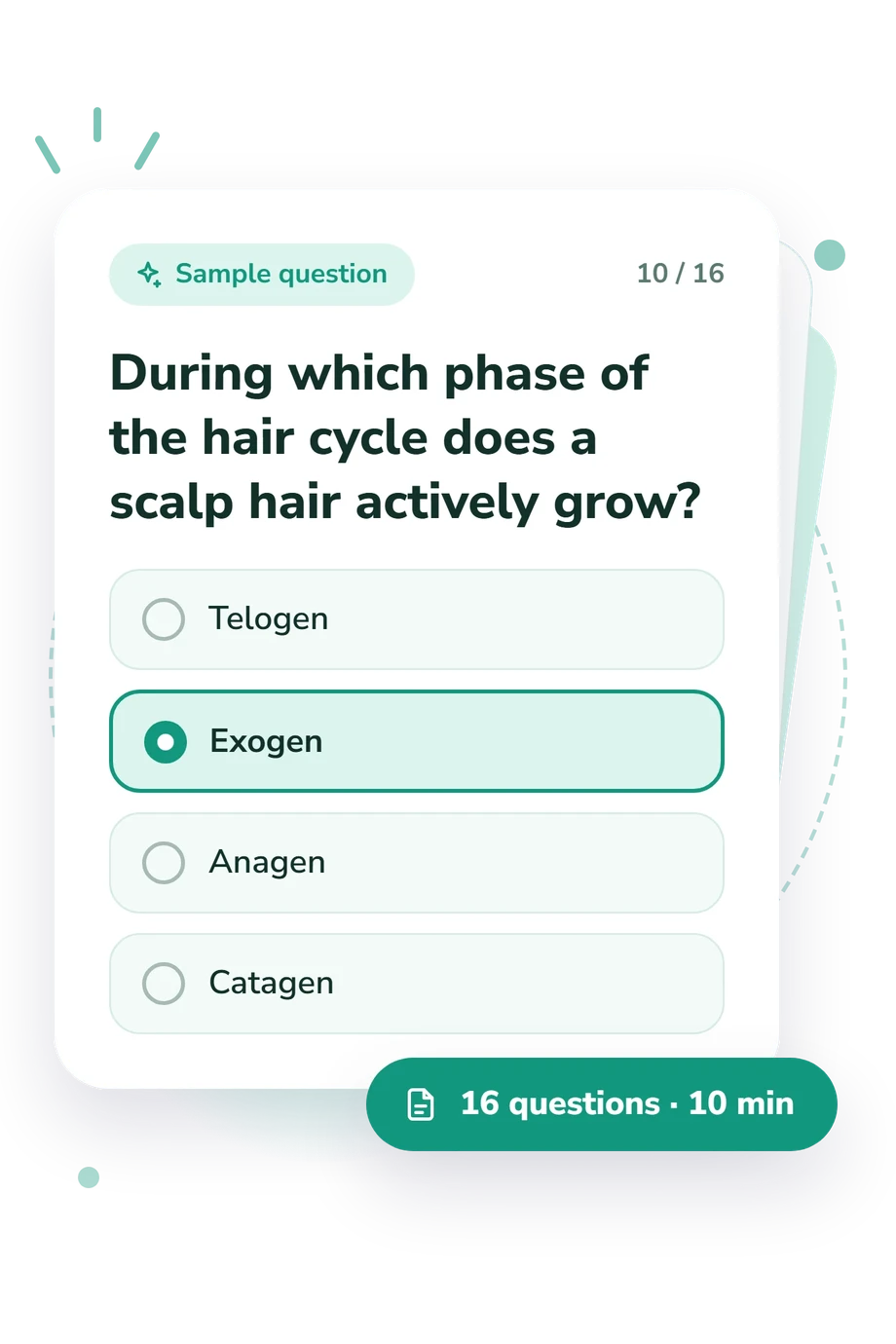
Example Questions From the Test
- About 1-5 hairs
- About 50-100 hairs
- About 300-500 hairs
- More than 1,000 hairs
- Normal adult pattern hair loss beginning early
- Ordinary graying of the hair shaft
- Temporary shedding caused solely by shampoo frequency
- A fungal scalp infection such as tinea capitis
- Telogen
- Exogen
- Anagen
- Catagen
Hair Loss Quiz - Description and methodology of the test
People who want to understand shedding, thinning, or scalp changes can use this hair loss quiz to review practical knowledge about common hair-loss scenarios. It is intended for readers comparing patterns, warning signs, and evaluation steps across situations involving illness, styling, family history, or scalp symptoms. It also functions as a hair loss knowledge test, giving an overall educational result rather than separate topic scores.
What This Assessment Explores
Questions link hair changes with explanations, distinguishing shaft breakage, inherited pattern loss, temporary diffuse shedding, smooth patches, traction, and inflammatory concerns. Timing, family history, styling, illness, childbirth, and scalp symptoms shape scenarios.
One item addresses an am I balding quiz concern through gradual temple or crown thinning with similar changes in relatives. The Hair Loss Knowledge result gives an overall educational level based on the questionnaire's keyed concepts.
The question themes are:
- Pattern recognition shows how well you connect recession, crown thinning, patches, or diffuse shedding with plausible explanations.
- Warning-sign awareness reflects recognition of symptoms that make timely evaluation more important.
- Evaluation and care knowledge covers history, examination, testing, supplements, topical treatment, and transplant expectations.
Together, these themes contribute to the Hair Loss Knowledge scale, scored from 0-16: Foundations to build (0-6), Developing knowledge (7-12), and Strong knowledge (13-16).
Methodology and Scientific Basis
Each item presents a scenario or factual prompt with four answer choices. The options test patterns, timing, triggers, warning signs, and care decisions. Responses form one educational total: a higher result reflects understanding of the keyed concepts, not the amount of hair shedding.
Alopecia-related items address whether someone may have alopecia-the concern expressed in a do I have alopecia quiz-through smooth patches, diffuse post-illness or postpartum loss, traction, breakage, and possible scarring signs.
The method is conceptually consistent with Mubki et al. (2014), whose framework places history and examination first, with trichoscopic and laboratory evaluation when indicated. Its attention to alopecia areata patterns also accords with Inui et al. (2008). This questionnaire is conceptually consistent with those works, not an adaptation of either study.
Interpret the bands as educational categories, not validated diagnostic or clinical cutoffs; this online knowledge questionnaire may reflect prior learning, guessing, and wording interpretation, so it cannot identify the cause of hair loss or replace prompt assessment for rapid or patchy loss, scalp pain, redness, scaling, pus, burning, or reduced follicular openings.
- Thamer Mubki, Lidia Rudnicka, Malgorzata Olszewska, and Jerry Shapiro. Evaluation and diagnosis of the hair loss patient: part I. History and clinical examination. Journal of the American Academy of Dermatology. 2014;71(3):415.e1-415.e15. 10.1016/j.jaad.2014.04.070
- Thamer Mubki, Lidia Rudnicka, Malgorzata Olszewska, and Jerry Shapiro. Evaluation and diagnosis of the hair loss patient: part II. Trichoscopic and laboratory evaluations. Journal of the American Academy of Dermatology. 2014;71(3):431.e1-431.e11. 10.1016/j.jaad.2014.05.008
- Shigeki Inui, Takeshi Nakajima, Koichi Nakagawa, and Satoshi Itami. Clinical significance of dermoscopy in alopecia areata: analysis of 300 cases. International Journal of Dermatology. 2008;47(7):688-693. 10.1111/j.1365-4632.2008.03692.x
Updated: