
Guess the Intro Music Quiz
How the Scales are Structured
Who Usually Takes This Test?
See How You Compare
Below is a preview of how scores are typically distributed across each scale.
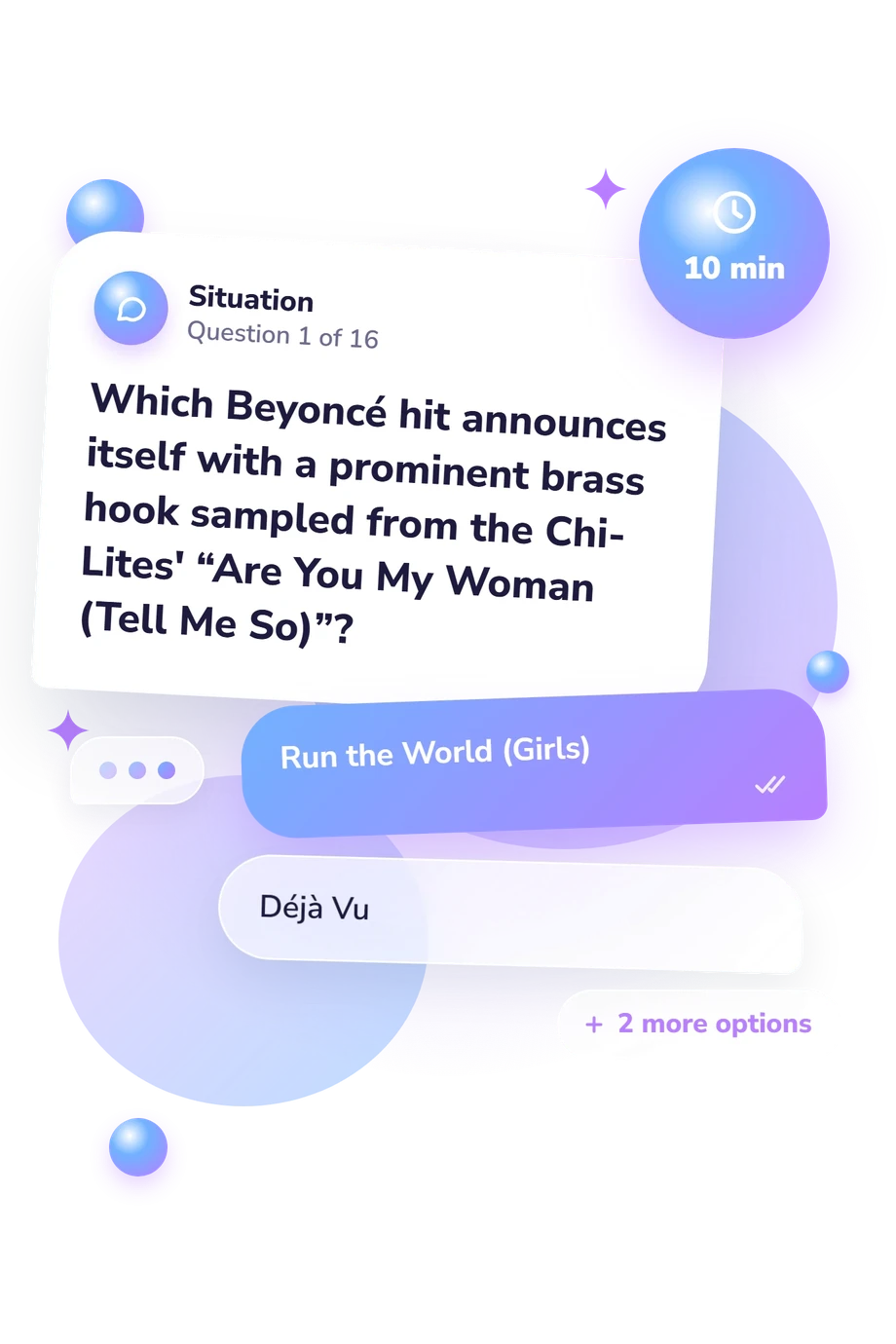
Example Questions From the Test
- Run the World (Girls)
- Déjà Vu
- Single Ladies (Put a Ring on It)
- Crazy in Love
- Highway Star
- Woman from Tokyo
- Black Night
- Smoke on the Water
- Paradise City
- Sweet Child o' Mine
- November Rain
- Welcome to the Jungle
Guess the Intro Music Quiz - Description and methodology of the test
Whether you are a casual listener, playlist builder, or longtime fan, the Guess the Intro Music Quiz offers a focused way to examine how familiar songs come to mind from distinctive openings. Its music intros quiz format concentrates on recognition sparked by riffs, voices, lyrics, rhythm, and production details rather than on performance skill. The result gives you a compact picture of your recall for the songs represented here.
What This Assessment Explores
The questions measure recognition of song openings through verbal clues. They cover riffs, vocal entrances, memorable first lines, grooves, and studio textures, asking you to connect each detail with a known recording. A song intro quiz in this format examines access to musical memories, not singing or instrumental skill.
The main clue groups are:
- Riffs and chord figures show how readily distinctive instrumental patterns trigger a title.
- Voices and lyrics show how strongly opening words or vocal textures support recall.
- Rhythm and production details show whether beat, bass, timbre, or recording texture narrows the choice.
Answers combine into Intro Music Knowledge (0-16), a descriptive result about the sampled openings. Opening Act (0-6) indicates more difficulty; Building the Set (7-12) reflects recognition with some gaps; Intro Expert (13-16) reflects strong recognition of distinctive details. It does not measure overall musical ability.
Methodology and Scientific Basis
The forced-choice format makes this intro quiz a recognition task: each item presents a verbal opening clue with four song titles. It tests identification under constrained alternatives rather than open-ended recall or performance, while distinguishing familiarity from successful title retrieval. All responses feed one overall result.
Its psychological basis is recognition-memory research. Jimenez et al. (2023) examined identification from piano-driven opening chords; Hébert and Peretz (1997) showed that melodic and temporal information both contribute to long-term music recognition; and Kostic and Cleary (2009) distinguished familiarity from successful naming.
The questionnaire is conceptually consistent with these findings, but it is not an adaptation of those studies; its categories are descriptive rather than population norms. Performance may shift with prior exposure, cultural familiarity, current memory accessibility, or whether a lyric, riff, timbre, or production detail triggers recall. Read the outcome as a snapshot of recognition for this set of recordings.
- Jimenez, I., Kuusi, T., Czedik-Eysenberg, I., & Reuter, C. (2023). Identifying songs from their piano-driven opening chords. Musicae Scientiae, 27(1), 27-53. 10.1177/10298649211003631
- Hébert, S., & Peretz, I. (1997). Recognition of music in long-term memory: Are melodic and temporal patterns equal partners? Memory & Cognition, 25(4), 518-533. 10.3758/BF03201127
- Kostic, B. N., & Cleary, A. M. (2009). Song recognition without identification: When people cannot “Name That Tune” but can recognize it as familiar. Journal of Experimental Psychology: General, 138(1), 146-159. 10.1037/a0014584
Updated: