
Groups of Animals Quiz
How the Scales are Structured
Who Usually Takes This Test?
See How You Compare
Below is a preview of how scores are typically distributed across each scale.
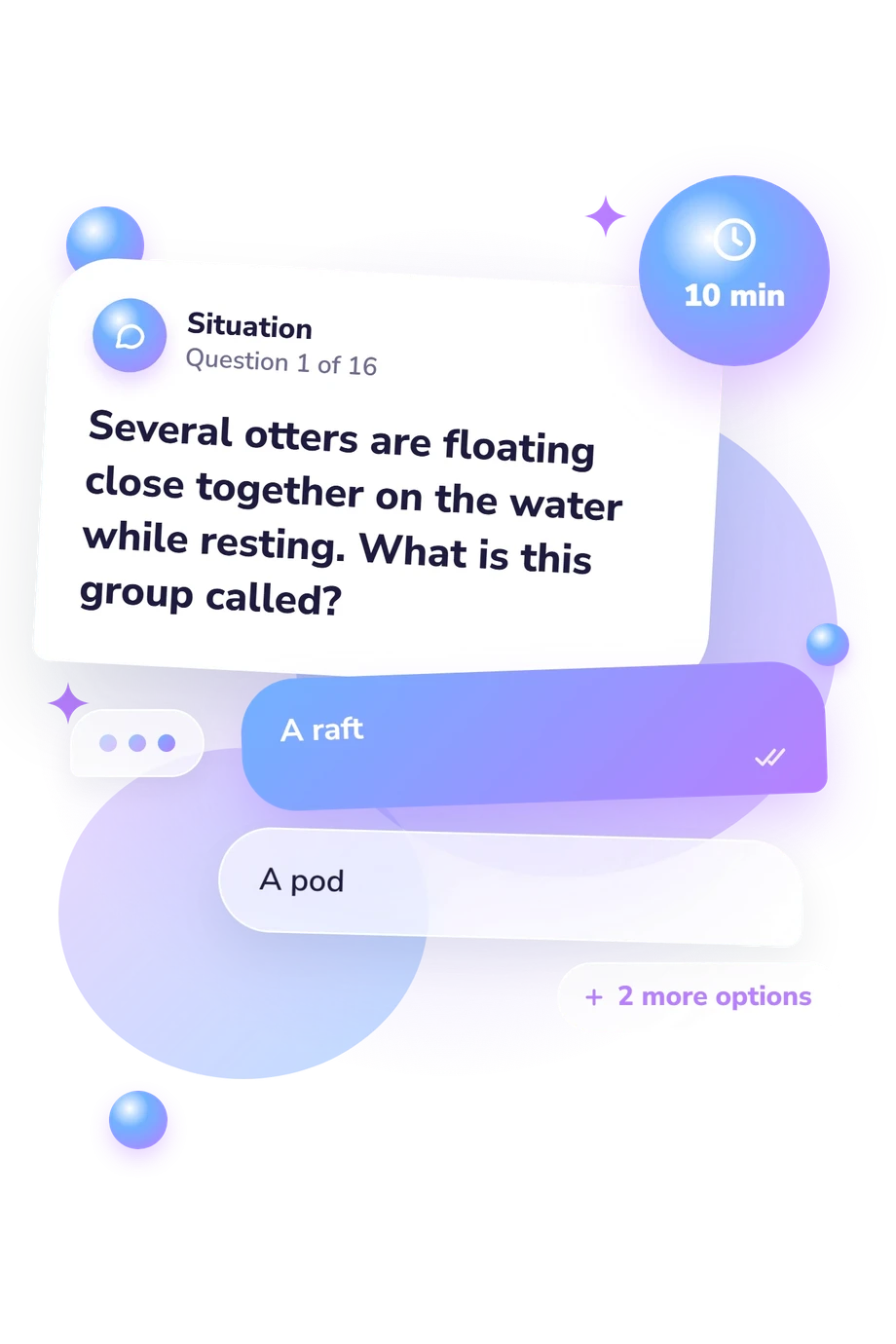
Example Questions From the Test
- A raft
- A pod
- A school
- A rookery
- A crash
- A herd
- A pride
- A troop
- A brood
- A litter
- A kennel
- A pack
Groups of Animals Quiz - Description and methodology of the test
Readers who enjoy language, natural history, or vocabulary challenges can use the groups of animals quiz to check how confidently they recognize collective nouns. For curious learners and teachers planning an informal activity, this quiz about animal group names offers a focused self-check. The questions test recall and context-sensitive word choice, while the result indicates terms to review.
What This Assessment Explores
The questions assess familiar, common, distinctive, and context-specific animal collective nouns whose use depends on species or situation. Examples include wolf packs, dolphin pods, and less familiar expressions. A quiz about animal groups as collectives tests vocabulary recall and contextual selection, not animal biology.
The result records correct answers and shows whether knowledge extends from common names to distinctive, context-specific terms. It can guide informal practice or classroom discussion.
The Groups of Animals Knowledge scale (0-16) is interpreted through three bands:
- Building Foundations (0-6) means you recognize some familiar group names but may confuse terms for different species or situations.
- Developing Knowledge (7-12) means you know many common terms and can apply several in context, with room to learn less familiar names.
- Strong Knowledge (13-16) means you accurately identify most common and distinctive animal group terms, including context-specific examples.
Methodology and Evidence Base
Each item presents a short language situation with four choices. The respondent selects the noun that best fits the species and circumstances, combining recognition with attention to context. The result counts correct responses and places performance in the corresponding band.
Prompts may test a species pairing, social arrangement, or traditional expression, so this quiz about animal collective nouns examines how a term fits its species and context.
Ushchapovska and Mushtai (2022) provide the closest research context by examining collective nouns for fauna in English-language publications. Their study supports treating these terms as a language-usage topic, but it does not validate this online questionnaire. Fanous (2015) offers a modern reference collection, while the work attributed to Juliana Berners (1486) documents the older literary tradition behind many celebrated expressions.
No external norms or validation have been established for the questionnaire. The displayed result is a raw correct-answer score grouped into the three bands. Familiarity, prior exposure, register, regional usage, memory, and prompt wording can affect performance, so the result describes selected vocabulary knowledge.
- Ushchapovska, Iryna, and Kateryna Mushtai. "Use of Collective Nouns for Fauna Denotation (A Case Study of English-Language News Site Publications)." Philological Treatises 13, no. 2 (2022): 82-94.
- Fanous, Samuel. A Barrel of Monkeys: A Compendium of Collective Nouns for Animals. Bodleian Library Publishing, 2015.
- Berners, Juliana (attributed). The Boke of Saint Albans: Containing Treatises on Hawking, Hunting, and Cote Armour. Saint Albans: Schoolmaster-Printer, 1486. 10.5962/bhl.title.22598
Updated: