
Great Gatsby Quiz
How the Scales are Structured
Who Usually Takes This Test?
See How You Compare
Below is a preview of how scores are typically distributed across each scale.
Example Questions From the Test
- It resembles music from Gatsby’s parties
- It sounds like a distant train
- It carries the sadness of the Midwest
- It is “full of money”
- Tom Buchanan
- Jay Gatsby
- Daisy Buchanan
- Jordan Baker
- An unnamed observer
- Jay Gatsby
- Tom Buchanan
- Nick Carraway
Great Gatsby Quiz - Description and methodology of the test
Readers who want a focused knowledge check before discussion, study, or rereading can use this assessment to decide how confidently to approach Fitzgerald’s novel. The Great Gatsby Quiz gives a concise indication of whether further review would be useful. This Great Gatsby book quiz can help students, book-club members, and returning readers choose the next kind of engagement.
What This Assessment Explores
The questionnaire suits readers who want to distinguish a general impression of the novel from reliable recall of its details. The Gatsby quiz links events with motives, relationships, social settings, and larger ideas, so a correct answer reflects more than isolated fact recall.
The questions examine these linked areas:
- Plot and causality show whether key meetings, decisions, and deaths are connected correctly.
- Character knowledge measures recall of actions, professions, relationships, and motives.
- Symbols and settings test recognition of meanings attached to the green light, valley of ashes, Eggs, and yellow car.
- Social contrasts assess understanding of inherited wealth, new wealth, mobility, and exclusion.
- Themes and narration connect the ending, aspiration, the past, and Nick’s perspective.
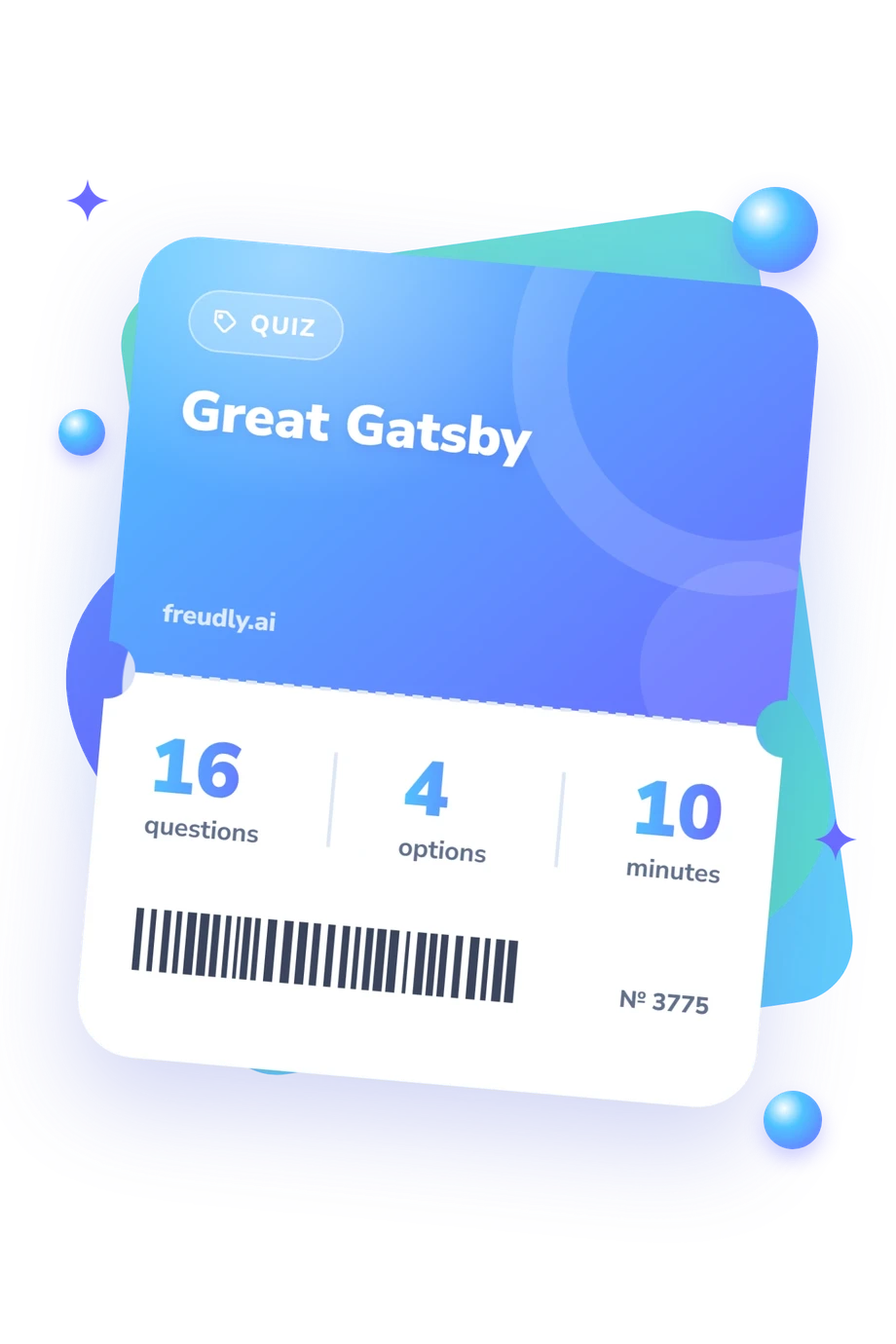
The displayed result is The Great Gatsby Knowledge, scored from 0-16. Its bands are Revisit the Eggs (0-6), Careful Observer (7-12), and Gatsby Scholar (13-16). The labels describe levels of knowledge and command across the novel’s events, contrasts, symbols, and themes.
Methodology and Literary Evidence
Each item uses four answer choices. The alternatives require the reader to select a precise detail or interpretation, making attentive reading more important than recognizing the title. Completing the Great Gatsby online quiz requires choosing one precise answer; its displayed total summarizes performance across the tested content, while the bands describe the result in accessible language.
The literary foundation is Fitzgerald (1925), which supplies the events, language, characters, settings, and symbols checked. Matterson (1990) supports a frame around class, narrative perspective, modernity, and tension between aspiration and history. Dibekulu and Gaudu (2026) offer a lens on Jordan Baker’s presentation and social role. The online test is conceptually consistent with these works, not an adaptation or reproduction of any source.
The displayed total is specific to the tested content and summarizes performance on selected events, language, characters, settings, and symbols; its descriptive bands should not be generalized into a measure of overall literary ability. Rereading, memory, guessing, or differing interpretations can affect results. It is best used to identify passages to revisit and support closer discussion of the novel.
- Fitzgerald, F. Scott. The Great Gatsby. New York: Charles Scribner's Sons, 1925.
- Matterson, Stephen. The Great Gatsby. The Critics Debate. London: Red Globe Press, 1990. 10.1007/978-1-349-20768-8.
- Dibekulu, Dawit, and Ayenew Gaudu. "Athletic Modernity and the New Woman: Jordan Baker's Subversion of the Flapper Archetype in The Great Gatsby." International Journal of the Sociology of Leisure, vol. 9, 2026, pp. 269-284. 10.1007/s41978-026-00213-y.
Updated: