
Great Depression Quiz
How the Scales are Structured
Who Usually Takes This Test?
See How You Compare
Below is a preview of how scores are typically distributed across each scale.
Example Questions From the Test
- A return to mercantilist limits on finished-goods exports
- A policy of balancing the budget through immediate spending cuts
- Keynesian support for countercyclical government spending
- A belief that monetary policy must always remain unchanged
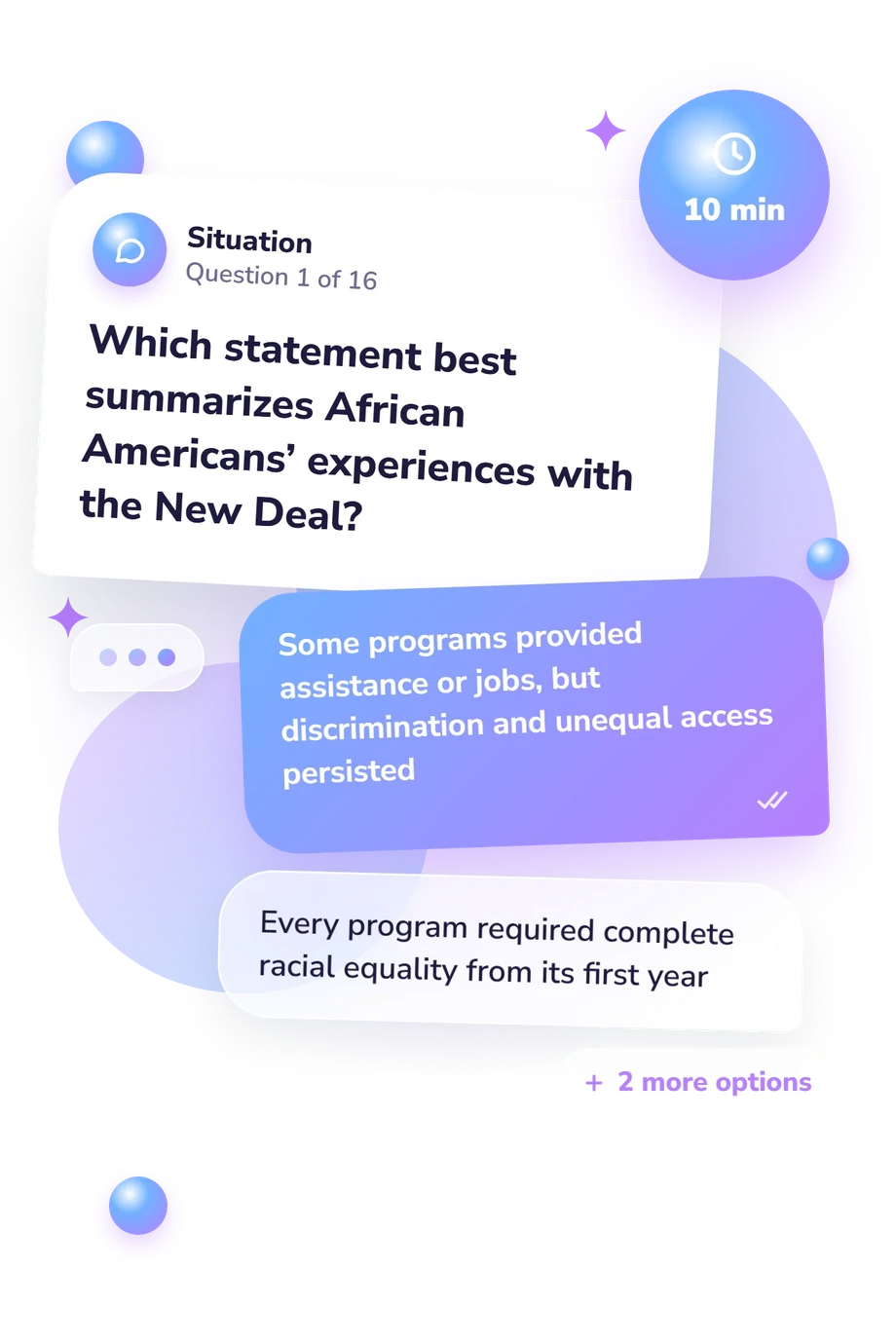
- Some programs provided assistance or jobs, but discrimination and unequal access persisted
- Every program required complete racial equality from its first year
- African Americans were legally barred from all New Deal employment nationwide
- The New Deal immediately ended segregation in every state
- The peak of Dust Bowl migration in the mid-1930s
- The national bank holiday of March 1933
- The Wall Street crash of October 1929
- The United States entering World War II in 1941
Great Depression Quiz - Description and methodology of the test
Readers who want to understand how economic collapse, public policy, and social change interacted can use the Great Depression Quiz to assess overall knowledge of the era, not just isolated recall. It suits students, lifelong learners, and anyone revisiting the period. As a quiz about the legacy of the Great Depression, it can indicate whether broader review would be useful.
What This Assessment Explores
The assessment tests understanding of Great Depression causes, chronology, policy responses, social effects, and global context. Scenarios and causal links test application of historical knowledge, not a separate reasoning trait.
The questions cover four thematic areas, while one overall score reports performance:
- Economic mechanisms show how you understand bank runs, falling demand, unemployment, and prolonged contraction.
- Public policy shows how you distinguish relief, regulation, recovery, and wartime mobilization.
- Social experience shows how race, gender, employment, and access shaped the period.
- Global context shows how tariffs, lending, Germany, and trade widened the crisis.
Reviewing responses can show performance, though correct answers may reflect knowledge or guessing. Great Depression Knowledge runs from 0-16: Foundations to build (0-6), Developing knowledge (7-12), and Strong knowledge (13-16). These bands indicate the level reached.
Methodology and Evidence Base
Each item presents a historical situation, interpretation, or policy question with four answer choices. Selecting the best-supported option combines factual recall with causal reasoning: the respondent must identify what happened and why it mattered. Distractors can reveal confusion about chronology, policy purpose, or wider consequences, while the single result summarizes performance across the material.
The questionnaire’s historical coverage is conceptually consistent with Rauchway (2008) on the crash, policy responses, and social consequences; Bindas (2022) on American society and the uneven reach of New Deal measures; and Friedman and Schwartz (1963) on banking instability, money, and credit. It is not an adaptation of these works.
As a Great Depression history test, this is an online educational self-check. No standardization, validation study, or reference-population norms are established for this questionnaire, so its score describes performance on these items rather than general historical ability. Performance can shift with prior coursework, reading, current interest, uncertainty, or guessing, making missed themes prompts for further study.
- Rauchway, Eric. The Great Depression and the New Deal: A Very Short Introduction. Oxford University Press, 2008. 10.1093/actrade/9780195326345.001.0001
- Bindas, Kenneth J. The New Deal and American Society, 1933-1941. Routledge, 2022. 10.4324/9781003043430
- Friedman, Milton, and Anna J. Schwartz. A Monetary History of the United States, 1867-1960. Princeton University Press, 1963.
Updated: