
GK Quiz in Hindi
How the Scales are Structured
Who Usually Takes This Test?
See How You Compare
Below is a preview of how scores are typically distributed across each scale.
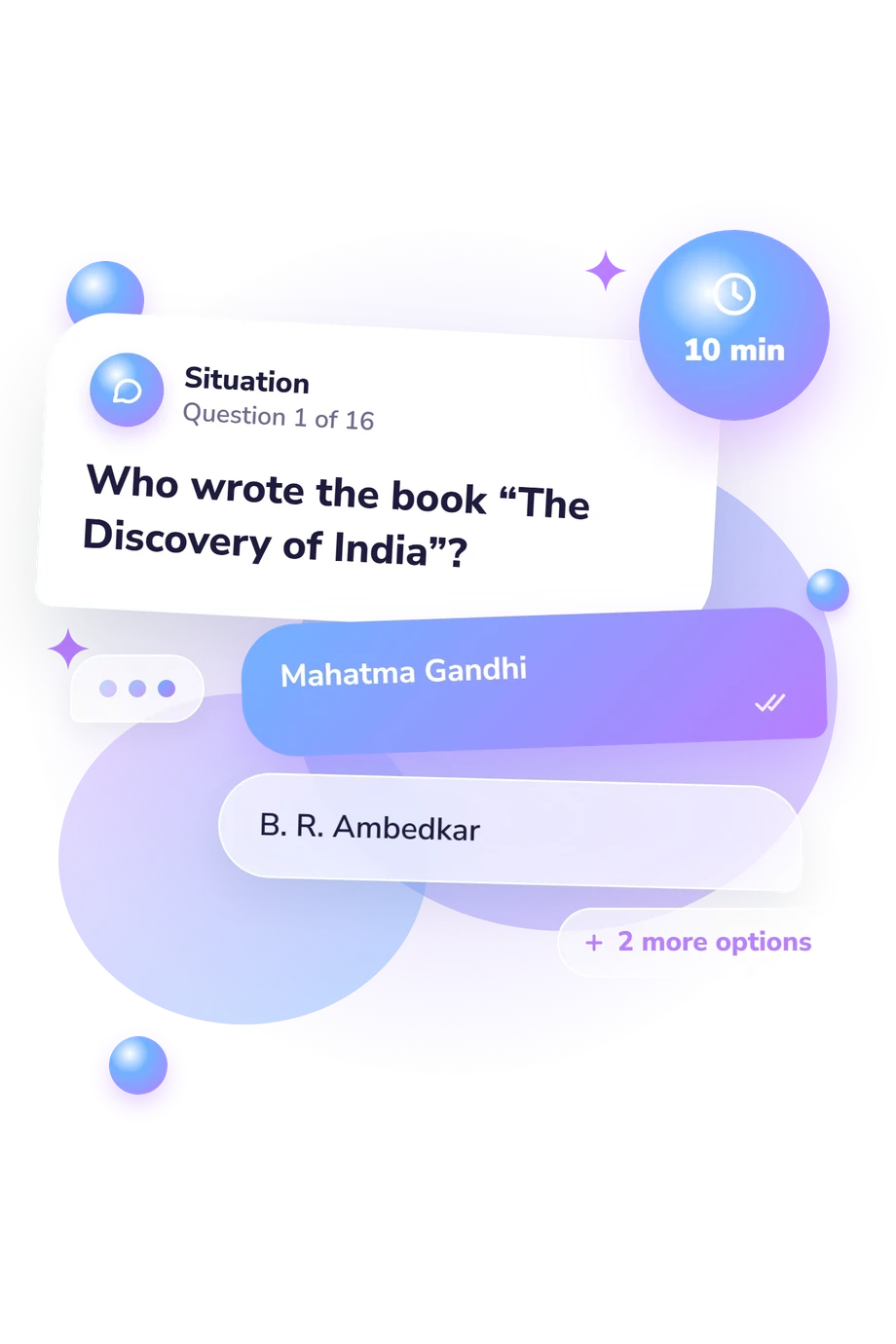
Example Questions From the Test
- Mahatma Gandhi
- B. R. Ambedkar
- Vallabhbhai Patel
- Jawaharlal Nehru
- Gujarat
- Arunachal Pradesh
- Rajasthan
- Kerala
- Evaporation
- Condensation
- Sublimation
- Precipitation
GK Quiz in Hindi - Description and methodology of the test
People who want a focused check of factual recall can use GK Quiz in Hindi: English Edition to review knowledge from Indian civics, history, geography, science, culture, and world facts. It suits learners and people interested in a general knowledge check who want an overall performance level across mixed topics. With questions presented in English, the English-language quiz gives a compact result rather than a profile of separate school subjects.
What This Assessment Explores
Rather than targeting one school subject, the assessment samples several kinds of general knowledge. The English quiz questions cover Indian history and constitutional structure, physical geography and time zones, basic science, astronomy, environmental processes, and international institutions. Some items ask for direct recall, while others require applying a familiar fact to a practical situation.
The result appears on one General Knowledge scale, scored from 0 to 16, with these bands:
- Building Basics (0-6) indicates recognition of some key facts while leaving room to broaden the foundation.
- Developing Knowledge (7-12) reflects a useful base with some less familiar topics.
- Strong Knowledge (13-16) indicates consistently accurate recall and reasoning across the Indian and global mix.
As a broad assessment of general knowledge, this result shows overall performance across mixed topics without separating performance into subject-specific scores.
Methodology and Scientific Basis
Each item presents four answer choices and asks for one best response. Topics are mixed rather than separated into subtests, and the questionnaire displays one overall result without stating how individual answers contribute to it. In this English-language general knowledge test, the format supports a quick check of recall and reasoning across Indian and global topics.
The questionnaire is conceptually consistent with General Knowledge of the World, but is not that instrument or a validated adaptation. BEFKI GC-K offers a second comparison through concise measures of crystallized knowledge, while Horn and Cattell’s model explains how accumulated learning and experience shape performance. These comparisons provide a theoretical context, not evidence that the online questionnaire has the same measurement properties.
Because this is not a standardized administration of the cited instruments, its displayed bands are descriptive rather than population norms, and performance can vary with language comfort, cultural familiarity, attention, and chance. The overall result therefore works best as a broad indication of performance on this mixed-topic set, helping a learner decide which general areas to revisit.
- Mariani, C., Sacco, L., Spinnler, H., & Venneri, A. (2002). General Knowledge of the World: A standardised assessment. Neurological Sciences, 23(4), 161-175. 10.1007/s100720200057
- Schipolowski, S., Wilhelm, O., Schroeders, U., Kovaleva, A., Kemper, C. J., & Rammstedt, B. (2013). BEFKI GC-K: A Short Scale for the Measurement of Crystallized Intelligence. Methods, Data, Analyses, 7(2), 153-181. 10.12758/mda.2013.010
- Horn, J. L., & Cattell, R. B. (1966). Refinement and test of the theory of fluid and crystallized general intelligences. Journal of Educational Psychology, 57(5), 253-270. 10.1037/h0023816
Updated: