
Giving You a Brutal Kin Quiz
How the Scales are Structured
Who Usually Takes This Test?
See How You Compare
Below is a preview of how scores are typically distributed across each scale.
Example Questions From the Test
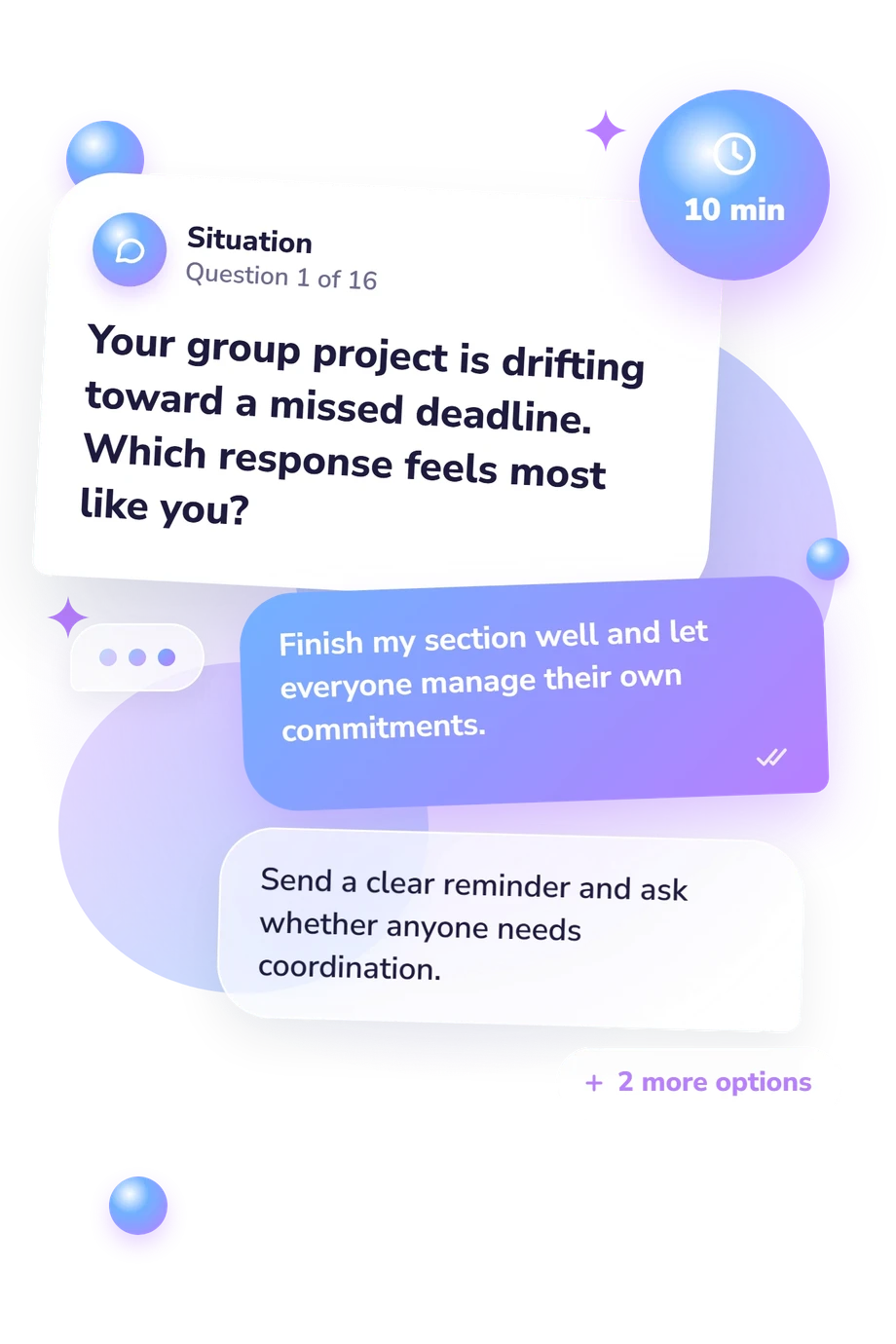
- Finish my section well and let everyone manage their own commitments.
- Send a clear reminder and ask whether anyone needs coordination.
- Create a schedule, assign open tasks, and keep everyone moving.
- Quietly redo weak or unfinished sections because trusting the group feels riskier.
- Give them room to vent and follow their lead.
- Ask whether they want comfort, ideas, or a distraction.
- Start outlining a practical way to improve tomorrow.
- Offer to handle part of the problem so it stops weighing on them.
- Stay present without making their progress my responsibility.
- Ask questions that might help them reach their own conclusion.
- Research options and send them the most useful resources.
- Build a plan for them and keep checking whether they follow it.
Giving You a Brutal Kin Quiz - Description and methodology of the test
Readers who want a candid way to examine social habits, protective strategies, helping impulses, and reactions to change can use Giving You a Brutal Kin Quiz as structured reflection. Its result shows which tendencies are strongest, helping you compare character-based patterns with your own responses. As a character comparison quiz, it keeps this kin-oriented self-comparison focused on behavioral tendencies.
What This Assessment Explores
Scenarios address feedback, support, responsibility, uncertainty, commitment, and change. Your brutal kin quiz result identifies the strongest pattern and what it represents.
The four displayed scales are:
- Approval-Seeking Performer (0-12) measures adapting for praise or belonging: Self-Directed Presence (0-4), Social Adapter (5-8), Approval-Seeking Performer (9-12).
- Guarded Strategist (0-12) measures protective planning and disclosure: Open Navigator (0-4), Selective Planner (5-8), Guarded Strategist (9-12).
- Overfunctioning Fixer (0-12) measures taking over responsibility for others: Respectful Supporter (0-4), Active Helper (5-8), Overfunctioning Fixer (9-12).
- Restless Escape Artist (0-12) measures using a dramatic reset to escape or solve discomfort, boredom, or commitment when difficult, rather than ordinary exploration: Grounded Explorer (0-4), Restless Reviser (5-8), Restless Escape Artist (9-12).
Scores within one point across the four scales form a blended affinity; otherwise, the highest score indicates the strongest affinity.
Methodology and Evidence Base
Each item presents four situational responses, and the respondent selects the option that feels most characteristic. The questionnaire reports a score for each dimension; the highest marks the strongest affinity, while scores within one point form a blended profile. Its comparative format is more useful for identifying patterns than treating a band as a clinical cutoff.
This kin self-reflection quiz uses its comparative format to support self-reflection rather than to reproduce a published scale. The questionnaire is conceptually consistent with the cited instruments but is not an adaptation of them. The closest reference is the Composite Codependency Scale-Revised (CCS-R) (Marks et al., 2012), relevant to over-responsibility and becoming indispensable. Snyder’s self-monitoring work (1974) connects with managing presentation in response to social feedback, while Bond et al.’s Acceptance and Action Questionnaire-II (2011) offers a related lens on psychological inflexibility and experiential avoidance.
The displayed bands are descriptive levels within this questionnaire, not population norms. Self-report results can shift with current circumstances, self-awareness, and the wish to appear a certain way, so the profile is best used as a reflection prompt rather than a diagnosis.
- Marks, Anthony D. G., Rebecca L. Blore, Donald W. Hine, and Greg E. Dear. (2012). Development and validation of a revised measure of codependency. Australian Journal of Psychology, 64(3), 119-127. 10.1111/j.1742-9536.2011.00034.x
- Snyder, Mark. (1974). Self-monitoring of expressive behavior. Journal of Personality and Social Psychology, 30(4), 526-537. 10.1037/h0037039
- Bond, Frank W., Steven C. Hayes, Ruth A. Baer, Kenneth M. Carpenter, Nigel Guenole, Holly K. Orcutt, Tom Waltz, and Robert D. Zettle. (2011). Preliminary psychometric properties of the Acceptance and Action Questionnaire-II: A revised measure of psychological inflexibility and experiential avoidance. Behavior Therapy, 42(4), 676-688. 10.1016/j.beth.2011.03.007
Updated: