
Girl Name Quiz
How the Scales are Structured
Who Usually Takes This Test?
See How You Compare
Below is a preview of how scores are typically distributed across each scale.
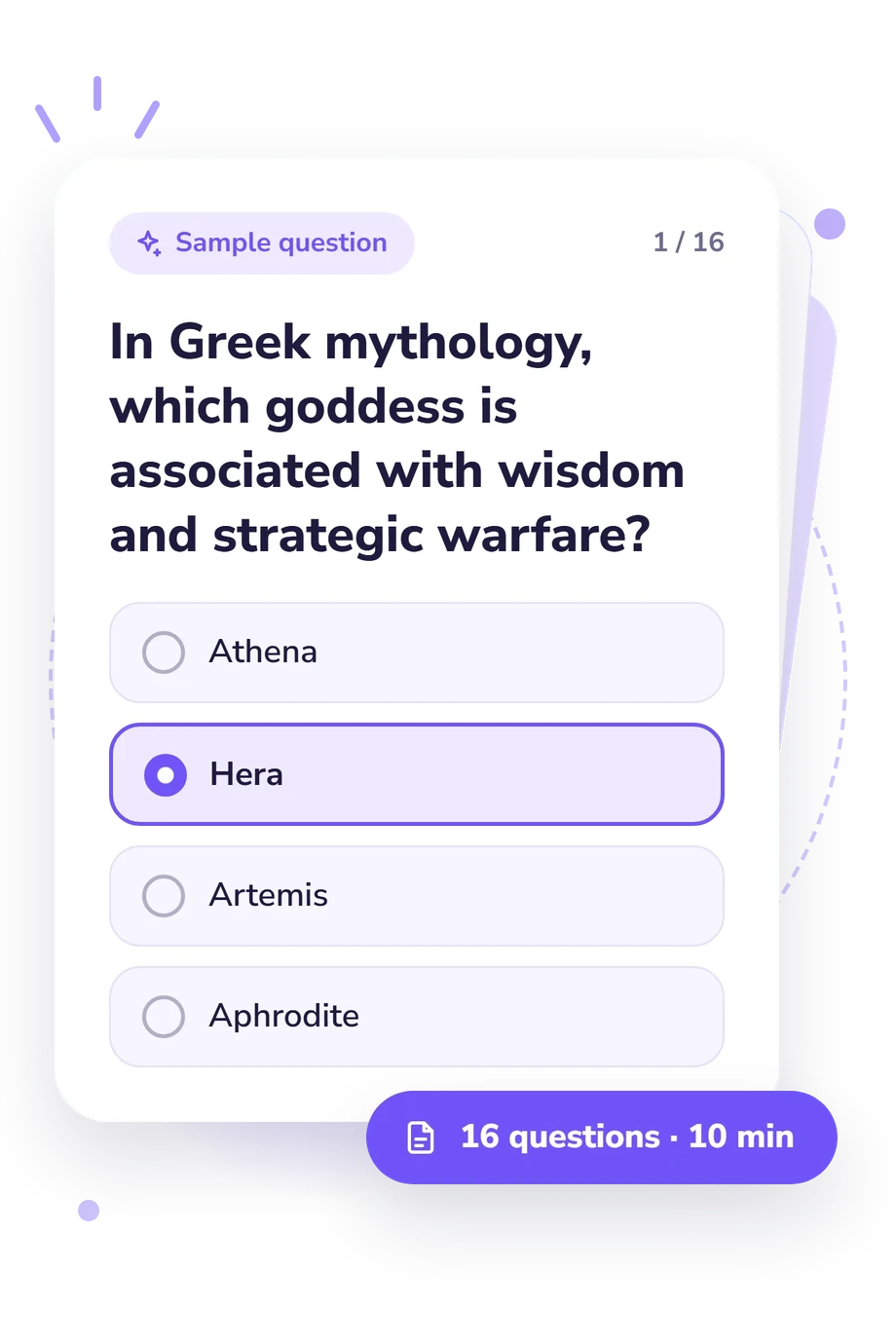
Example Questions From the Test
- Athena
- Hera
- Artemis
- Aphrodite
- Andrea
- Alexandra
- Antonia
- Amanda
- Eve
- Sarah
- Ruth
- Mary
Girl Name Quiz - Description and methodology of the test
People who enjoy names, cultural trivia, or choosing meaningful names may use this girl name quiz to examine how confidently they connect feminine names with origins, stories, spelling, and associations. It is designed for curious readers who want a focused snapshot of current naming knowledge rather than a measure of personality or identity. A girl name test can also turn missed answers into clear topics for further exploration.
What This Assessment Explores
This assessment is intended for anyone curious about how names carry cultural, literary, linguistic, and visual clues. It tests recognition and comparison rather than personal preference: a respondent may identify a mythological figure, connect a name with a meaning, recognize a traditional short form, or solve a letter-based relationship. As a girl names quiz, it also rewards careful reading because several prompts depend on exact spelling, order, or repeated letters.
The question themes are:
- Mythology and religion measure recognition of names linked with deities, sacred figures, and traditional domains.
- Literature and culture show whether familiar stories and characters help identify a name.
- Origins and associations connect names with meanings, cognates, variants, short forms, and themes.
- Spelling and structure assess anagrams, initials, palindromes, alphabetic order, and letter patterns.
- Girl Name Knowledge (0-16) records correct-answer breadth and places the result in Emerging (0-6), Developing (7-12), or Strong (13-16).
Methodology and Evidence Base
Each item presents a prompt, four answer choices, and one best answer. The set combines recall with comparison and pattern recognition, making it a structured knowledge quiz rather than a personality inventory. Its format makes it a name knowledge quiz in which mythology, literature, meanings, cognates, shortened forms, spelling, and alphabetical order contribute to the total.
Scoring is direct: every correct response contributes one point, and the total is interpreted through the displayed result bands. Individual misses can still identify subjects worth reviewing.
The naming content is conceptually consistent with Hanks, Hardcastle and Hodges (2006), whose work documents first-name origins, forms, variants, and usage. It also aligns with the broader onomastic perspective represented by Hough (2016), which treats names as linguistic and cultural phenomena. These sources support the quiz’s subject matter; the online questionnaire is not presented as a direct adaptation of either publication.
The score is descriptive rather than norm-referenced and does not estimate overall naming expertise. Performance may vary with language background, cultural exposure, familiarity with mythology or literature, and guessing, so the result is best read as current knowledge within this particular set of questions.
- Patrick Hanks, Kate Hardcastle, and Flavia Hodges. A Dictionary of First Names. 2nd ed. Oxford: Oxford University Press, 2006. ISBN 9780198610601.
- Carole Hough, ed. The Oxford Handbook of Names and Naming. Oxford: Oxford University Press, 2016. DOI 10.1093/oxfordhb/9780199656431.001.0001.
Updated: