
Genres of Literature Quiz
How the Scales are Structured
Who Usually Takes This Test?
See How You Compare
Below is a preview of how scores are typically distributed across each scale.
Example Questions From the Test
- Elegy
- Satire
- Romance
- Pastoral
- Lyric poetry
- Drama
- Narrative nonfiction
- The novel
- It tells a book-length story in verse
- It has three lines arranged by syllable count
- It is a 14-line poem with a structured pattern
- It is written solely for performance by a chorus
Genres of Literature Quiz - Description and methodology of the test
Readers who want to strengthen their command of literary terminology can use this genres of literature quiz to check how well they distinguish forms, conventions, and subject-matter patterns. It suits students, teachers, and curious readers who want a structured snapshot rather than an extended lesson. The result offers a practical starting point for choosing what to review next. A literary genre test can make those gaps easier to name and revisit.
What This Assessment Explores
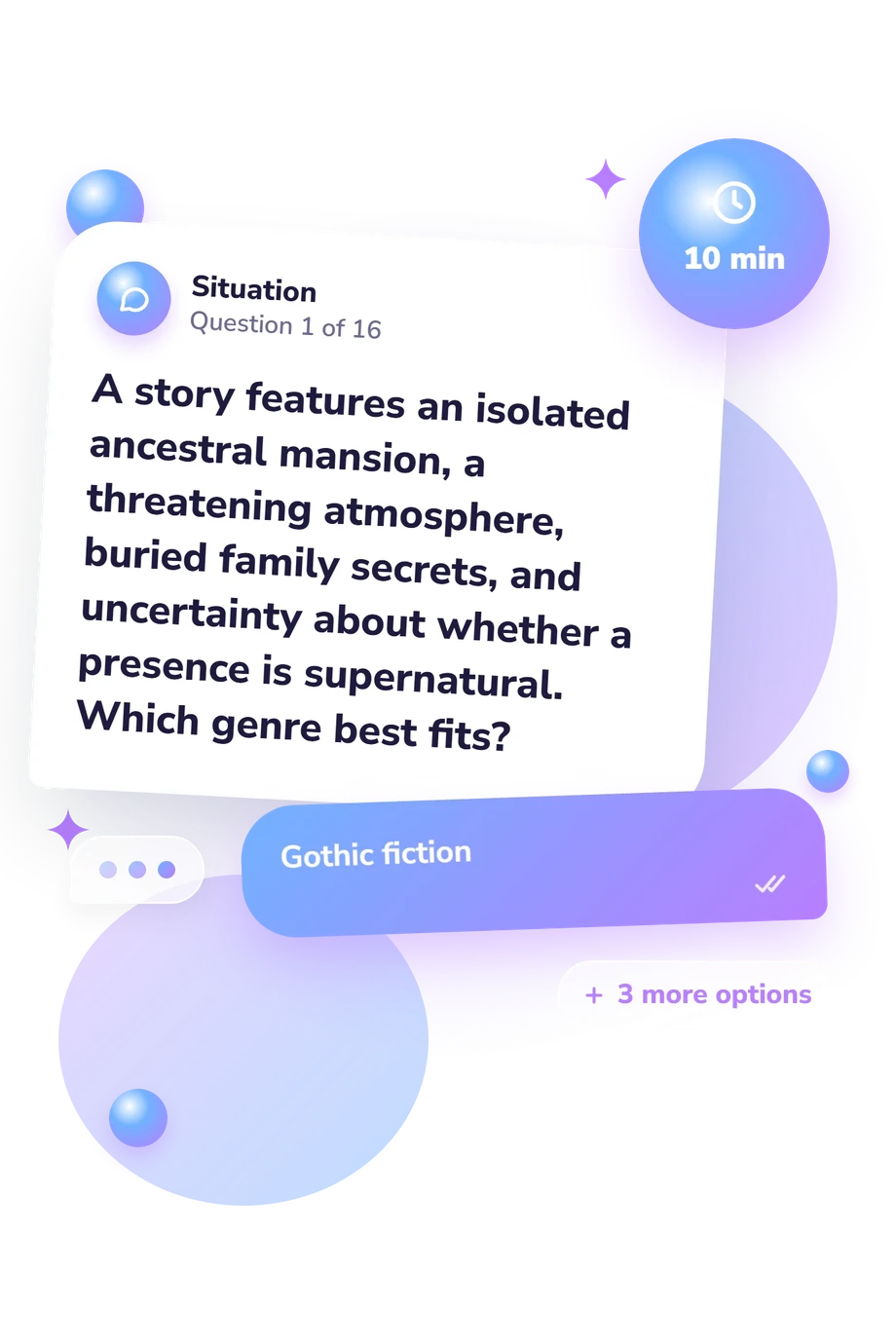
The questions test genre awareness by asking how formal signals, narrative purposes, conventions, and themes distinguish fiction, drama, poetry, and nonfiction. Some items describe a plot or setting; others focus on a work’s structure, treatment of reality, performance, history, or invention.
More specific forms include the Bildungsroman, sonnet, memoir, fable, dystopian fiction, and mystery fiction. This literary genres quiz therefore tests application, not just recall: you must connect a label with the features that make it appropriate.
The Genres of Literature Knowledge scale runs from 0 to 16 and is interpreted through three bands:
- Foundation Building (0-6) indicates that some genre features are recognizable, while distinctions among forms, conventions, and themes may need review.
- Developing Knowledge (7-12) indicates that many common categories are identifiable, with less familiar distinctions still worth refining.
- Strong Knowledge (13-16) indicates a reliable command of major genres and their conventions in context.
Methodology and Evidence Base
Each item uses four answer choices. Some describe a scene or plot pattern; others define a form or ask for a classification. Selecting the strongest match makes the score a measure of genre recognition and application, not personal preference.
The questionnaire is a focused literature genre assessment whose items are conceptually consistent with genre theory and genre-awareness research. Rozimela (2014) links awareness of text types with reading comprehension. Frow (2015) presents genre as a system of conventions that guides recognition and interpretation, while Foung and Lughmani (2021) highlight the role of genre knowledge in academic writing tasks. Together, these ideas provide context for the questionnaire’s focus on genre recognition and application in learning.
The questionnaire reports one knowledge profile using the displayed knowledge bands, so interpret the result as a snapshot of current performance rather than a norm-referenced estimate. Scores may vary with coursework, reading experience, terminology, and testing context. It can guide review, but it cannot represent every interpretive judgment required by real texts.
- Rozimela, Yenni. “The Students’ Genre Awareness and Their Reading Comprehension of Different Text Types.” International Journal of Asian Social Science, vol. 4, no. 4, 2014, pp. 460-469.
- Frow, John. Genre. 2nd ed., Routledge, 2015. 10.4324/9781315777351
- Foung, Dennis, and Lughmani, Shari Dureshahwar. “Exploring L2 University Students’ Assignment Genre Knowledge and Writing Challenges.” Asian EFL Journal, vol. 28, no. 1.3, 2021, pp. 315-335.
Updated: