
GED Math Quiz
How the Scales are Structured
Who Usually Takes This Test?
See How You Compare
Below is a preview of how scores are typically distributed across each scale.
Example Questions From the Test
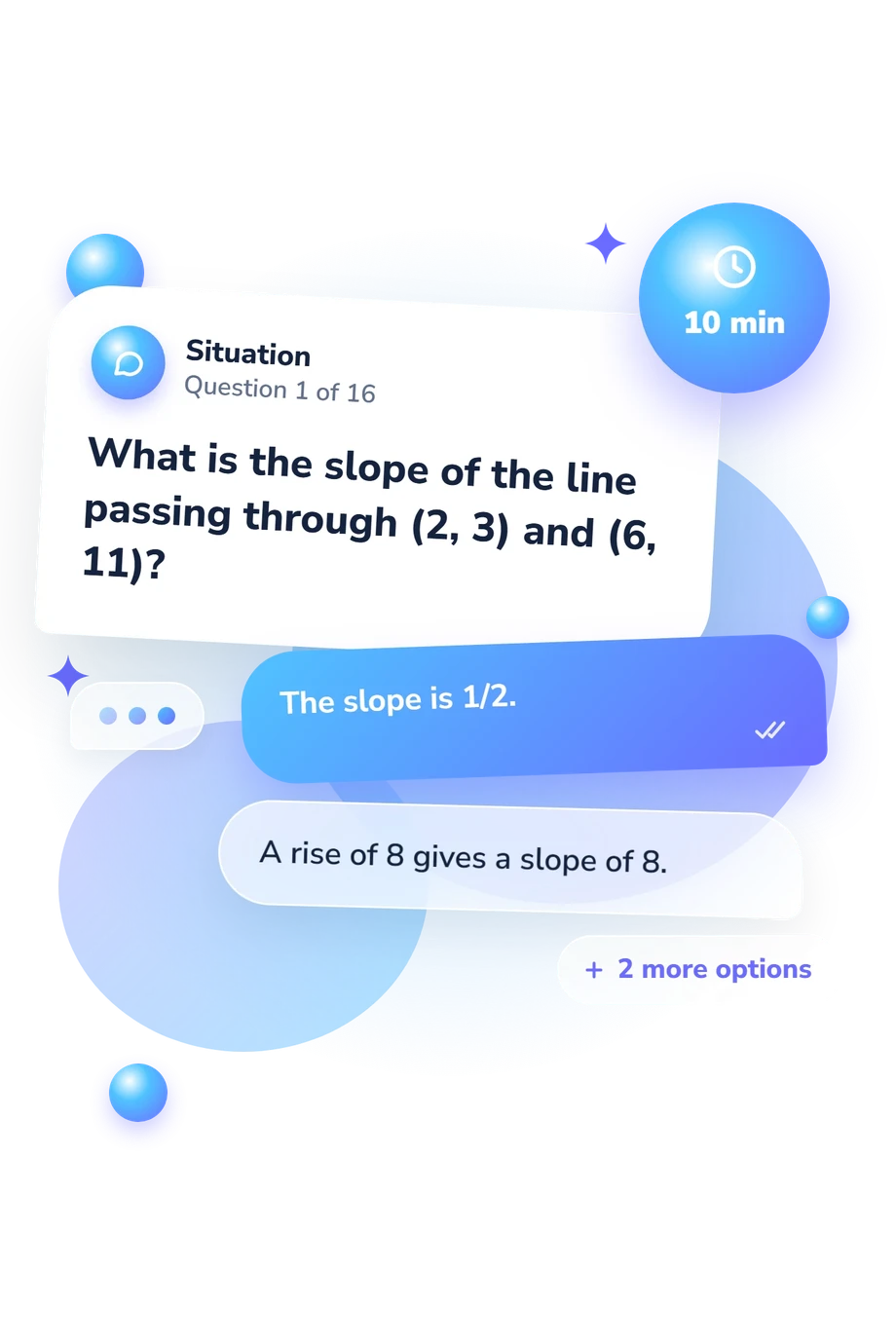
- The slope is 1/2.
- A rise of 8 gives a slope of 8.
- The horizontal change makes the slope 4.
- The slope is 2.
- The number of minutes included at no extra charge
- The fixed monthly charge before per-minute costs
- The additional charge for each minute used
- The greatest possible monthly bill
- They intersect at (2, 5).
- Their common point is (1, 3).
- Both equations pass through (3, 4).
- The intersection occurs at (5, 2).
GED Math Quiz - Description and methodology of the test
Students preparing for the GED can use the GED Math Quiz to see how they apply algebraic ideas before choosing what to study next. It suits learners reviewing mathematical reasoning independently or checking progress after practice. Focused math quiz practice for the GED can help turn a result into a practical review plan. The score points to sampled skills that may deserve more attention, rather than assigning a permanent label.
What This Assessment Measures
The item themes span algebra and function work relevant to mathematical-reasoning preparation. Across the GED math questions, learners interpret slope, intercepts, equations, inequalities, tables, graphs, domains, rates of change, and function notation. Applied scenarios ask them to translate costs and motion into equations or compare representations.
The displayed GED Math Knowledge scale runs from 0-16 and uses three result bands:
- Foundations to Build (0-6) identifies a need to review function rules, coordinate graphs, slope, intercepts, and translating situations into equations.
- Developing Knowledge (7-12) indicates understanding of central ideas while more practice may be needed to connect tables, graphs, equations, and applied models.
- Strong Knowledge (13-16) reflects strong command of the graph and function skills sampled here.
This focus suits learners seeking a targeted snapshot of algebraic reasoning during independent review or after recent study.
Methodology and Evidence Base
Each item presents an equation, table, graph description, ordered-pair relation, or practical situation with four answer choices. The options distinguish slope, intercepts, inequality boundaries, exponential growth, vertex form, function rules, domains, and average rate of change. The questionnaire produces one displayed result; its response-conversion or weighting rule is not stated.
The method is content-focused practice rather than norm-referenced measurement. Content is conceptually consistent with GED Mathematical Reasoning Assessment Targets and Common Core expectations for algebra, functions, graphs, and modeling. It is not an adaptation of those sources or a reproduction of the official examination.
For learners using a GED math practice test, the result is a study signal for revisiting missed concepts in varied representations. Its content is conceptually consistent with the GED Mathematical Reasoning Assessment Targets, but research on official GED examinations does not validate this online practice result. The questionnaire provides no stated norms or psychometric estimates for interpreting its practice result, and current preparation and attention can affect performance. It is not an official GED score or a guarantee of test performance.
- GED Testing Service. (2016). Assessment Guide for Educators: Mathematical Reasoning. GED Testing Service.
- GED Testing Service. (2022). Technical Manual: GED Test, Updated 2022 Edition. GED Testing Service LLC.
- National Governors Association Center for Best Practices, & Council of Chief State School Officers. (2010). Common Core State Standards for Mathematics. Washington, DC: Authors.
- Whitney, D. R., Malizio, A. G., & Patience, W. M. (1986). Reliability and Validity of the GED Tests. Educational and Psychological Measurement, 46(3), 689-698. 10.1177/0013164486463025
Updated: