
Future Husband Quiz
How the Scales are Structured
Who Usually Takes This Test?
See How You Compare
Below is a preview of how scores are typically distributed across each scale.
Example Questions From the Test
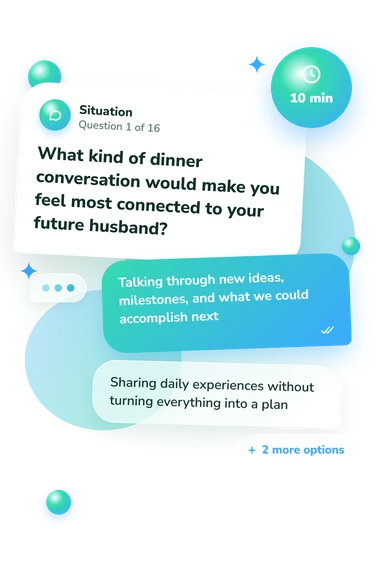
- Talking through new ideas, milestones, and what we could accomplish next
- Sharing daily experiences without turning everything into a plan
- Discussing one current goal before moving on to lighter subjects
- Leaving work and achievement talk aside so we can fully unwind
- Frequently trying unfamiliar places, activities, or spontaneous ideas
- Returning to favorite places because shared history makes them special
- Alternating trusted favorites with occasional experiments
- Planning a new experience for special occasions rather than ordinary weeks
- Go immediately and decide the details along the way
- Agree if we can make a quick plan for the essentials first
- Save the idea for a future weekend when we can prepare properly
- Choose a relaxing weekend close to home instead
Future Husband Quiz - Description and methodology of the test
Readers reflecting on marriage can use this assessment to clarify the partnership they would most enjoy, whether they are dating, single, or simply curious about long-term relationship preferences. The future husband quiz maps preferences for closeness, novelty, ambition, and home life, describing preferred marriage dynamics rather than a specific person. Together, these themes make this husband quiz a useful prompt for discussing relationship priorities and expectations.
What This Marriage Preferences Quiz Explores
Choices describe married life. As a marriage preferences quiz, it reveals preferences for novelty, stability, closeness, shared goals, and cooperation through travel, money, routines, affection, and career scenarios. Answers show the preferred shared-life pattern.
The four dimensions are:
- Adventurous Companion (0-12) measures affinity for novelty and exploration in marriage: Familiar Pleasures (0-4), Selective Explorer (5-8), Shared Adventure (9-12).
- Ambitious Builder (0-12) measures affinity for goals and progress in marriage: Contented Pace (0-4), Purposeful Progress (5-8), Power-Couple Vision (9-12).
- Romantic Teammate (0-12) measures affinity for affection and emotional expression in marriage: Quiet Connection (0-4), Warm Partnership (5-8), Heart-Forward Romance (9-12).
- Steady Homebody (0-12) measures affinity for dependable routines and home: Flexible Roots (0-4), Grounded Balance (5-8), Cozy Foundation (9-12).
The highest score shows strongest affinity; scores within one point create a blended result.
Methodology and Scientific Basis
Each item presents a relationship situation with four responses. Travel, money, celebrations, rituals, closeness, and shared goals create trade-offs; the respondent selects the option nearest the marriage they prefer. This structure captures priorities through choices, not abstract ratings.
The questionnaire profiles the respondent's preferred balance of affection, novelty, shared goals, and home life. Scoring groups choices across four themes and, in this future marriage quiz, reports the strongest affinity, including blended outcomes when scores are close. Because answer-to-point weighting is undocumented, the displayed bands are result categories, not a formula to reverse-engineer.
Lam et al. (2016) is the closest conceptual reference, linking marriage ideals with companionship, passion, resources, and stability. Fletcher et al. (1999) likewise treats intimate ideals as multidimensional. This questionnaire is conceptually consistent with those findings, not an adaptation of either measure.
Eastwick et al. (2014) reviewed whether ideal-partner preferences predict later evaluations and relationship outcomes. That evidence supports reading the profile as desired qualities and comparing the relative pull of its four marriage patterns. Self-report is sensitive to context, self-awareness, and impression management; displayed ranges do not establish population norms.
- Ben C. P. Lam, Susan E. Cross, Tsui-Feng Wu, Kuang-Hui Yeh, Yi-Chao Wang, and Jenny C. Su (2016). What Do You Want in a Marriage? Examining Marriage Ideals in Taiwan and the United States. Personality and Social Psychology Bulletin, 42(6), 703-722. 10.1177/0146167216637842
- Garth J. O. Fletcher, Jeffry A. Simpson, Geoff Thomas, and Louise Giles (1999). Ideals in Intimate Relationships. Journal of Personality and Social Psychology, 76(1), 72-89. 10.1037/0022-3514.76.1.72
- Paul W. Eastwick, Laura B. Luchies, Eli J. Finkel, and Lucy L. Hunt (2014). The Predictive Validity of Ideal Partner Preferences: A Review and Meta-Analysis. Psychological Bulletin, 140(3), 623-665. 10.1037/a0032432