
Flag Quiz Hard
How the Scales are Structured
Who Usually Takes This Test?
See How You Compare
Below is a preview of how scores are typically distributed across each scale.
Example Questions From the Test
- Seychelles
- Mauritius
- Comoros
- South Africa
- Kenya
- Lesotho
- Eswatini
- Botswana
- Switzerland
- Nepal
- Qatar
- Vatican City
Flag Quiz Hard - Description and methodology of the test
Readers who enjoy geography, vexillology, or challenging visual identification can use Flag Quiz Hard to decide whether this level of difficulty suits their interests. Its result describes performance in identifying national flags and recognizing their design features. This national flag quiz offers a structured challenge for learners, trivia enthusiasts, and anyone drawn to demanding quizzes.
What This Assessment Measures
The questions test national-flag recognition through combinations of color, geometry, emblems, historical symbols, or unusual construction. They suit geography and vexillology readers, whether casually learning or examining how accurately they distinguish design features.
For readers who want their hardest flag quiz yet, items present designs that can be confused by shared colors, neighboring layouts, or distinctive emblems. The result reflects performance in recognizing varied cues rather than familiarity with one region.
The result is reported on one scale, National Flag Knowledge (0-16), with three descriptive bands:
- Flag Foundations (0-6) indicates recognition of some prominent designs and suggests comparing layouts, symbols, and color placement.
- Developing Recognition (7-12) shows that many distinctive flags are identifiable while less familiar emblems and regional look-alikes remain study targets.
- Advanced Flag Knowledge (13-16) reflects strong command of famous and challenging national flag designs.
Methodology and Evidence Base
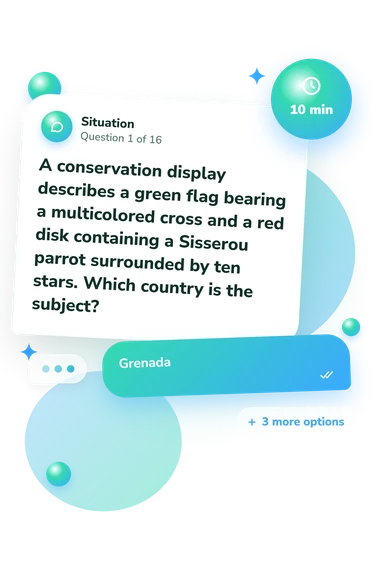
Each item presents a written visual description and four country choices, asking the respondent to select the best match rather than recall a name without prompts. The format focuses attention on color placement, shape, emblems, and national symbolism, although prior exposure and geography knowledge may also help.
The result is reported on the displayed scale and interpreted through its bands. These levels describe performance on this quiz; attention, concentration, prior exposure to flags, and familiarity with geographic information can affect performance, and they do not establish mastery of all flags.
Conceptually, the quiz is consistent with Conci et al. (2021), whose findings support the role of familiar national associations in holding color-and-shape combinations in visual memory. It is not an adaptation of that study. Znamierowski’s encyclopedia and Barker and Carpenter’s guide supply reference knowledge for layouts, symbols, and exceptions such as Nepal’s non-rectangular design.
Performance on this flag knowledge test may vary with designs included and recognition of cues in each description. The score can guide learning but does not measure visual memory or the breadth of geographical knowledge.
- Conci, Markus, Philipp Kreyenmeier, Lisa Kröll, Connor Spiech, and Hermann J. Müller. "The nationality benefit: Long-term memory associations enhance visual working memory for color-shape conjunctions." Psychonomic Bulletin & Review, vol. 28, 2021, pp. 1982-1990. 10.3758/s13423-021-01957-2.
- Znamierowski, Alfred. The World Encyclopedia of Flags: An Illustrated Guide to International Flags, Banners, Standards and Ensigns. Lorenz Books, 2020.
- Barker, Brian Johnson, and Clive Carpenter. The Complete Guide to Flags of the World, 3rd Edition. Fox Chapel Publishing, 2015.