
Fixing Your Credit Math Quiz
How the Scales are Structured
Who Usually Takes This Test?
See How You Compare
Below is a preview of how scores are typically distributed across each scale.
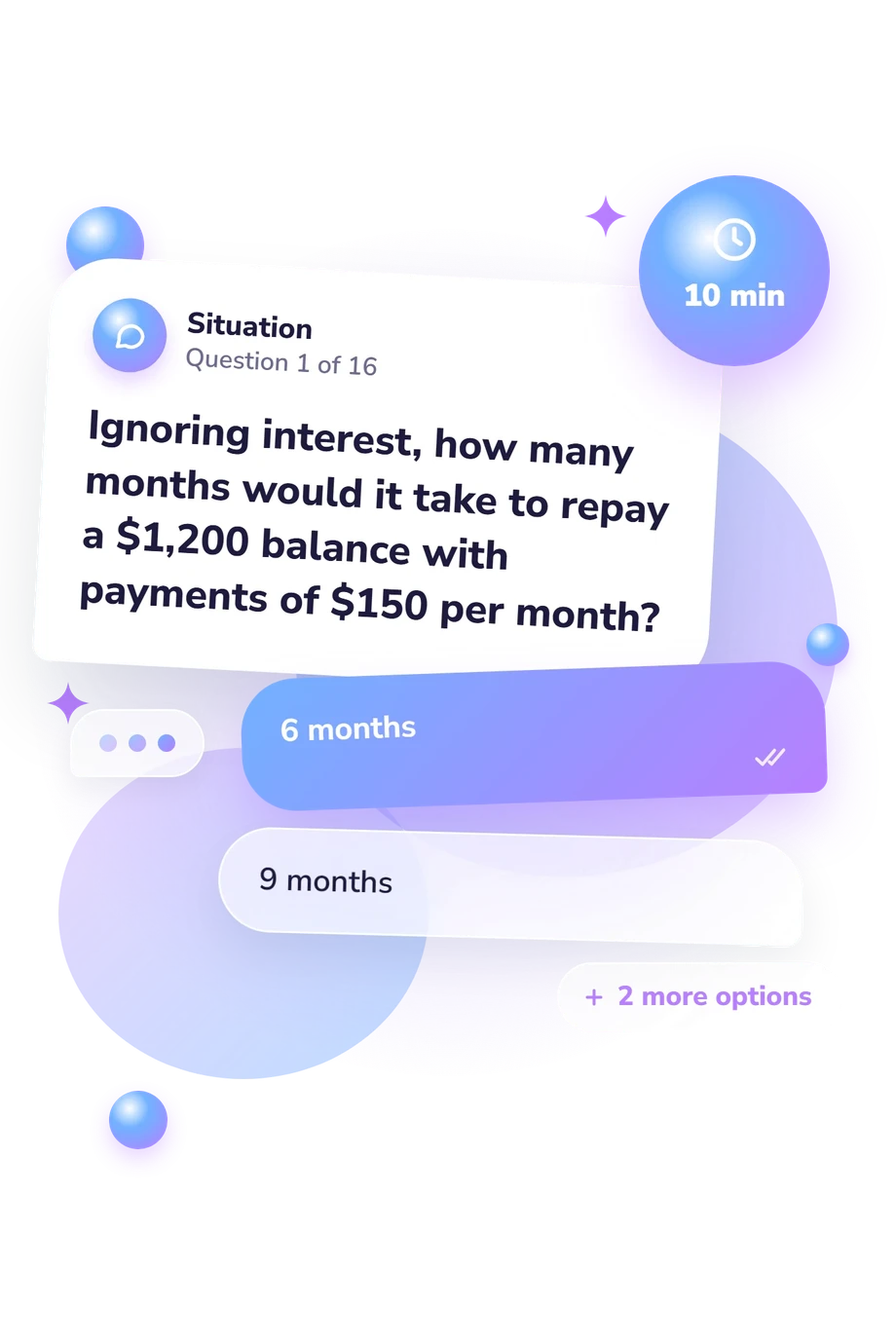
Example Questions From the Test
- 6 months
- 9 months
- 8 months
- 10 months
- 70%
- 23%
- 33%
- 30%
- A $350 balance at 12% APR
- A $700 balance at 21% APR
- A $1,400 balance at 18% APR
- A $3,000 balance at 9% APR
Fixing Your Credit Math Quiz - Description and methodology of the test
Readers who want to check their understanding before making borrowing decisions can use Fixing Your Credit Math Quiz to see where their current knowledge is strongest and where further review may help. It suits people working through everyday credit choices who want a broad educational indication of how confidently they interpret numerical information. The result can guide targeted credit math calculations without claiming to predict a financial outcome.
What This Assessment Measures
The questions measure applied knowledge, not beliefs or personality. They cover utilization, simple interest, fees, repayment totals, snowball and avalanche priorities, balance discrepancies, available credit, and debt-to-income ratios. Credit utilization math is one part of this check on borrowing calculations.
The displayed scale is Fixing Your Credit Math Knowledge: 0-16. Its bands are Foundations to build (0-6), Developing knowledge (7-12), and Strong working knowledge (13-16). These levels move from reviewing core formulas, through developing command of common calculations, to accurate handling of most covered tasks. The score does not predict a particular credit-score change because lender terms, reporting dates, and scoring models vary.
Three themes are:
- Utilization and interest show how you estimate costs from balances, rates, and time.
- Repayment planning shows how you compare totals and payoff priorities.
- Reporting and affordability show how you handle discrepancies and debt-to-income figures.
Methodology and Evidence Base
Each item presents a short numerical or decision-making scenario with four answer choices. The result identifies a broad level of current knowledge, while the covered calculations include percentages, time periods, fees, payoff order, and the difference between balance and principal. The assessment turns credit math practice into concrete situations rather than reporting attitudes.
The approach is conceptually consistent with Hilgert, Hogarth, and Beverly (2003), who connected financial knowledge with household financial behavior. It also relates to Knoll and Houts (2012) on financial-literacy measurement, Gal and McShane (2012) on snowball and avalanche choices, and the Bureau’s financial-skill framework. The online score has no stated norms, so these published sources provide context for the content rather than validation of this questionnaire.
As an online educational questionnaire, its score is a snapshot of performance. Attention, arithmetic slips, familiarity with credit terms, current experience, and simplified assumptions can affect performance, so use the result to identify concepts worth checking rather than as a universal measure of financial ability.
- Hilgert, Marianne A., Jeanne M. Hogarth, and Sondra G. Beverly. 2003. "Household Financial Management: The Connection between Knowledge and Behavior." Federal Reserve Bulletin 89 (7): 309-322.
- Knoll, Melissa A. Z., and Carrie R. Houts. 2012. "The Financial Knowledge Scale: An Application of Item Response Theory to the Assessment of Financial Literacy." Journal of Consumer Affairs 46 (3): 381-410. 10.1111/j.1745-6606.2012.01241.x
- Gal, David, and Blakeley B. McShane. 2012. "Can Small Victories Help Win the War? Evidence from Consumer Debt Management." Journal of Marketing Research 49 (4): 487-501. 10.1509/jmr.11.0272
- Bureau of Consumer Financial Protection. 2018. "Measuring financial skill: A guide to using the Bureau of Consumer Financial Protection's Financial Skill Scale."
Updated: