
Fire Safety Quiz
How the Scales are Structured
Who Usually Takes This Test?
See How You Compare
Below is a preview of how scores are typically distributed across each scale.
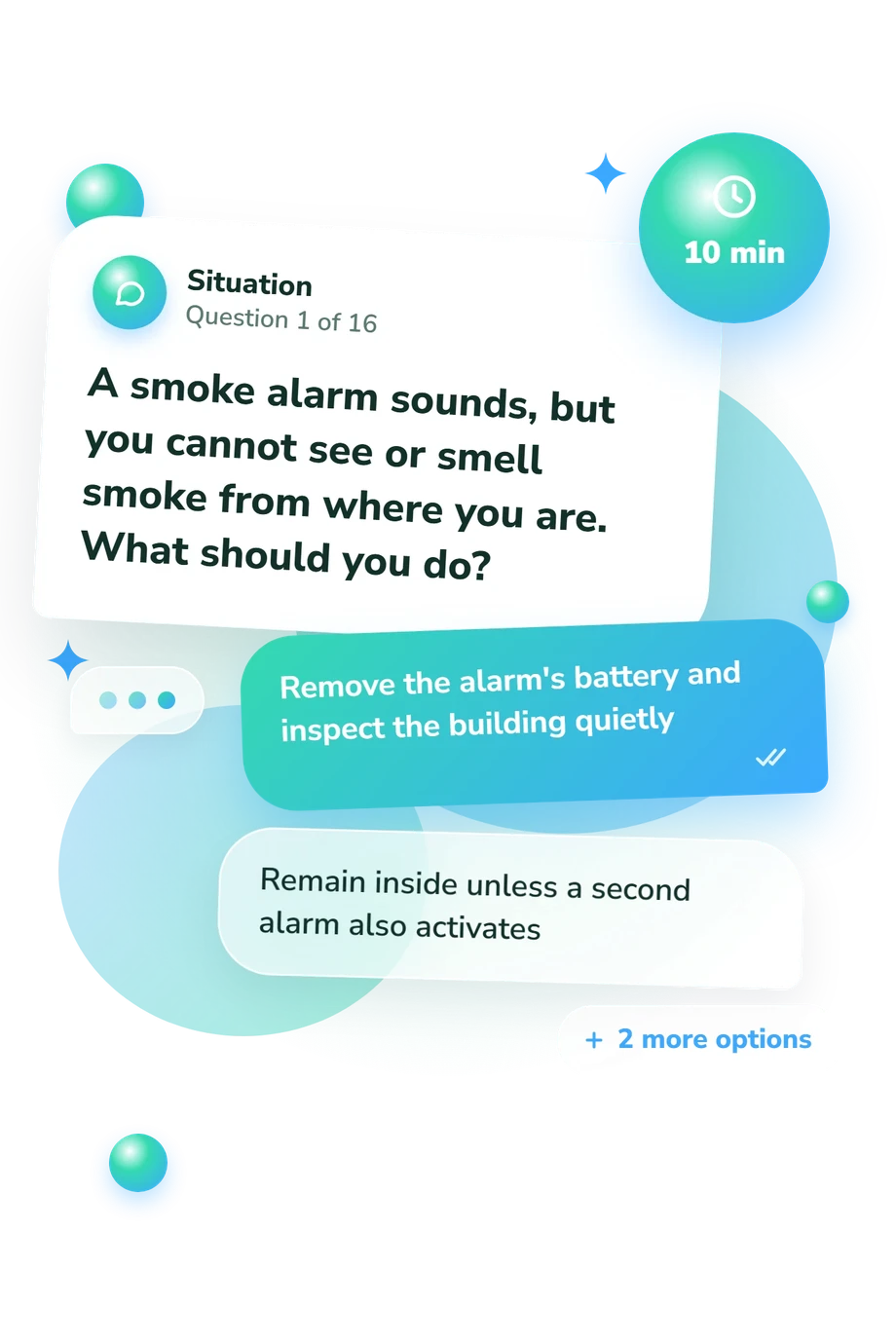
Example Questions From the Test
- Alert others and follow the planned route outside immediately
- Search every room to find the source before deciding what to do
- Open windows to clear smoke before leaving
- Silence the alarm and wait briefly to see whether it sounds again
- Stop, drop to the ground, and roll to smother the flames
- Remove the clothing while remaining upright
- Fan the clothing to push the flames away from the face
- Run outside so other people can help
- Open it slowly while standing behind the door
- Cover your face and move through it as quickly as possible
- Wait beside the door until the smoke stops entering
- Keep it closed and use the planned alternative escape route
Fire Safety Quiz - Description and methodology of the test
Rather than measuring personality or emotion, the test checks fire risks and safer actions. Its scenarios cover alarms, escape, hazards, and unsafe interventions. The fire safety quiz shows how well a respondent recognizes safer responses and which areas of fire-safety knowledge may need attention. It is intended for anyone reviewing household readiness through a focused self-check. This fire safety awareness quiz supports a deliberate conversation about choices that deserve practice.
What This Assessment Explores
Rather than measuring personality or emotion, the test checks fire risks and safer actions. Its scenarios cover alarms, escape, hazards, and unsafe interventions.
The scenarios represent three broad themes; some also ask why a response is safe or what a feature does:
- Prevention and hazards show safer choices around candles, heaters, appliances, and cooking.
- Alarms and escape show recognition of warnings, routes, smoke, closed doors, and staying outside.
- Immediate response covers stop, drop, and roll, moving low through smoke, and reporting a pet to firefighters.
The assessment is a practical fire quiz focused on household fire-safety decisions that can be practised at home. Fire Safety Knowledge is scored from 0-16 correct. Foundations to Build (0-6) means basic guidance needs review; Developing Knowledge (7-12) means many essentials are understood; Strong Knowledge (13-16) means broad understanding of common principles, with continued practice and local guidance.
Methodology and Scientific Basis
Methodologically, this is a scenario-based multiple-choice knowledge assessment. The format combines fire-safety quiz questions and answers, with respondents selecting the best of four options; each option identifies an action or explains a safety principle.
This is a Freudly-created educational questionnaire whose content is consistent with prevention, evacuation, alarm, and response principles in the CDC and U.S. Fire Administration toolkit. Lehna et al. (2015) and Hwang et al. (2006) show that structured education can address fire-safety knowledge and behavior; their studies do not standardize this questionnaire.
Scoring counts correct responses, and the unvalidated result is an educational indicator rather than a certification of preparedness. The three result bands can guide review: begin with fundamentals at the lower level, refresh less familiar hazards and extinguisher limits in the middle, and maintain broad knowledge through practice and local guidance at the highest level. Memory, guessing, current attention, and personal interpretation can affect results. During an active fire, evacuate, stay outside, contact local emergency services, and follow firefighters’ instructions.
- Centers for Disease Control and Prevention; U.S. Fire Administration. Fire Safety Program Toolkit: A Comprehensive Resource for Fire Safety Educators. 2015.
- Lehna C, Coty MB, Fahey E, Williams J, Scrivener D, Wishnia G, Myers J. Intervention study for changes in home fire safety knowledge in urban older adults. Burns. 2015;41(6):1205-1211. 10.1016/j.burns.2015.02.012
- Hwang V, Duchossois GP, Garcia-Espana JF, Durbin DR. Impact of a community based fire prevention intervention on fire safety knowledge and behavior in elementary school children. Injury Prevention. 2006;12(5):344-346. 10.1136/ip.2005.011197
Updated: