
Field Hockey Stick Quiz
How the Scales are Structured
Who Usually Takes This Test?
See How You Compare
Below is a preview of how scores are typically distributed across each scale.
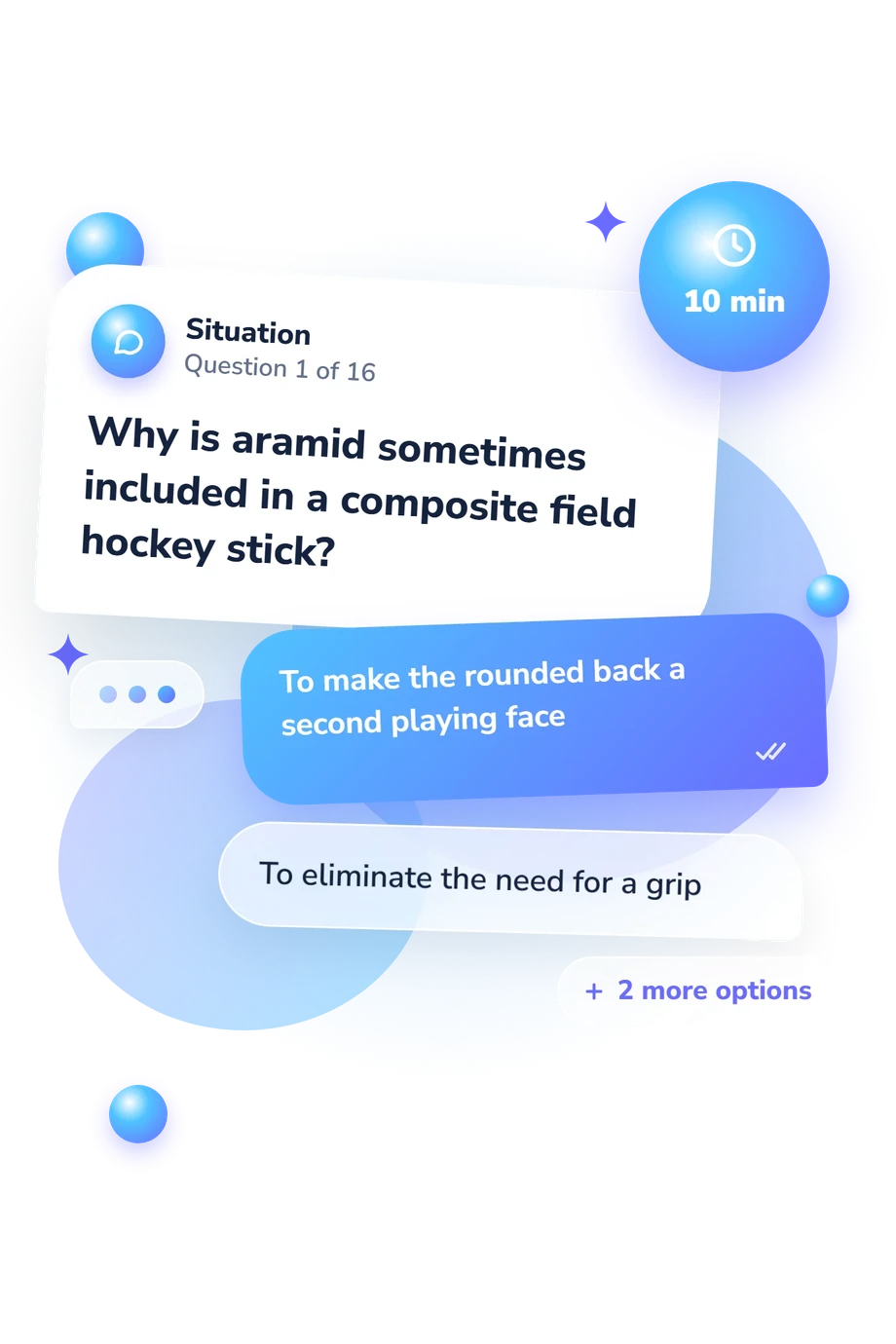
Example Questions From the Test
- To make the rounded back a second playing face
- To eliminate the need for a grip
- To guarantee that the stick can never break
- To help with impact resistance and vibration damping
- The flat face
- The rounded back
- Either broad side equally
- Only the upper edge of the head
- The same design with an even higher carbon percentage
- A lower-carbon composite with more fiberglass and a softer feel
- A longer stick with the same stiff construction
- The most aggressive bow available, regardless of construction
Field Hockey Stick Quiz - Description and methodology of the test
Players, parents, coaches, and shoppers can use this assessment to connect stick specifications with practical equipment decisions. The field hockey stick quiz checks whether the reader can interpret equipment information and make a reasoned choice. This quiz addresses the practical question of what hockey stick should I buy by providing a structured way to compare trade-offs rather than chase one universally best model.
What This Assessment Explores
The assessment examines knowledge rather than brand preference or maximum carbon. Its questions connect materials, fit, geometry, handling, maintenance, safety, and indoor or outdoor context with equipment consequences.
The questions span four practical themes, while the visitor receives one total knowledge score:
- Materials and construction show how carbon, fiberglass, aramid, stiffness, and vibration affect feel.
- Fit and geometry indicate how length, posture, bow position, balance, and the legal playing face affect control.
- Handling and context explain how touch, dribbling, lifting, surface, and skill level shape demands.
- Buying and care cover cost, returns, warranty, seller reliability, grip wear, and damage.
Field Hockey Stick Knowledge runs from 0-16: Foundations to build (0-6) means basics need review; Developing knowledge (7-12) shows workable understanding; Strong knowledge (13-16) reflects broad understanding. In this hockey stick quiz, the score reflects equipment knowledge rather than personal playing ability.
Methodology and Evidence Base
The items combine direct technical questions with player and buyer scenarios, followed by answer choices. One point is awarded for each correct answer, so the result reflects the answer key rather than swing speed, touch, or match performance. Questions cover construction, playing surfaces, fit, bow profiles, feel, safety, price, returns, and warranty.
Sharp (2005) relates stick weight to penalty-stroke velocity and accuracy. Thiel, Tremayne, and James (2012) treat stick speed and ball control as observable performance factors. Field Hockey Alberta (2026) supports comparisons of fit, materials, bow, feel, and purchasing, while International Hockey Federation (2026) supplies rules context for the legal playing surface and equipment checks. These sources provide factual and subject-matter context for the questions, rather than scoring norms for this online questionnaire.
This quiz addresses the practical question of which hockey stick is right for me, highlighting what to investigate rather than selecting a model. Carbon level should be weighed alongside touch, stiffness, bow, balance, fit, skill, and preference. Answers reflect current experience and familiarity, so the bands do not establish suitability or confirm that equipment meets current competition rules.
- Sharp, Lee-Ann. Possible Effects Field Hockey Stick Weight May Have on Player Performance During a Penalty Stroke. Master's thesis, Indiana State University, 2005.
- Thiel, David V., Melissa Tremayne, and Daniel A. James. Monitoring stick speed and ball control in field hockey drills using a stick-mounted inertial accelerometer. Procedia Engineering 34 (2012): 574-579. 10.1016/j.proeng.2012.04.098
- Field Hockey Alberta. How to Choose a Field Hockey Stick. Field Hockey Alberta, 2026.
- International Hockey Federation. Rules of Hockey: Effective from 1 March 2026. Lausanne: International Hockey Federation, 2026.
Updated: