
Favorite Genshin Character Quiz
How the Scales are Structured
Who Usually Takes This Test?
See How You Compare
Below is a preview of how scores are typically distributed across each scale.
Example Questions From the Test
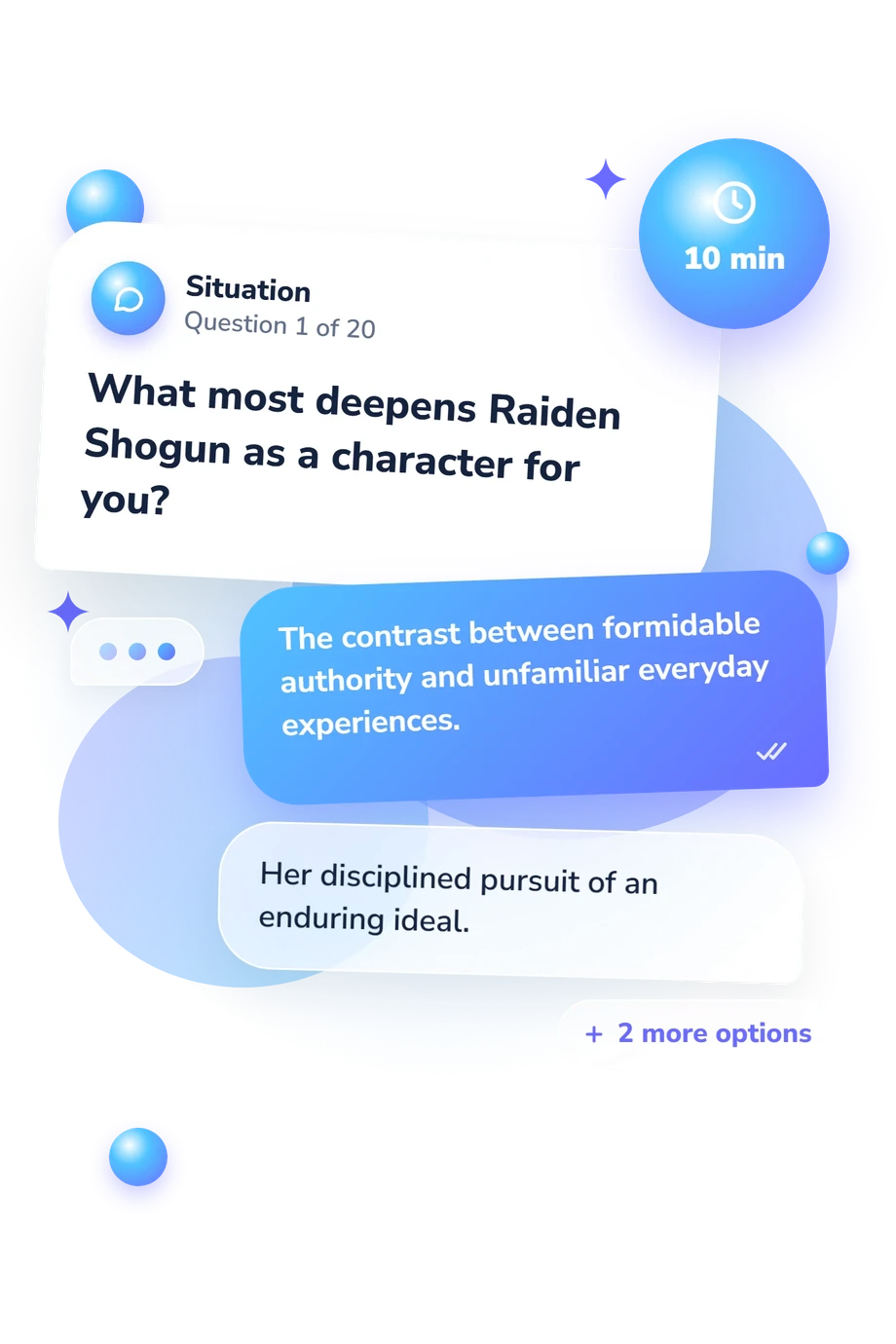
- The contrast between formidable authority and unfamiliar everyday experiences.
- Her disciplined pursuit of an enduring ideal.
- The visual spectacle and intensity of her combat presence.
- I tend to prefer characters driven by exploration rather than preservation.
- They can turn their knowledge into decisive action.
- They preserve context and explain why traditions matter.
- They admit when old knowledge needs to meet present realities.
- They constantly surprise others with unconventional ideas.
- Giving people tools to understand and choose for themselves.
- Making a firm decision when others remain uncertain.
- Protecting valuable knowledge for future generations.
- Offering clever solutions that make daily life easier.
Favorite Genshin Character Quiz - Description and methodology of the test
Fans who want to understand why certain Genshin Impact characters appeal to them can use this profile to reflect on values such as freedom, curiosity, duty, tradition, and emotional performance. This fav genshin character quiz compares those preferences across five character affinities rather than ranking popularity. This favorite Genshin character quiz adds context to a simple character choice by showing which style of appeal is strongest.
What This Assessment Explores
Scenarios cover leadership, learning, promises, tradition, pressure, freedom, humor, and public/private emotion. The questionnaire describes character appeal, not a fixed personality.
The Genshin character affinities show:
- Furina Affinity (0-12) measures theatrical resilience: Quiet Preference (0-4), Captivated Audience (5-8), and Center Stage (9-12).
- Nahida Affinity (0-12) measures curious empathy: Practical Observer (0-4), Thoughtful Seeker (5-8), and Curious Sage (9-12).
- Raiden Shogun Affinity (0-12) measures disciplined resolve: Flexible Current (0-4), Measured Resolve (5-8), and Focused Thunder (9-12).
- Venti Affinity (0-12) measures spontaneous freedom: Different Rhythm (0-4), Kindred Breeze (5-8), and Ballad Companion (9-12).
- Zhongli Affinity (0-12) measures traditional composure: Modern Momentum (0-4), Respectful Listener (5-8), and Keeper of Contracts (9-12).
The highest score leads; results within one point form a blend.
Methodology and Scientific Basis
Each item presents a situation or asks about character preferences through four choices about leadership, relationships, customs, goals, or fictional motivations. Options contrast authority, adaptation, creativity, empathy, context, and spontaneity; none is objectively correct. Respondents compare fictional traits with choices about leadership, relationships, customs, and setbacks.
The Genshin character test combines answers into five affinity totals. The displayed ranges and labels describe the outputs; they do not disclose a point-by-point scoring rule. The highest total is the strongest match, while totals within one point form a blended outcome.
This approach is conceptually consistent with Park and Henley (2007), who linked personality preferences with fantasy game character preferences, but this questionnaire is not their instrument. Hoorn and Konijn (2003) address how people perceive and experience fictional characters, while Huang and Fung (2024) offer a framework for measuring identification with narrative characters. These sources support the interpretive lens, not validation of this online questionnaire.
As a self-report profile, results may vary with current mood, familiarity with the characters, and response consistency, so read them as a snapshot of fictional preferences.
- Park, Anna E., and Tracy B. Henley. "Personality and Fantasy Game Character Preferences." Imagination, Cognition and Personality 27, no. 1 (2007): 37-46. 10.2190/IC.27.1.d
- Hoorn, Johan F., and Elly A. Konijn. "Perceiving and experiencing fictional characters: An integrative account." Japanese Psychological Research 45, no. 4 (2003): 250-268. 10.1111/1468-5884.00225
- Huang, Kate Y., and Helene H. Fung. "Measuring identification with narrative characters: the development and validation of a new scale." Current Psychology 43 (2024): 24835-24849. 10.1007/s12144-024-06191-2
Updated: