
European Cities Quiz
How the Scales are Structured
Who Usually Takes This Test?
See How You Compare
Below is a preview of how scores are typically distributed across each scale.
Example Questions From the Test
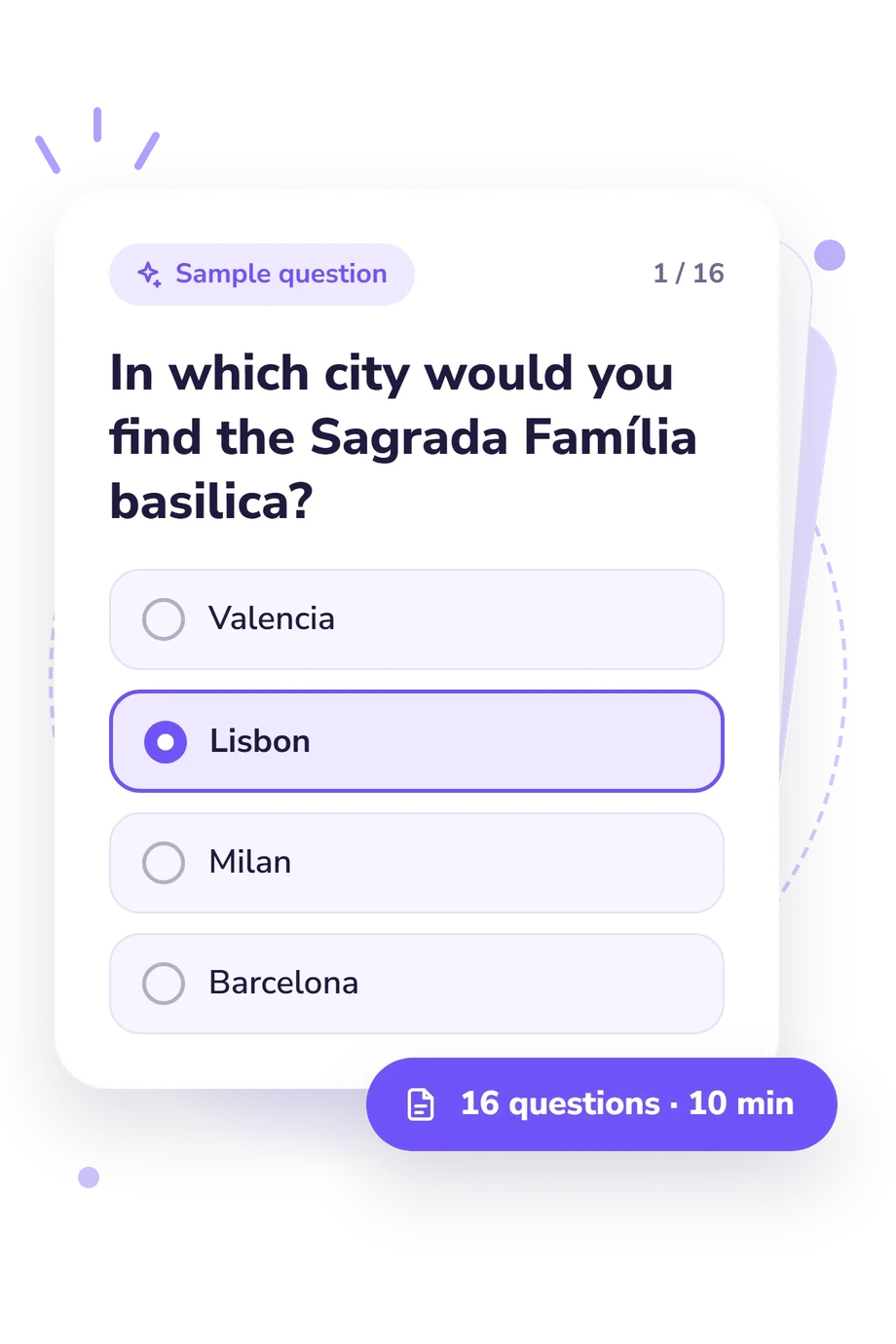
- Valencia
- Lisbon
- Milan
- Barcelona
- Kyiv
- Warsaw
- Minsk
- Vienna
- Bratislava
- Budapest
- Belgrade
- Bucharest
European Cities Quiz - Description and methodology of the test
Travelers, students, and curious learners can use this assessment when they want a broad check of their knowledge of European places. The European Cities Quiz helps a person decide whether to move on to more advanced geography or spend time strengthening basic knowledge. As a Europe cities quiz, it supports self-reflection without promising a detailed profile.
What This Assessment Measures
The questionnaire measures city recognition through landmarks, rivers, historic districts, routes, and neighboring places.
Together, these clues turn the questionnaire into a cities of Europe quiz, testing whether you can connect a distinctive feature with its city and geographic setting.
Results appear on the European Cities Knowledge scale, 0-16. Foundations to build (0-6) signals basic recognition; Developing knowledge (7-12) shows a useful grasp with gaps; Strong knowledge (13-16) reflects accurate connections between cities, defining places, and context.
The main clue families are:
- Landmark recognition shows whether famous buildings and public spaces lead you to the correct city.
- River and waterfront knowledge shows how waterways support urban identification.
- Capital and historic-core knowledge links national capitals with old towns and civic landmarks.
- Routes, borders, and travel details provide verbal clues that test geographic knowledge rather than a separate reasoning trait.
Methodology and Evidence Base
Each of the 16 items presents a geographic prompt with four answer choices. You select the city that best fits a landmark, river, capital, travel connection, or urban feature. The result summarizes performance across the full set as an overall score, and the questionnaire defines no additional weighting rule.
Torrens (2001) is the closest conceptual reference: it treats place-location knowledge as assessable through identifying and situating places. Dunn (2011) connects location knowledge with spatial thinking and geography education. Chang, Huang, and Tsaur (2019) add a geographic-literacy perspective on practical experience. This questionnaire is conceptually consistent with those works; those studies do not validate the online questionnaire or establish norms for its bands.
Taken as a whole, the questionnaire is a European geography quiz that uses multiple-choice verbal prompts and map-like location knowledge without showing a map. Performance may reflect familiarity with iconic destinations, travel experience, schooling, language, guessing, and current attention. These factors can influence an overall knowledge result, while the displayed bands remain descriptive levels for this question set rather than standardized norms.
- Torrens, Paul M. (2001). Where in the world? Exploring the factors driving place location knowledge among secondary level students in Dublin, Ireland. Journal of Geography, 100(2), 49-60. 10.1080/00221340108978417
- Dunn, James M. (2011). Location Knowledge: Assessment, Spatial Thinking, and New National Geography Standards. Journal of Geography, 110(2), 81-89. 10.1080/00221341.2010.511243
- Chang, Kang-Tsung, Huang, Chung-Ching, and Tsaur, Sheng-Hshiung. (2019). Tourist geographic literacy and its consequences. Tourism Management Perspectives, 29, 131-140. 10.1016/j.tmp.2018.11.005
Updated: