
Elements of Art Quiz
How the Scales are Structured
Who Usually Takes This Test?
See How You Compare
Below is a preview of how scores are typically distributed across each scale.
Example Questions From the Test
- Implied texture
- Atmospheric texture
- Actual texture
- Negative texture
- Form
- Shape
- Value
- Texture
- Shape
- Form
- Space
- Line
Elements of Art Quiz - Description and methodology of the test
Designed for readers who want a practical check of visual-art vocabulary, the elements of art quiz asks you to recognize how artists organize what we see. It suits beginners, students reviewing introductory concepts, and curious viewers who want a clearer framework for looking at images. The result shows which core terms you understand and where focused review may strengthen your performance on this visual art knowledge test.
What This Test Measures
The questionnaire treats these elements as practical tools for describing images, not measures of artistic talent. It asks learners to distinguish related concepts and apply them to brief examples from drawing, painting, design, sculpture, and composition. As an elements of art test, it suits beginners and anyone reviewing foundational vocabulary. The result reflects how confidently those concepts are recognized and applied.
The content areas represented in the result are:
- Line identifies marks that create direction, contour, movement, or emphasis.
- Shape describes a flat enclosed area, whether geometric or organic.
- Form indicates solid volume or the illusion of three dimensions.
- Color covers hue and relationships such as complementary contrast.
- Value measures lightness, darkness, and tonal contrast.
- Texture distinguishes a surface that is felt from one visually suggested.
- Space concerns positive and negative areas, overlap, and depth.
Methodology and Evidence Base
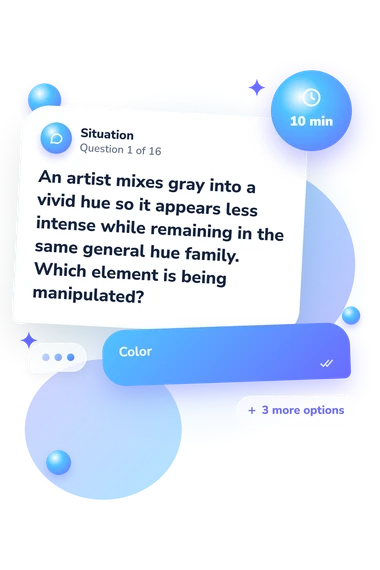
Each item presents a brief definition or visual situation with four answer choices. The respondent selects the best concept, applying terms to examples such as light-dark contrast, felt surface texture, contour, volume, overlap, or color relationships. This format checks recognition and transfer rather than personal preference.
Scoring is direct: each correct answer contributes one point to Elements of Art Knowledge, spanning 0-16. The displayed bands are Building Foundations (0-6), Developing Understanding (7-12), and Strong Understanding (13-16). Answers to the quiz on the seven elements of art show how consistently the respondent identifies the vocabulary in the presented examples.
The framework is conceptually consistent with Ocvirk et al. (2013), while Getty Museum Education Department (2006) and Porterfield (2020) support classroom-style observation and discussion of visual elements. O'Neil (2011) connects such practices with visual literacy. These sources provide context; this online questionnaire is not presented as an adaptation of their published instruments.
The score is an instructional self-check rather than a norm-referenced standardized scale, so the bands are categories for this questionnaire, not universal cutoffs. Results may vary with prior study, attention, and familiarity with examples, and describe current knowledge rather than artistic ability.
- Ocvirk, Otto G., Robert E. Stinson, Philip R. Wigg, Robert O. Bone, and David L. Cayton. Art Fundamentals: Theory and Practice. 12th ed. McGraw-Hill, 2013. ISBN 978-0-07-337927-2.
- Getty Museum Education Department. Landscapes, Classical to Modern: Lessons and Ideas for Discussion. J. Paul Getty Museum, 2006.
- Porterfield, Marie. "Lesson 02: Elements and Principles." Art Appreciation Open Educational Resource. East Tennessee State University, 2020.
- O'Neil, Kathleen Ellen. "Reading Pictures: Developing Visual Literacy for Greater Comprehension." The Reading Teacher, 65(3), 214-223, 2011. 10.1002/TRTR.01026.