
Electrician Quiz
How the Scales are Structured
Who Usually Takes This Test?
See How You Compare
Below is a preview of how scores are typically distributed across each scale.
Example Questions From the Test
- Ampere
- Volt
- Watt
- Ohm
- It provides a closed current path
- It interrupts the current path
- It limits current like a resistor
- It converts alternating current to direct current
- Farad
- Ohm
- Henry
- Coulomb
Electrician Quiz - Description and methodology of the test
People deciding whether to revisit electrical fundamentals before formal instruction or supervised trade practice can use this electrician quiz. It suits learners, trainees, and anyone reviewing core terminology before choosing their next step. The result places you in one of three knowledge bands-Foundation to build, Developing knowledge, or Strong knowledge. This electrical knowledge quiz can guide that decision across the subject areas sampled here.
What This Assessment Explores
The questionnaire tests practical understanding rather than preferences. Items cover safe work, electrical quantities, circuit components, fault conditions, and basic calculations. They ask respondents to identify terms, choose explanations, and apply simple relationships to familiar situations. Together, the questions sample foundation topics that may be useful for further study before classroom or supervised trade learning.
Electrician Knowledge is the displayed scale, ranging from 0-16. Foundation to build covers 0-6, Developing knowledge covers 7-12, and Strong knowledge covers 13-16. These bands describe the tested content, not every skill required in electrical work.
Four themes organize the electrical quiz questions:
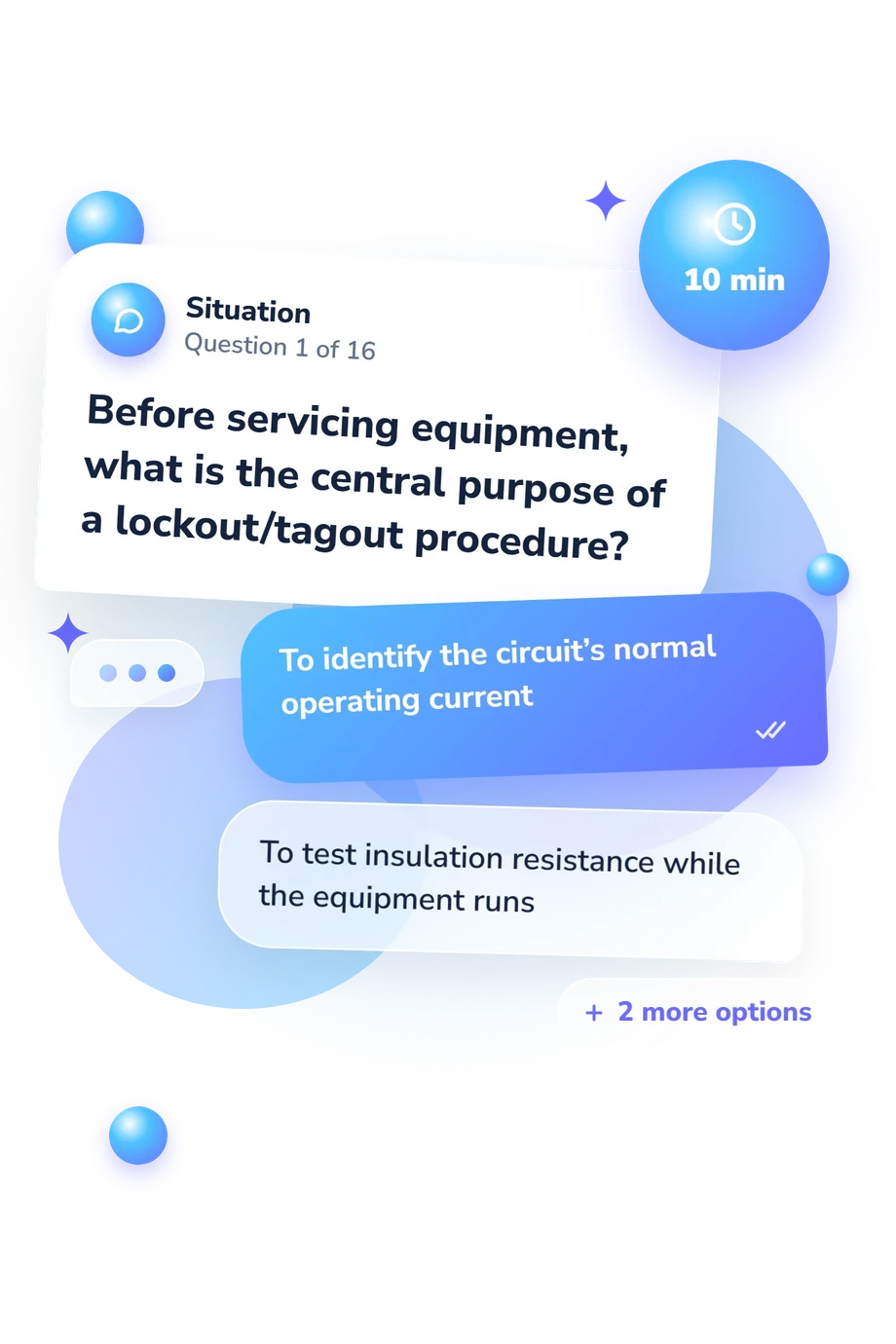
- Safety procedures show recognition of hazardous-energy control and fault protection.
- Electrical quantities show understanding of measurements and units.
- Circuit reasoning shows how series, parallel, contact, transformer, and continuity principles are handled.
- Troubleshooting and calculation show how symptoms and numbers support an explanation.
Methodology and Evidence Base
With one prompt and four answer choices, this electrical quiz tests recognition and application rather than extended written explanation. Items move from definitions and units to safety, circuit behavior, fault identification, and short calculations. Respondents choose the best option; the result condenses those responses into a single overall score, with no separate weighting rule stated.
PISA-VET provides general vocational-assessment context that is conceptually consistent with the applied knowledge tested here, rather than an electrician-specific model. Electrical reference texts support the treatment of quantities, units, circuit relationships, transformers, and calculations, while NFPA 70E provides context for the safety content. These sources provide content context; they do not establish that this online questionnaire has been adapted, standardized, or validated against them.
Interpret the bands as feedback about the content sampled here. A strong result suggests solid command of the tested vocabulary and reasoning, while a lower result suggests revisiting the sampled foundations. The bands are educational feedback, and performance can vary with attention, prior instruction, and wording familiarity; they do not confer a license, competency certification, or safe independent work.
- OECD (2024), PISA Vocational Education and Training (VET): Assessment and Analytical Framework, PISA, OECD Publishing, Paris. 10.1787/b0d5aaf9-en
- Maryam A. Al-Othman, John H. Cole, and Dimitrios Peroulis (2025), Electrical Engineering Fundamentals, Purdue University Press, West Lafayette, Indiana.
- Dennis K. Neitzel, Mary Capelli-Schellpfeffer, and Al Winfield (2019), Electrical Safety Handbook, 5th ed., McGraw-Hill Education, New York.
- National Fire Protection Association (2024), NFPA 70E: Standard for Electrical Safety in the Workplace, 2024 edition, Quincy, Massachusetts.
Updated: