
Earthworm Anatomy Quiz
How the Scales are Structured
Who Usually Takes This Test?
See How You Compare
Below is a preview of how scores are typically distributed across each scale.
Example Questions From the Test
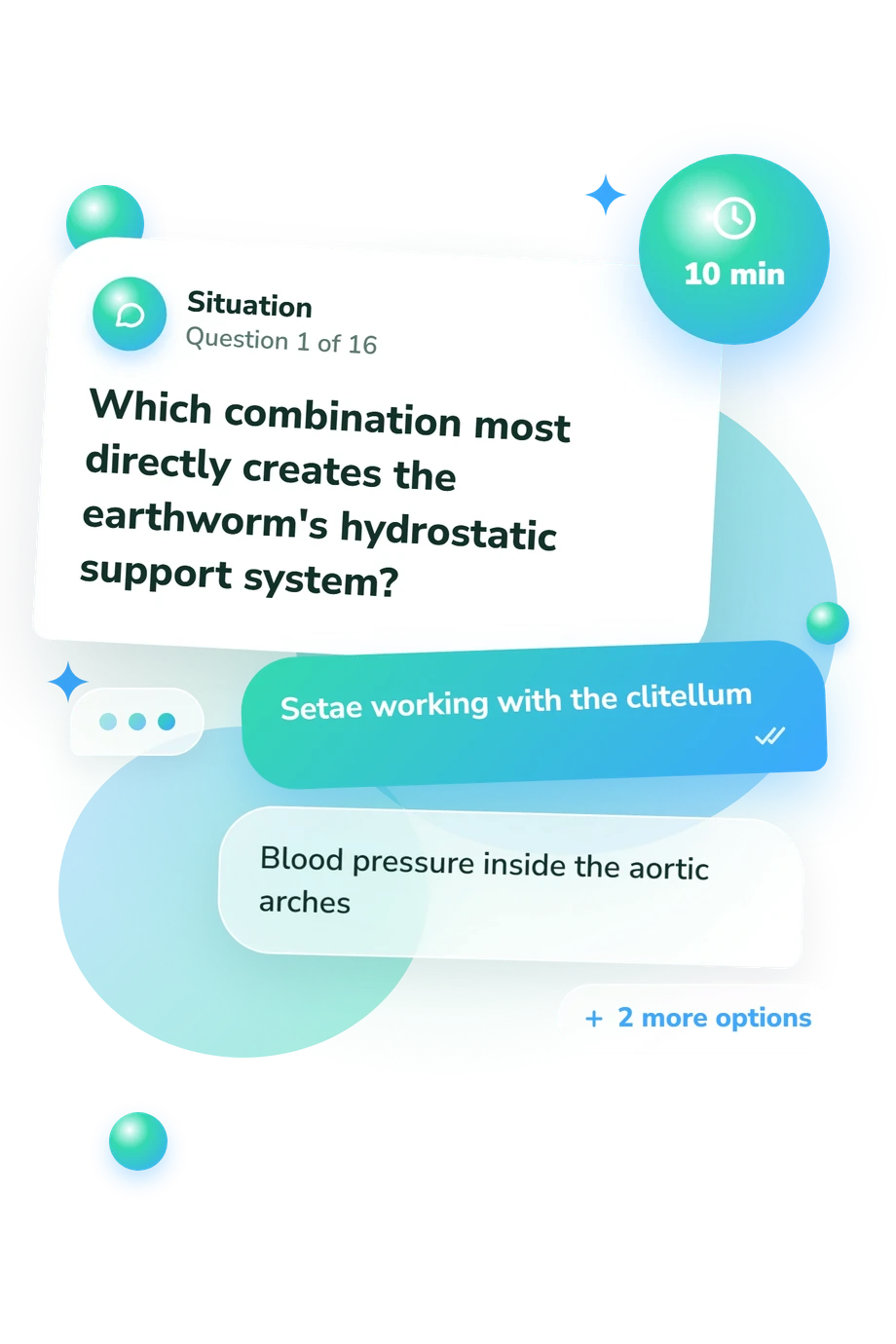
- Setae working with the clitellum
- Blood pressure inside the aortic arches
- Food held between the crop and gizzard
- Pressurized coelomic fluid working with body-wall muscles
- Typhlosole
- Nephridium
- Clitellum
- Septum
- Crop
- Esophagus
- Intestine
- Pharynx
Earthworm Anatomy Quiz - Description and methodology of the test
Students, teachers, and curious learners can use this earthworm anatomy quiz to connect visible structures with the jobs those structures perform. It suits anyone seeking an earthworm anatomy review, preparing for a dissection, or testing recall after study. The result highlights secure anatomical relationships and topics that deserve another look. The question format links identification with function, so each answer can reinforce how the body works.
What This Assessment Explores
The questionnaire tests functional anatomy rather than isolated vocabulary. Across its earthworm anatomy questions, learners identify organs, membranes, vessels, nerves, and external structures, then connect them with digestion, circulation, support, movement, excretion, or reproduction. Short laboratory scenarios require relationships among parts, not only term recall. Dissection-style prompts suit practical-biology review and check transfer from study to specimen observation.
Results use the Earthworm Anatomy Knowledge scale, 0-16: Foundational (0-6), Developing (7-12), or Strong (13-16). The question themes are:
- Digestive anatomy shows how you link the crop, gizzard, intestine, and anus to their functions.
- Support and circulation show how coelomic fluid, muscles, setae, vessels, and aortic arches work together.
- Nervous and excretory anatomy shows how the ventral nerve cord and nephridia serve the body.
- Reproductive anatomy shows how the clitellum and seminal receptacles relate to reproduction.
Methodology and Scientific Basis
Each item presents one question with four answer choices. Prompts combine direct identification with short situations involving food movement, circulation, support, or organ damage. The format therefore checks anatomical vocabulary alongside the ability to infer a structure’s function from context.
As an earthworm anatomy test, the questionnaire reports the displayed result through the supplied educational bands. That presentation helps readers identify which anatomical relationships to review next.
The content is conceptually consistent with Whitehouse and Grove (1943), whose dissection-focused account supports links between structures, functions, and laboratory observations. Lankester (1865) contributes foundational anatomical description, and Edwards and Lofty (1977) place the systems in broader biological context. These sources support the subject matter, but this questionnaire is not presented as an adaptation or standardized reproduction of any one work.
Because performance depends on study, attention, guessing, and familiarity with specimen terminology, the result is best read as a review guide. Use the displayed band to prioritize topics, then return to the relevant anatomy and functional relationships rather than treating one score as a complete measure of biological knowledge.
- Whitehouse, Richard Henry, and Alfred John Grove. The Dissection of the Earthworm. London: University Tutorial Press, 1943.
- Lankester, E. Ray. “The Anatomy of the Earthworm.” Journal of Cell Science, s2-5(17), 1865, 7-18. 10.1242/jcs.S2-5.17.7
- Edwards, C. A., and J. R. Lofty. Biology of Earthworms. New York: Springer, 1977. 10.1007/978-1-4613-3382-1
Updated: