
Does My Husband Love Me Anymore Quiz
How the Scales are Structured
Who Usually Takes This Test?
See How You Compare
Below is a preview of how scores are typically distributed across each scale.
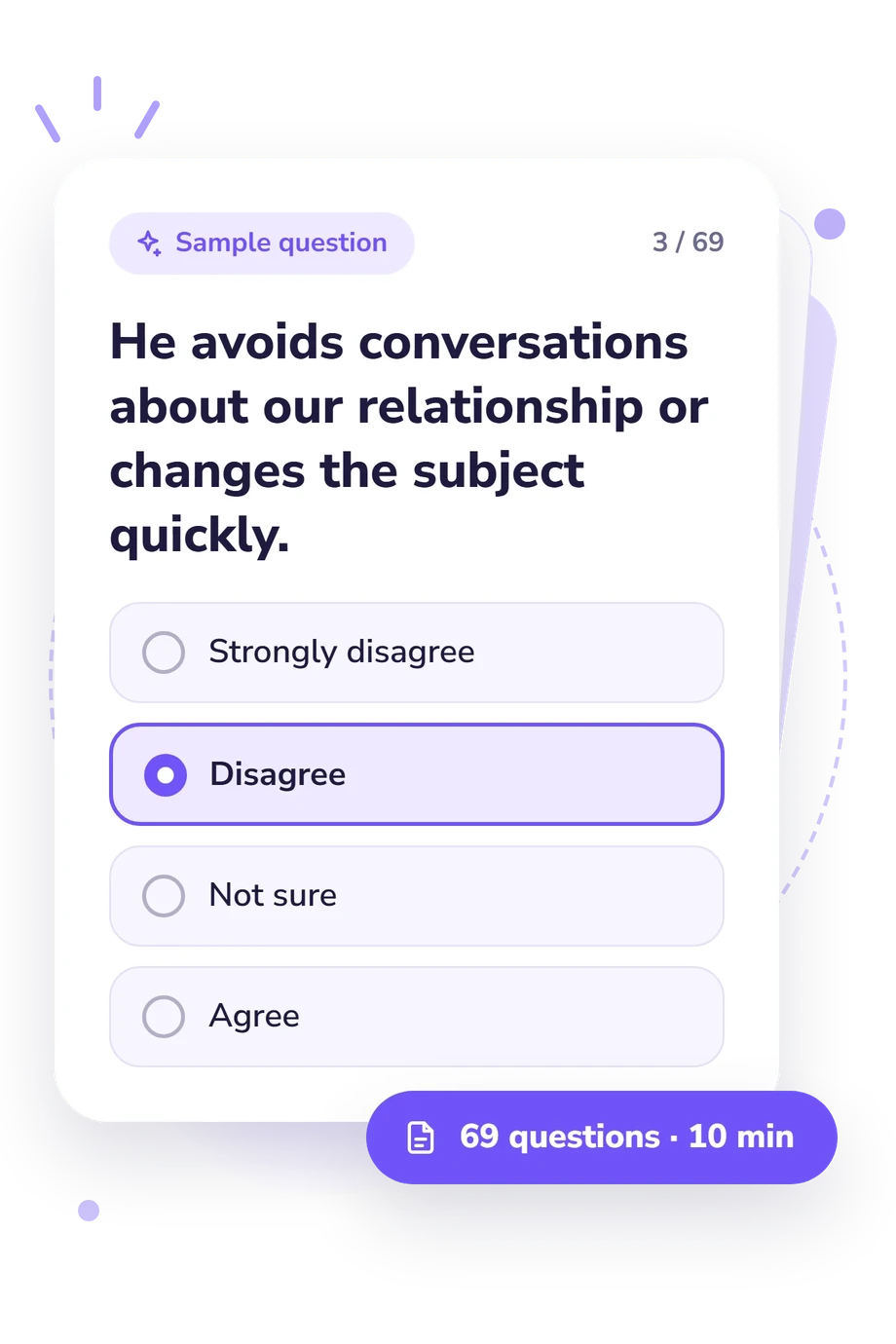
Example Questions From the Test
- Strongly disagree
- Disagree
- Not sure
- Agree
- Strongly disagree
- Disagree
- Not sure
- Agree
- Strongly disagree
- Disagree
- Not sure
- Agree
Does My Husband Love Me Anymore Quiz - Description and methodology of the test
People who feel uncertain about warmth, reliability, or shared plans may want a structured way to organize what they notice. The Signs Your Husband Isn't in Love With You Quiz is intended for someone reflecting on a marriage or committed partnership. This marriage relationship quiz organizes concerns about closeness and commitment into a profile for reflection.
What This Assessment Explores
The questionnaire examines affection, responsiveness, shared decisions, reliability, support, conflict repair, future planning, avoidance, reduced warmth, and feeling unheard. The result shows whether concern is concentrated in commitment, everyday connection, or emotional withdrawal; it describes perceived relationship patterns rather than proving what a partner feels. As a marital emotional distance test, it is suited to personal reflection within a marriage or committed partnership.
These are the displayed dimensions:
- Commitment & Future Alignment (0-20) shows shared planning, support, and reliability. Bands: Low alignment 0-7; Moderate alignment 8-14; High alignment 15-20.
- Connection & Communication (0-30) shows closeness, responsiveness, quality time, and feeling heard. Bands: Low connection 0-10; Moderate connection 11-20; High connection 21-30.
- Emotional Distance (0-30) shows withdrawal, reduced affection, irritability, and avoidance. Bands: Low distance 0-10; Moderate distance 11-20; High distance 21-30.
Methodology and Scientific Basis
Items are self-report statements about closeness, support, affection, communication, future planning, conflict repair, and disengagement.
The response options include Strongly disagree, Disagree, Not sure, and Agree; the shown items also include Strongly agree. They capture degree of agreement rather than a yes-or-no judgment.
Answers combine into three displayed scores. Because no response-to-point key is provided, interpret the profile through its named bands rather than reverse-engineering individual points.
Conceptually, the questionnaire is consistent with the Marital Disaffection Scale (Kayser, 1996), which addresses emotional estrangement in marriage. Disengagement themes also align with Barry, Lawrence, and Langer (2008); disharmony and disaffection with Herrington and colleagues (2008). Its commitment dimension is compatible with Stanley and Markman (1992). These sources offer construct comparisons, not scoring rules for this online questionnaire.
The assessment serves as a relationship reflection questionnaire, organizing perceptions of closeness, commitment, and distance; its profile indicates how each area falls within its named band. Current conflict, mood, memory, self-awareness, and response bias can affect answers, so read the result alongside concrete relationship examples.
- Kayser, Karen. (1996). The Marital Disaffection Scale: An Inventory for Assessing Emotional Estrangement in Marriage. The American Journal of Family Therapy, 24(1), 83-88. 10.1080/01926189508251019
- Barry, Robin A., Lawrence, Erika, and Langer, Amie. (2008). Conceptualization and assessment of disengagement in romantic relationships. Personal Relationships, 15(3), 297-315. 10.1111/j.1475-6811.2008.00200.x
- Herrington, Rachael L., Mitchell, Alexandra E., Castellani, Angela M., Joseph, Jana I., Snyder, Douglas K., and Gleaves, David H. (2008). Assessing disharmony and disaffection in intimate relationships: Revision of the Marital Satisfaction Inventory factor scales. Psychological Assessment, 20(4), 341-350. 10.1037/a0013759
- Stanley, Scott M., and Markman, Howard J. (1992). Assessing Commitment in Personal Relationships. Journal of Marriage and the Family, 54(3), 595-608. 10.2307/353245
Updated: