
Do I Want Kids Quiz
How the Scales are Structured
Who Usually Takes This Test?
See How You Compare
Below is a preview of how scores are typically distributed across each scale.
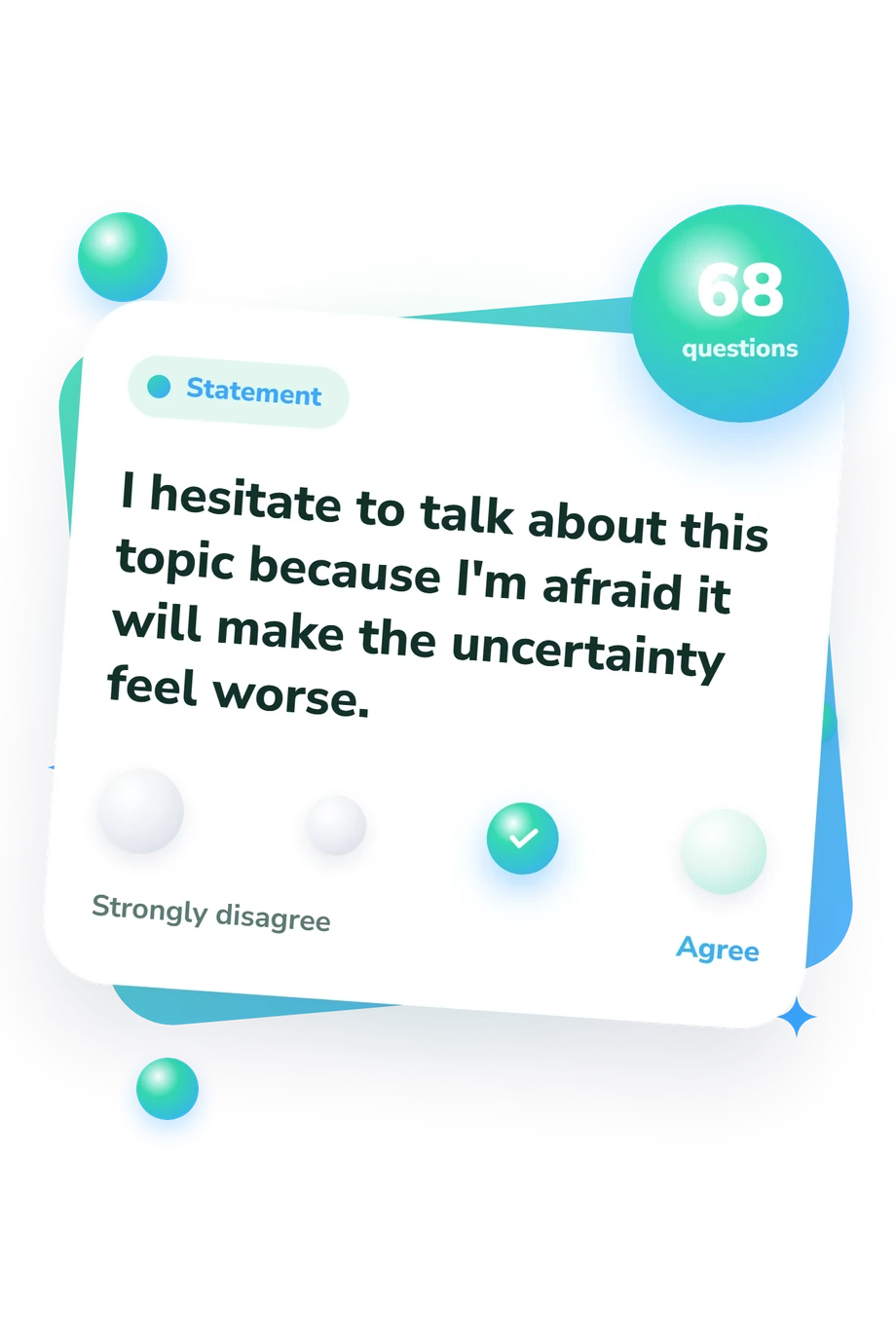
Example Questions From the Test
- Strongly disagree
- Disagree
- Not sure
- Agree
- Strongly disagree
- Disagree
- Not sure
- Agree
- Strongly disagree
- Disagree
- Not sure
- Agree
Do I Want Kids Quiz - Description and methodology of the test
People who feel torn about parenthood can use this parenthood decision quiz to separate emotional desire from practical conditions and unresolved concerns. The Do I Want Kids Quiz is intended for adults reflecting on whether parenting fits their values, identity, relationships, and life plans. It offers more than a yes-or-no answer, helping organize the issues behind a personal decision and prepare for thoughtful discussion.
What This Assessment Explores
The questions examine how settled the preference feels, how strongly parenthood fits the respondent’s values, and whether current circumstances appear workable. Statements address caregiving, future identity, lifestyle change, finances, housing, schedules, relationship reliability, childcare, and support. The Should I Have Kids Quiz goes beyond a yes-or-no answer by showing how desire, readiness, and unresolved concerns can diverge in this decision.
The profile separates these dimensions as follows:
- Ambivalence & Uncertainty (0-20) captures mixed or changeable feelings; Clearer Preference 0-6, Some Ambivalence 7-13, and High Uncertainty 14-20 are the displayed bands.
- Parenthood Inclination (0-40) measures the pull toward parenting through values, caregiving, and life goals; Low inclination 0-13, Mixed/uncertain 14-26, and High inclination 27-40 are the displayed bands.
- Readiness & Resources (0-30) assesses perceived preparation in money, time, flexibility, stability, and support; Gaps to Address 0-14, Some Foundations 15-22, and Well-Resourced 23-30 are the displayed bands.
Methodology and Evidence Base
Responses use four response choices-Strongly disagree, Disagree, Not sure, and Agree-so respondents can show agreement without assigning a number. The statements combine emotional reactions, imagined futures, and practical conditions into a profile across the dimensions.
Scoring converts answers into separate scale totals and places them within displayed bands. Because the questionnaire does not provide a reproducible item-by-item scoring key, the result is not a probability, deadline, or prediction. This having children quiz is most useful when read alongside the reasons behind it.
Conceptually, the questionnaire aligns with Boivin and colleagues’ 2018 International Fertility Decision-Making Study, which links readiness with decision context and resources. Miller’s 1995 work supports its focus on childbearing motivation, while Sennott and Yeatman’s 2018 research describes ambivalence as dynamic and socially situated. These are conceptual parallels, not evidence that the online questionnaire adapts their instruments.
The displayed bands are questionnaire result categories, not population norms or clinical cutoffs. Current relationships, stress, finances, fertility concerns, self-awareness, and social pressure can shape responses. Read the result as a reflection prompt: strong inclination may coexist with practical gaps, while solid resources may coexist with little desire.
- Boivin, Jacky, Laura Bunting, Natasha Kalebic, and China Harrison. (2018). What makes people ready to conceive? Findings from the International Fertility Decision-Making Study. Reproductive Biomedicine and Society Online, 6, 90-101. 10.1016/j.rbms.2018.10.012
- Miller, Warren B. (1995). Childbearing motivation and its measurement. Journal of Biosocial Science, 27(4), 473-487. 10.1017/S0021932000023087
- Sennott, Christie, and Sara Yeatman. (2018). Conceptualizing Childbearing Ambivalence: A Social and Dynamic Perspective. Journal of Marriage and Family, 80(4), 888-901. 10.1111/jomf.12489
Updated: