
Do I Need Rehab Quiz
How the Scales are Structured
Who Usually Takes This Test?
See How You Compare
Below is a preview of how scores are typically distributed across each scale.
Example Questions From the Test
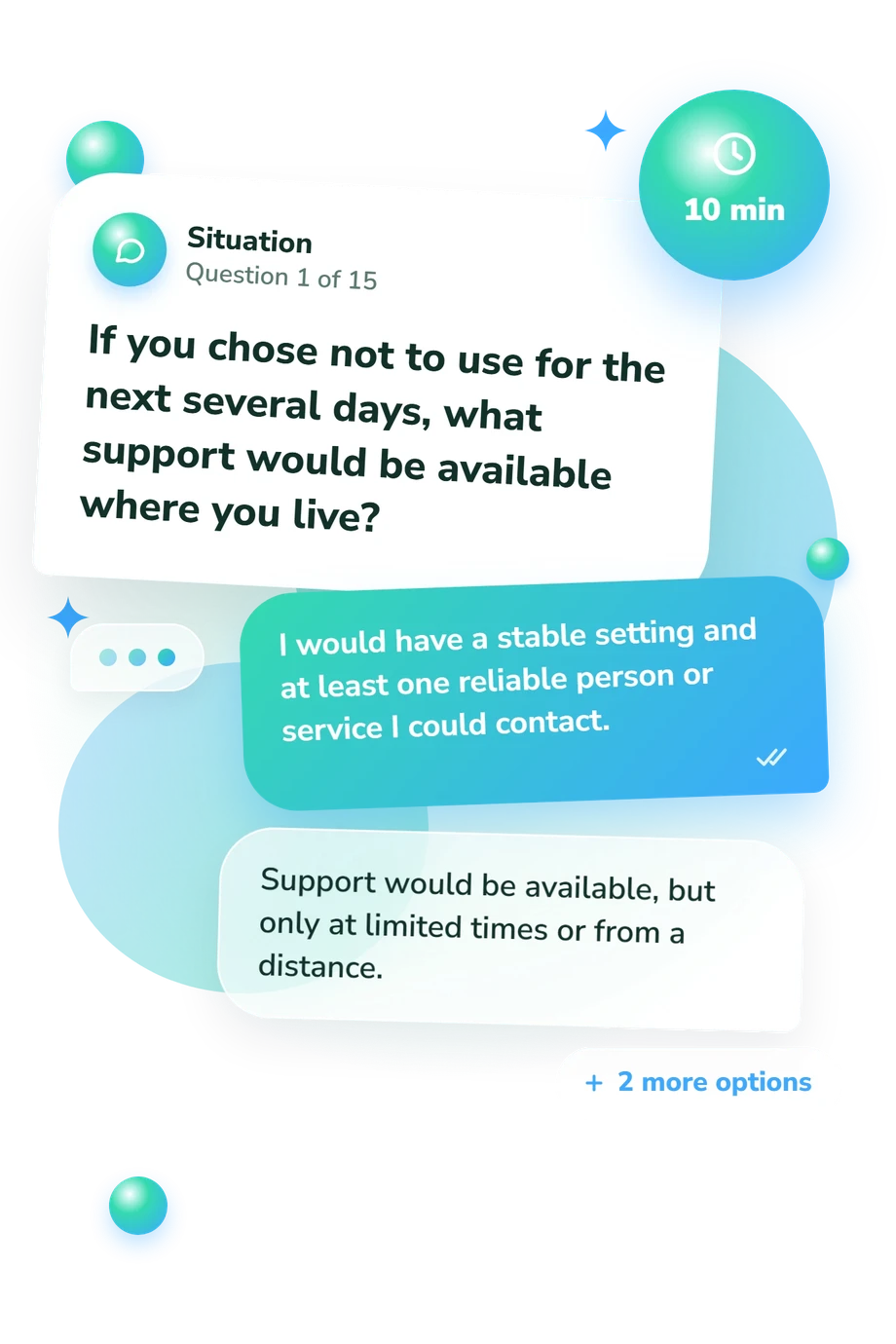
- I would have a stable setting and at least one reliable person or service I could contact.
- Support would be available, but only at limited times or from a distance.
- I would mostly be around active use, strong pressure to use, or people unable to support the change.
- The setting includes threats, violence, exploitation, homelessness, or another condition that makes attempting change there immediately unsafe.
- I have not needed these services, or the support I used met my goals.
- I tried limited support but did not stay engaged long enough to judge it.
- I completed or repeatedly used support, yet quickly returned to a pattern that concerns me.
- I returned to use after treatment and soon experienced overdose, dangerous withdrawal, violence, or another immediate safety crisis.
- I can meet basic needs and follow a safety plan while arranging any support I want.
- I am managing, but extra check-ins or professional guidance would make the plan more realistic.
- Cravings, unstable housing, mental health symptoms, or repeated return to use make it hard to follow a plan without structured support.
- I may overdose, experience dangerous withdrawal, harm myself or someone else, or otherwise cannot remain safe without immediate assistance.
Do I Need Rehab Quiz - Description and methodology of the test
People reflecting on whether substance use has become unsafe can use the Do I Need Rehab Quiz to organize concerns before deciding what kind of help may fit. This rehab quiz brings together questions about control, health, daily functioning, immediate safety, previous support, and the environment around change. The result is a structured starting point for a conversation about next steps.
What This Assessment Explores
The questionnaire is for people examining their own alcohol or drug use, whether they are curious, concerned, or considering treatment. Items cover control, cravings, withdrawal, health, responsibilities, relationships, hazardous activities, and safety while changing.
The profile groups these concerns into three displayed dimensions:
- Control and Escalation (0-15) shows limits, increasing use, return to use, and dangerous episodes. Bands: No indicators marked 0; Worth discussing 1-2; Prompt action 3-15.
- Health and Daily-Life Impact (0-15) shows physical, emotional, and practical consequences. Bands: No indicators marked 0; Worth discussing 1-2; Prompt action 3-15.
- Need for Structured Support (0-15) shows whether safety, setting, prior attempts, or access to help point toward added structure. Bands: No indicators marked 0-0; Explore support 1-2; Prompt assessment 3-15.
Together, they frame a substance use assessment around safety and care.
Methodology and Scientific Basis
Each item offers four ordered self-report choices, from little or no concern to greater difficulty, consequence, or danger. Questions cover support, prior attempts, withdrawal, overdose, hazardous tasks, escalating use, and inability to stop. This graded format is not a yes-or-no judgment.
Scores span three dimensions; displayed totals are unvalidated reflective summaries, not severity, diagnostic, legal, or treatment-placement cutoffs. A zero means no indicator was marked by these items; it does not establish safe continued use or that treatment is unnecessary. Concerning responses matter independently, and a red flag should not be cancelled by a lower total. Displayed bands do not determine treatment placement or level of care.
The questionnaire is conceptually consistent with ASAM Criteria, which addresses safety, health, functioning, support, and care needs. Turner examined automated treatment matching; Padwa documented variation in ASAM-based assessment. These sources support breadth, not a claim that this online tool is an ASAM assessment or validated adaptation.
Current context, memory, self-awareness, and disclosure can affect self-report. Use results to discuss professional guidance, medically supervised withdrawal, peer support, or structured treatment; immediate danger requires urgent assistance.
- Mee-Lee D, Shulman GD, Fishman MJ, Gastfriend DR, Miller MM, Provence SM, editors. The ASAM Criteria: Treatment Criteria for Addictive, Substance-Related, and Co-Occurring Conditions. 3rd ed. Carson City, NV: The Change Companies; 2013.
- Turner WM, Turner KH, Reif S, Gutowski WE, Gastfriend DR. Feasibility of multidimensional substance abuse treatment matching: automating the ASAM Patient Placement Criteria. Drug Alcohol Depend. 1999;55(1-2):35-43. 10.1016/S0376-8716(98)00178-1.
- Padwa H, Mark TL, Wondimu B. What's in an "ASAM-based Assessment?" Variations in Assessment and Level of Care Determination in Systems Required to Use ASAM Patient Placement Criteria. J Addict Med. 2022;16(1):18-26. 10.1097/ADM.0000000000000804.
Updated: